
Why 'Bad Leads' Are Killing Your Sales Team's Morale (and How to Stop Them)
Last Updated: January 2026 • 12 min read
📌 Key Takeaways
Bad leads drain sales engineering talent and erode trust in marketing—the fix starts with intent filtering at the content level, not better forms.
- Junk Leads Tax Your Best Sellers: Every unqualified inquiry steals time from sales engineers who should be closing six-figure contracts, not fielding student requests.
- Trust Collapse Hurts Real Opportunities: Repeated low-quality leads train sales teams to ignore inbound entirely, causing legitimate RFQs to sit untouched while competitors respond faster.
- Filter Intent Before the Form: Pages that clearly state MOQ, industries served, and capability boundaries repel poor-fit visitors before they ever reach your CRM.
- Target Buying Queries, Not Traffic: Ranking for "AS9100 certified CNC machining services" attracts procurement officers; ranking for "how does CNC machining work" attracts students.
- Track Quality Like QC: Weekly sales-marketing reviews that categorize bad leads by source reveal which pages, keywords, or offers need fixing.
Fewer leads with higher sales acceptance beats high volume that sales ignores.
Manufacturing marketers and sales leaders struggling with lead quality will find a diagnostic framework and 30-day pilot plan here, preparing them for the implementation steps that follow.
Twelve new leads. A sales engineer opens the CRM, coffee in hand, ready to work. Half are students asking for CAD files. Two are competitors running price checks. Three want a single unit shipped to a home address.
The real RFQs? Buried somewhere in the noise—if they exist at all.
This scene plays out every morning in manufacturing companies across the country. Marketing celebrates "lead volume" while sales quietly stops following up because it's never real. The VP of Sales pulls you aside after the weekly meeting: "Stop sending us junk. We're wasting our best people on garbage."
You're not alone in this. And the fix isn't what most marketers think.
Bad leads aren't just a nuisance—they're a morale tax on your highest-paid sellers. In manufacturing, your sales team often includes sales engineers. Every student inquiry, DIY request, or competitor "price check" steals time from real RFQs. Worse, repeated junk leads train sales to ignore marketing entirely. The fix isn't only better forms—it's intent filtering: building pages and offers that attract buyers who actually need your specs, tolerances, and capacity.
What Counts as a "Bad Lead" in Manufacturing?
A bad lead is any inquiry from someone who will never become a customer—either because they lack buying intent or because they're a poor fit for your business.
In industrial manufacturing, lead quality is less about volume and more about fit and readiness. Buyers are often engineers or procurement stakeholders evaluating suppliers against specs, tolerances, certifications, capacity, and lead-time realities.
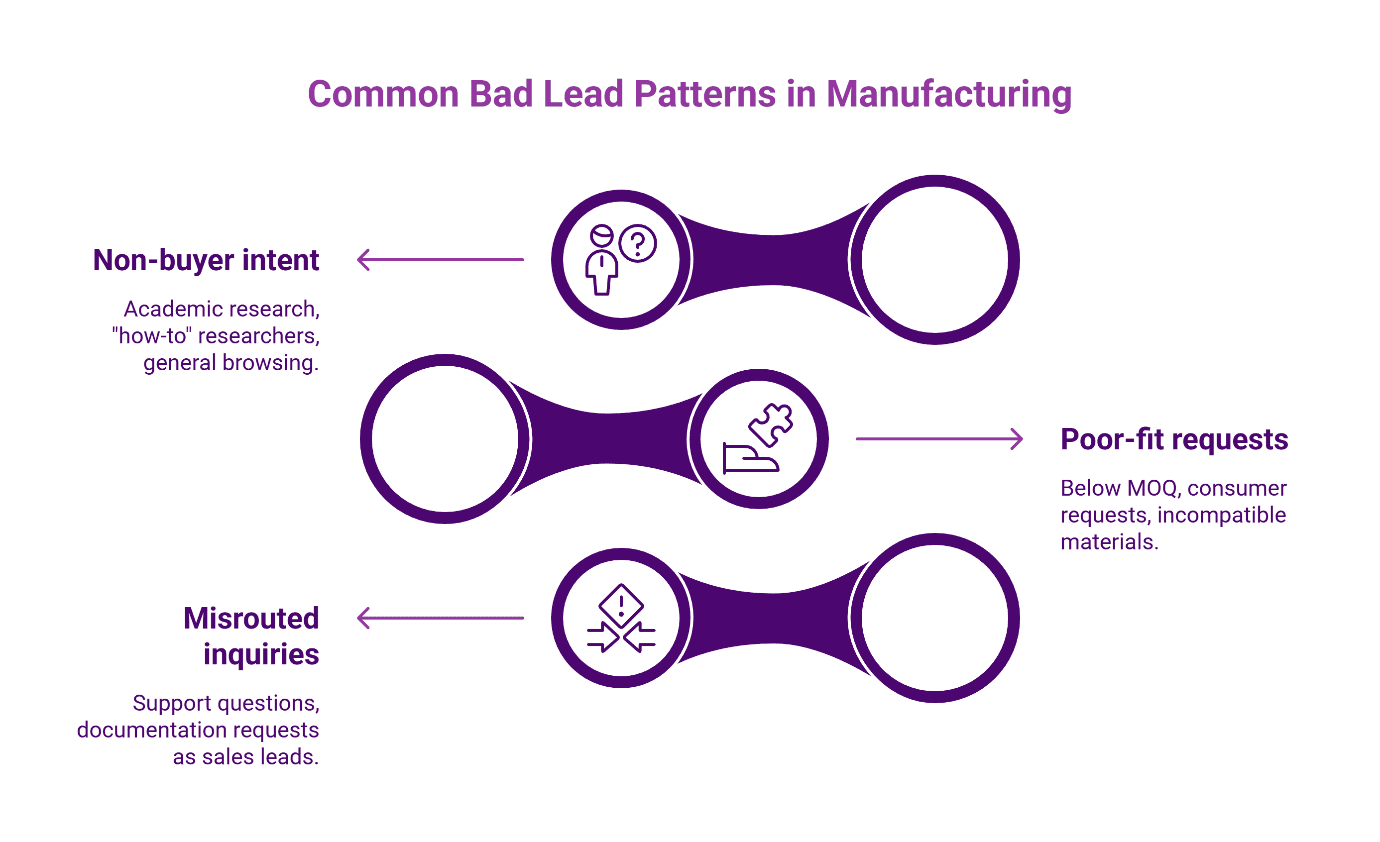
Common bad-lead patterns include:
- Non-buyer intent: Academic research requests, "how-to" researchers, general informational browsing, competitor reconnaissance.
- Poor-fit requests: Below your MOQ, consumer or home-use requests, incompatible materials or tolerances, out-of-scope industries, unrealistic lead times.
- Misrouted inquiries: Support questions and documentation requests landing as sales "leads," creating noise in the CRM.
A practical way to align internally is to separate two definitions. An MQL (Marketing Qualified Lead) shows engagement and interest signals. An SQL (Sales Qualified Lead) meets fit criteria and merits sales time.
The Real Cost of Bad Leads (It's Not Just Annoying)
The obvious cost is wasted time. But the real damage runs deeper.
Your sales engineers aren't entry-level reps. They're technical experts who can walk a procurement officer through tolerances, explain why your heat treatment process matters, and close six-figure contracts. Every hour they spend responding to a student's capstone project is an hour stolen from a real opportunity.
Think about what bad leads actually cost you:
Direct time theft. A sales engineer spends 15 minutes qualifying a lead that was never going to buy. Multiply that by 20 junk leads per week. That's five hours of your most expensive talent doing unpaid customer support for non-buyers.
Response drag on real RFQs. When the queue is full of noise, legitimate requests sit longer. Speed-to-lead research consistently shows that response time impacts conversion rates—delayed follow-up gives your competitor an opening. The exact impact varies by industry and deal type, but the core principle remains: timely response matters.
Broken attribution. Your dashboards show leads and traffic, but they can't tell you whether those leads are sales-ready RFQs. Marketing looks successful on paper while revenue stalls.
The metrics that matter aren't lead volume. They're sales acceptance rate (what percentage of leads does sales actually work?), SQL rate (how many become real opportunities?), and spam rate (how many are obvious junk?).
If you're not tracking these, you're flying blind.
Why Bad Leads Kill Sales Morale: The Boy Who Cried Wolf Effect
Here's the part that doesn't show up in your analytics: trust collapse.
When sales engineers get burned enough times—opening "leads" that turn out to be students, hobbyists, or competitors—they stop believing marketing leads are real. They develop a mental filter: Marketing leads = probably garbage.
This creates a devastating pattern:
- Sales slows down their follow-up.
- Real RFQs sit in the queue longer.
- Some get missed entirely.
- Deals go to competitors who responded faster.
Meanwhile, the marketing team feels unfairly judged. They're hitting their lead targets. The forms are working. Why is sales complaining?
The disconnect is that marketing measures inputs (leads generated) while sales measures outputs (deals closed). Without a shared definition of "qualified," both teams are optimizing for different goals—and blaming each other for the gap.
Bad leads don't just waste time. They train your best technical sellers to ignore the channel entirely. Even when a genuinely qualified RFQ comes through, it gets the same skeptical, delayed treatment as the junk.
Where Bad Leads Actually Come From
Most manufacturing marketers assume bad leads are a form problem. Add more fields. Require a company email. That'll fix it.
It rarely solves the root cause. While modern forms can use enrichment tools to block non-business emails, relying solely on them is reactive. By the time someone hits your contact page, they have already consumed marketing resources and skewed your traffic data.
Bad leads come from three upstream failures:
Intent mismatch at the keyword level. You're ranking for queries that attract researchers instead of buyers. 'How does CNC machining work' generally attracts students or researchers. Conversely, 'AS9100 certified CNC machining services' is significantly more likely to attract procurement officers or quality engineers vetting suppliers. Generic SEO brings generic traffic.
Offer mismatch. Ungated resources with no commercial filter pull in anyone curious about the topic. A downloadable "Guide to Metal Fabrication" sounds helpful—but who's downloading it? If there's no signal of buying intent, you're building a list of researchers.
Missing gatekeeper signals on key pages. Your capability pages don't mention MOQ, industries served, typical order volumes, or what you don't do. Without these filters, anyone who needs "some metal parts" thinks you might be a fit—even if you only serve aerospace OEMs with $50K minimum orders.
The pattern is clear: bad leads are a content and targeting problem that forms can't solve. You're attracting the wrong people before they ever see a form field.
How to Stop Bad Leads: Intent Filtering Before the Form
Fixing lead quality requires working upstream. You need to filter intent at the content level—before anyone reaches your CRM.
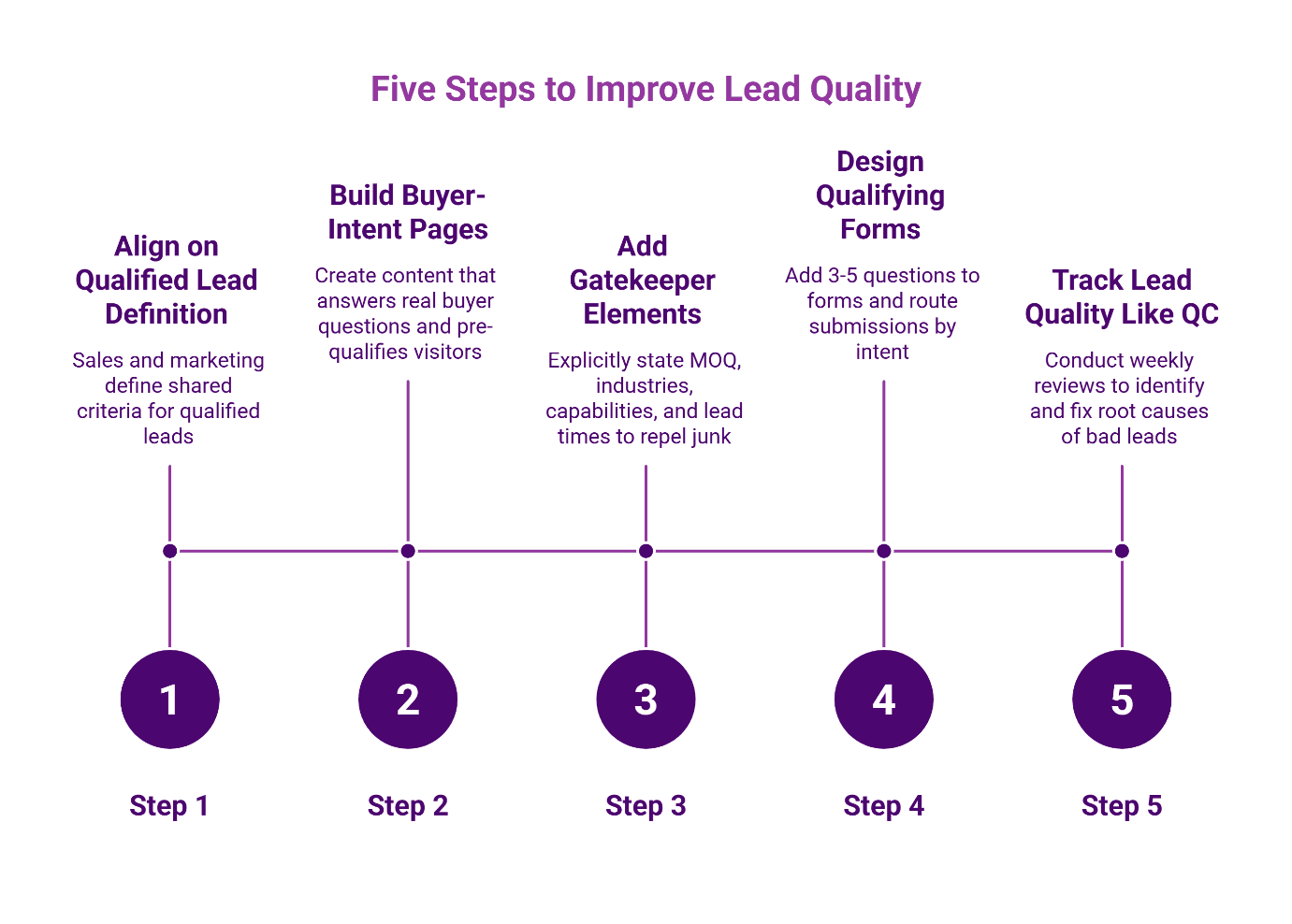
Here's a five-step approach that works:
Step 1: Align on what "qualified" actually means.
Get sales and marketing in a room. Define, specifically, what makes a lead worth pursuing. What's your MQL vs. SQL in practice? What would sales accept today?
This isn't about theory. It's about creating a shared standard that both teams can point to. For a formal definition framework, see the Gartner glossary entry on qualified leads.
Consider criteria such as minimum order expectations, required certifications, supported industries, capability limits, and geographic constraints.
Step 2: Build pages for buying intent, not traffic.
Stop chasing high-volume keywords that attract researchers. Focus on Part/Spec/Application intent mapping—queries that reveal commercial intent.
A buyer-ready page pre-qualifies visitors by answering the questions real buyers ask: What tolerances can you hold? What materials do you work with? What industries do you serve? What's your typical lead time?
When the page itself communicates fit, the wrong visitors leave before they ever submit a form.
Because buyers increasingly discover suppliers through both Google and AI-powered search tools, your content should be answer-first and scannable. Clear definitions, tight sections, and pages that state fit constraints up front perform better across both traditional search and AI discovery.
Step 3: Add gatekeeper elements that repel junk.
Be explicit about who you serve—and who you don't. Include:
- MOQ guidance ("Typical orders start at $10K")
- Industries served ("We specialize in aerospace, medical, and defense")
- Capability boundaries ("We don't do residential or single-unit orders")
- Lead time expectations ("Standard turnaround is 4-6 weeks")
These signals save everyone time. The DIYer looking for one custom bracket will self-select out. The procurement manager with a $200K annual spend will recognize you as a serious partner.
Step 4: Design forms that qualify, not just collect.
Add 3-5 qualifying questions: industry, application, quantity range, timeline, and (optionally) a spec file upload. Route submissions by intent—real RFQs go to sales engineers, general inquiries go to customer support, obvious mismatches get a polite disqualification.
Step 5: Track lead quality like QC.
Institute a weekly "bad lead review" with sales. Categorize junk leads by root cause: Was it the query? The page? The form? The channel?
Over time, you'll see patterns. Maybe one blog post pulls in students. Maybe a specific keyword attracts competitors. Fix the source, and the downstream metrics improve.
Don't Forget Negative Keyword Exclusions
Intent filtering also includes excluding queries that reliably indicate non-buyer intent. Review your search data and consider adding negative keywords for:
- Academic research terms: "student," "school project," "definition," "thesis"
- Consumer and home-use terms: "home," "single unit," "hobby," "DIY"
- Job and training terms: "course," "certification," "salary," "career"
- Competitor shopping terms: "reviews," "comparison," "vs," "alternatives"
Validate these against your actual query data before implementing—but the principle holds: stop paying for clicks that will never convert.
For a deeper look at building a manufacturing SEO strategy that generates qualified RFQs instead of inbox noise, start with the frameworks above.
Sales Friction Diagnostic
Answer yes or no to each question:
- [ ] Sales ignores inbound because "it's never real"
- [ ] Sales acceptance rate of inbound leads is under 25-30%
- [ ] You can't name your top 10 "bad lead" queries or pages
- [ ] Your forms don't ask for application, quantity, or timeline
- [ ] You don't have clear MOQ or fit guardrails on key pages
- [ ] "Contact us" is the only CTA on most pages
- [ ] Marketing reports lead volume, not SQLs or RFQs
- [ ] Sales feedback on lead quality is anecdotal, not logged
- [ ] You rank for broad "how-to" queries that pull students and hobbyists
- [ ] Your best product pages don't clearly answer specs and capabilities
Scoring: If you answered YES to 3 or more, you have a lead-quality system problem—not a sales effort problem. The fix requires intent filtering at the content level, not just better follow-up.
A Simple 30-Day Plan to Fix Lead Quality
You don't need to overhaul your entire website. Start with a focused pilot:
Week 1: Pick 5-10 high-margin pages. Choose your best-selling capabilities or highest-margin product categories. These are the pages where qualified RFQs matter most. For guidance on prioritizing product-led pages, see SKU-First Manufacturing SEO.
Week 2: Add intent filters and gatekeeper copy. Update each page with MOQ signals, industries served, capability boundaries, and qualifying CTAs. Make it clear who you're for—and who you're not.
Week 3: Implement form qualification. Add the 3-5 qualifying fields. Set up routing so real RFQs go straight to sales engineers.
Week 4: Start the feedback loop. Hold your first weekly sales/marketing review. Log every bad lead by source. Adjust based on what you learn.
The goal isn't zero bad leads—it's fewer leads with higher sales acceptance. When sales starts trusting inbound again, follow-up speeds up, and real opportunities stop slipping through.
Within 30 days, you'll have data showing which changes work. From there, you can expand the approach across your site—building a system that turns technical expertise into measurable pipeline outcomes. For more on connecting SEO to lead generation, see Manufacturing SEO for Lead Generation.
Frequently Asked Questions
Ready to stop the junk and start generating RFQs that sales actually wants?
Schedule Your Free Strategy Session
Disclaimer: This article is for informational purposes only and does not constitute legal, financial, or professional advice.
By: Brazos Valley Marketing Editorial Team — We help industrial and manufacturing companies turn technical expertise into measurable pipeline outcomes through engineered content systems and manufacturing-first SEO.

About the Author
Dustin Ogle
Dustin Ogle is the Founder and Head of Strategy at Brazos Valley Marketing. With over 9 years of experience as an SEO agency founder, he specializes in developing the advanced AI-driven strategies required to succeed in the new era of search.