Tracking What Matters in Local SEO: From Visibility to Booked Tours
Last Updated: 24 November 2025 • 12 min read
📌 Key Takeaways
Most homebuilder marketing teams celebrate rankings and traffic while their sales teams ask where the appointments are.
- Tours Are the Only Metric That Matters: Map pack impressions, direction requests, and profile actions exist solely to forecast and drive booked model-center tours—everything else is noise.
- Leading Indicators Forecast Demand Before It Arrives: Track direction requests and profile actions weekly to identify which communities need support 1-2 weeks before appointments drop.
- Attribution Requires Plumbing, Not Magic: Standardized UTM parameters on every profile link plus proper CRM status mapping turn visibility into provable tour conversions.
- Brand Traffic Masks Local SEO Performance: When buyers search your community by name, that reflects offline awareness—not the discovery visibility Local SEO generates in "new homes near [city]" queries.
- Operational Discipline Determines Data Accuracy: Speed-to-lead response times, calendar management, and sales feedback loops protect attribution integrity as prospects move from profile click to booked tour.
Prepared = visibility that converts to forecasted tours.
Luxury homebuilder marketing and sales leaders will find the complete KPI framework here, positioning them for the detailed implementation roadmap that follows.
When your community profiles generate thousands of map pack impressions but model-center tours remain inconsistent, the disconnect isn’t a mystery. Most marketing teams track the wrong metrics—celebrating rankings and sessions while the sales team still asks where the appointments are.
Local SEO for luxury homebuilders requires a different measurement framework. One that connects community-level visibility to the outcome that actually matters: booked model-center tours and design-center appointments.
Local SEO KPIs are the measurable signals that connect community-level visibility in map pack results to offline tour bookings. An effective KPI framework tracks leading indicators like map pack impressions and direction requests weekly, then validates those efforts monthly with lagging indicators like booked tours and design-center appointments. This progression from visibility to engagement to conversion creates a forecastable pipeline when supported by consistent UTM governance and CRM status mapping.
The Answer Up Front: Your KPI Ladder from Visibility to Booked Tours
A tour-first KPI ladder organizes metrics into two categories: leading indicators that forecast demand, and lagging indicators that prove revenue impact.
The progression works like this:
Leading Indicators (track weekly to forecast):
- Map Pack Impressions
- Direction Requests
- Profile Actions (calls, messages, website clicks)
- Tour CTA Clicks
Lagging Indicators (report monthly to prove impact):
- Booked Model-Center Tours
- Design-Center Appointments
- Close Rate (optional, if CRM data permits)
“If it doesn’t book tours, it’s not a KPI.”
This framework shifts attention from vanity metrics to the signals that actually matter. Map-pack visibility enables direction requests, which forecast offline tour potential. Consistent UTM governance makes it possible to attribute profile clicks and CTA engagement to booked tours. Lagging indicators then validate whether earlier visibility and engagement work translated to appointments.
For executive reporting, present lagging indicators first—these are the numbers that matter to the organization. Monitor leading indicators weekly with your marketing and sales teams to identify which communities need support before release deadlines arrive.
Lead Indicators to Track Weekly: Forecasting Model-Center Demand
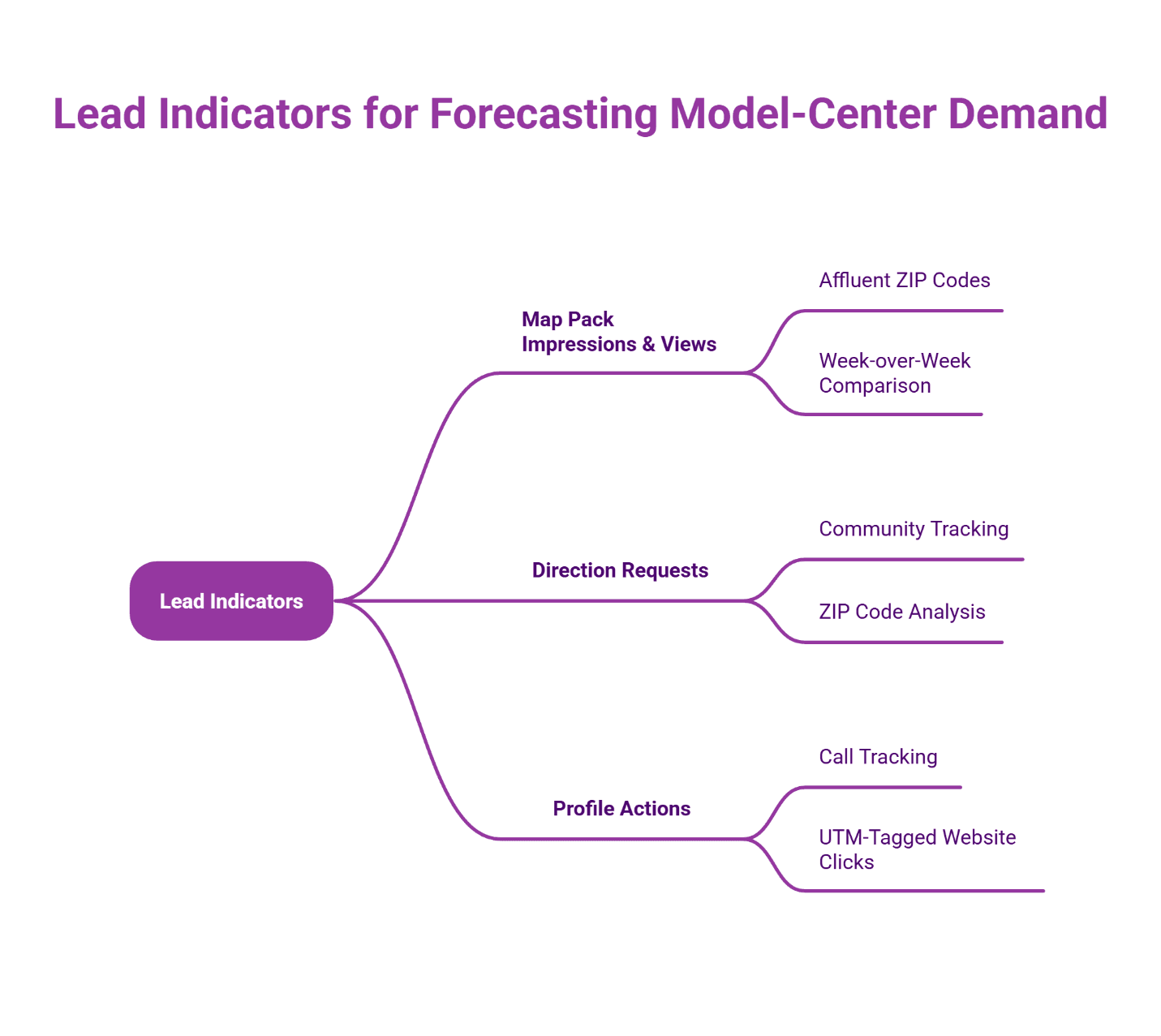
Leading indicators reveal whether your communities are building the visibility and engagement necessary to generate tour bookings. Track these metrics weekly to spot problems early and adjust tactics before they affect monthly appointment targets.
Map Pack Impressions & Views
What it is: Map Pack Impressions measure how often your community profile appeared in local search results for relevant queries. Google Business Profile performance reports surface these metrics along with views, calls, direction requests, and other actions.
Why it matters: Local searches carry remarkably high intent. Studies indicate that well over half of local searches result in a store visit or call within a day. For luxury communities, map-pack visibility in affluent ZIP codes directly forecasts future traffic to your model centers.
How to use it: Focus on impressions from affluent ZIP codes and cities in your service area. If a particular community consistently underperforms in a high-value ZIP, that signals either a profile optimization issue or insufficient content connecting that community to buyer search behavior. Compare impressions week over week to catch sudden drops that warrant investigation.
Direction Requests (by Community/ZIP)
What it is: Direction Requests capture clicks for driving directions from your Google Business Profile to the model center address.
Why it matters: This metric indicates genuine offline intent. When someone clicks for driving directions to your model center, they're typically planning a visit within the next few days. Direction requests often provide the clearest early signal of tour demand.
How to use it: Track Direction Requests weekly by community and ZIP code to identify which areas are generating the most qualified interest. Many builders find that a consistent rise in direction requests precedes tour bookings by one to two weeks. Establish a baseline conversion ratio—often around 5 direction requests yielding 1-2 actual tours—to forecast upcoming model-center demand. Watch for pattern changes around Parade of Homes events or new phase releases.
Profile Actions: Calls, Messages, Website Clicks (UTM-Tagged)
What it is: Profile Actions capture direct engagement from your Google Business Profile, including phone calls to the sales office, messages sent through the profile, and clicks to your website.
Why it matters: Calls and messages represent obvious lead signals. Website clicks serve as your bridge from Google Business Profile into GA4 and ultimately into your CRM—but only when properly tagged with tracking parameters.
How to use it: Standardize tracking numbers for each community so call tracking can attribute inquiries back to the right profile. UTM-tag all profile URLs, including your primary website link, "Book a Tour" buttons, and any appointment or secondary CTAs. Create a weekly report showing calls by community, messages by community, and UTM-tagged sessions from profiles to tour or contact pages. Your goal is clear attribution: when a booked tour appears in the CRM, you should see the complete path from profile click through session to booking.
Lag Indicators to Report Monthly: Sales-Proving Metrics
Lagging indicators confirm whether your visibility and engagement work translated into the outcomes your organization values. Report these monthly to demonstrate Local SEO's contribution to the sales pipeline.
Booked Model-Center Tours
Booked Model-Center Tours represent confirmed appointments with a date and time on the calendar. This is the primary success metric for Local SEO in the homebuilding context. Everything in the leading indicator ladder exists to drive this outcome.
Track tours by source (which profile or campaign generated the appointment) and by status (scheduled, completed, no-show). This granularity helps you identify not just volume, but quality. Attribute each tour to community, source/medium (such as gbp/organic), and campaign (such as community-oakwood-zip-77401) to demonstrate clear impact.
Design-Center Appointments
Design-Center Appointments indicate buyers moving deeper into the purchase process. These consultations typically follow an initial model-center tour and suggest genuine purchase consideration.
If you're generating tours but few design-center appointments result, that may indicate a profile-to-sales handoff issue rather than a Local SEO problem. Consider implementing a feedback loop between marketing and sales to diagnose where prospects disengage.
Close Rate (Optional)
If your CRM provides sufficient data, add a close rate dimension: the percentage of Local-SEO-sourced tours that become buyers. This helps compare community performance and lead quality. Use close rate as a secondary lens rather than a core KPI, particularly when sample sizes are small or attribution is mixed across sources.
Attribution Plumbing: UTM Governance and CRM Status Mapping
Attribution accuracy depends on two foundational elements: consistent UTM parameters across all touchpoints, and proper mapping between marketing data and CRM statuses. Without these, you're measuring traffic but cannot connect it to tours.
Standardize UTMs on All Location Profiles and On-Site CTAs
Every URL in your Google Business Profile—and every community-specific CTA on your website—should follow a standardized UTM structure. Google Analytics 4 treats these as campaign parameters, allowing you to group traffic by source, medium, campaign, and content.
Use this standard:
utm_source=gbp&utm_medium=organic&utm_campaign=community-[slug]-zip-[code]&utm_content=profile
Examples:
Main community page: https://example.com/oakwood-estates?utm_source=gbp&utm_medium=organic&utm_campaign=community-oakwood-zip-77401&utm_content=profile
Tour booking page: https://example.com/oakwood-estates/book-tour?utm_source=gbp&utm_medium=organic&utm_campaign=community-oakwood-zip-77401&utm_content=cta
The campaign parameter identifies both the specific community and the primary ZIP code it targets. This allows you to track performance by neighborhood and by geographic market simultaneously. The content parameter specifies whether the click came from the main profile, a post, a Q&A response, or another element.
Maintain this structure across all profiles and all on-site tour booking CTAs. Inconsistent UTMs make attribution impossible. Establish a governance rule: marketing owns the pattern, and no one creates ad-hoc UTMs.
Map Sessions and Clicks to CRM: Source, Campaign, Community, Status
Your CRM must capture the marketing source and campaign for every lead. When someone books a tour, that record should include:
- Lead Source: GBP Organic
- Campaign Name: community-[slug]-zip-[code]
- Community: specific neighborhood or model center
- Required Statuses: Inquiry/New Lead, Tour Booked, Tour Completed, Design-Center Booked
This mapping allows you to trace a booked appointment back to the specific community profile and geographic market that generated it. Without these fields, you can report traffic but cannot demonstrate tour impact.
SLA: Sales Response, Calendar Hold, and Feedback Loop
Attribution also requires operational discipline. Establish clear service-level agreements for:
- Speed-to-Lead: how quickly does sales respond to profile inquiries or tour requests?
- Calendar Management: how long are tour slots held before they’re released?
- Feedback Loop: Does sales report which leads attended, which no-showed, and which converted to design-center appointments?
These operational details determine whether your attribution data remains accurate as prospects move through the funnel.
Build the Dashboard: KPI Field Dictionary & Owners
A functional KPI dashboard requires clear definitions, assigned ownership, and consistent update cadences. Use this specification to implement your tracking:
| KPI Name | Type | Source | Cadence | Owner | Definition |
|---|---|---|---|---|---|
| Map Pack Impressions | Leading | GBP Insights | Weekly | Marketing | Times your community profile appeared in local results for relevant queries. |
| Direction Requests | Leading | GBP Insights | Weekly | Marketing | Clicks for driving directions to the model center address, segmented by community/ZIP. |
| Profile Actions | Leading | GBP Insights, Call Tracking, GA4 | Weekly | Marketing | On-profile engagement events (calls, messages, website clicks) attributable to community profiles. |
| Tour CTA Clicks | Leading | GA4 (events) with UTMs | Weekly | Marketing | Clicks on “Book a Tour at [Community]” or equivalent local-specific CTA. |
| Booked Tours | Lagging | CRM | Monthly | Sales | Confirmed model-center appointments with date/time. |
| Design-Center Appointments | Lagging | CRM | Monthly | Sales | Confirmed design-center consultations tied to a contact/opportunity. |
Governance Requirements: Document your definitions, establish thresholds for what constitutes a "qualified" direction request or tour booking, and maintain a change log (version, date, owner) whenever you modify a metric definition or data source. This prevents inconsistencies when comparing performance across quarters or communities.
Include benchmarks in your governance documentation, such as: "Direction Requests below threshold for three consecutive weeks triggers profile investigation" or "Map Pack Impressions down 20% month-over-month requires immediate visibility audit."
Common Pitfalls to Avoid
Three common mistakes undermine Local SEO attribution for homebuilders:
- Reporting Brand Traffic as Local Victory: When buyers search for your builder name or a specific community by name, that's brand demand, not local discovery. Don't conflate branded searches with the community-level visibility Local SEO is designed to generate. Split your reporting into brand versus non-brand performance where possible.
- Inconsistent UTMs Across Profiles and CTAs: If one community uses the standardized UTM structure and another doesn't, or if your website's booking CTAs use different parameters than your profiles, attribution collapses. Store a one-page UTM standard where everyone can access it. Audit all touchpoints quarterly to ensure consistency.
- Ignoring Direction Requests and On-Profile Actions: Many teams focus exclusively on website clicks and overlook the signals that precede them. Direction requests and profile calls often indicate higher intent than a casual website visit. Builders who only monitor traffic often discover visibility problems only after tours have already declined for the month.
Next Steps: Put the KPI Ladder to Work
Turn this framework into action with a 30-day pilot:
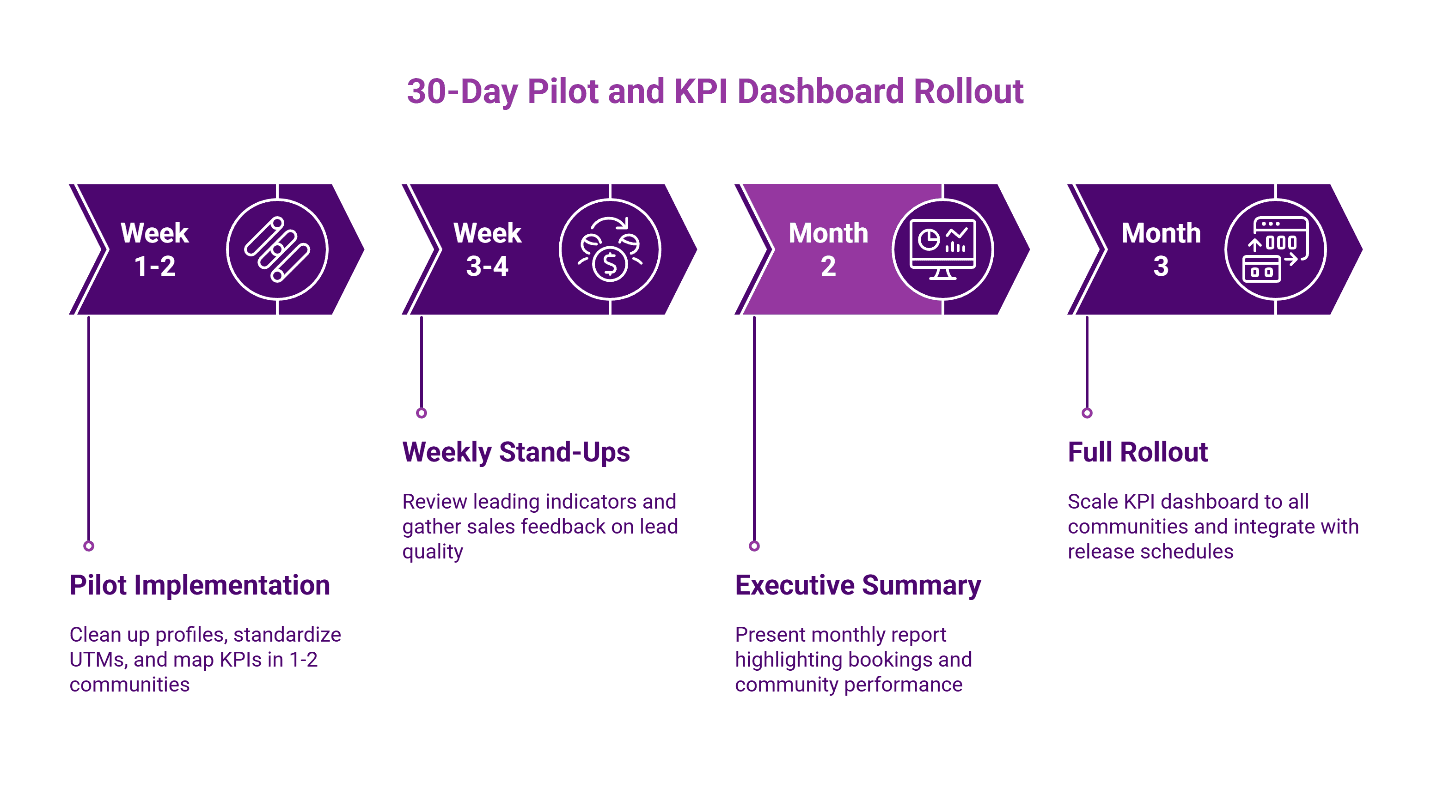
Week 1–2: Pilot on 1–2 Communities Select communities where you can clean up Google Business Profile listings, standardize UTMs, and verify tracking numbers. Implement the full KPI ladder and status mapping for these pilot locations first.
Week 3–4: Run Weekly Marketing and Sales Stand-Ups Review leading indicators: impressions, direction requests, profile actions, and CTA clicks. Capture qualitative feedback from sales about lead quality—are these tours qualified? Are they in the right price range? Are geographic targeting and messaging aligned?
Month 2: Deliver Monthly Executive Summary Open with Booked Tours and Design-Center Appointments. Show the complete chain from visibility through actions to bookings. Highlight which communities are ahead or behind launch and inventory timelines.
Month 3: Scale the Dashboard Roll the Local SEO KPI Dashboard Spec to all communities. Maintain a clear owner for the KPI dictionary and change log. Tie this framework to your release schedules and Parade of Homes participation.
When Local SEO is measured this way, it stops being a vague line item and becomes what it should be: a reliable engine for booked tours and design-center appointments, aligned to your release schedule.
Ready to shift from vanity metrics to tour-driving KPIs? Download the KPI Dashboard Spec to get the one-pager and CSV field dictionary your team can implement immediately.
For a deeper consultation on building Local SEO systems that align with your release schedules and sales process, schedule your free consultation.
Our Editorial Process: Our expert team uses AI tools to help organize and structure our initial drafts. Every piece is then extensively rewritten, fact-checked, and enriched with first-hand insights and experiences by expert humans on our Insights Team to ensure accuracy and clarity.
About the Brazos Valley Marketing Insights Team: The Brazos Valley Marketing Insights Team is our dedicated engine for synthesizing complex topics into clear, helpful guides. While our content is thoroughly reviewed for clarity and accuracy, it is for informational purposes and should not replace professional advice.

About the Author
Dustin Ogle
Dustin Ogle is the Founder and Head of Strategy at Brazos Valley Marketing. With over 9 years of experience as an SEO agency founder, he specializes in developing the advanced AI-driven strategies required to succeed in the new era of search.