Tour-First Local SEO: Why Community-Level Visibility Beats Brand-Term Rankings for Builders
Last Updated: 08 December 2025 • 11 min read
📌 Key Takeaways
Brand-term rankings celebrate awareness you already have, but affluent buyers discover options through ZIP-code searches you're probably not tracking.
- Brand Searches Are Navigation, Not Discovery: When prospects search your company name, they've already decided—that click confirms awareness but creates zero new demand in target communities.
- Community-Level Profiles Unlock Geographic Relevance: One distinct Google Business Profile per model center, with clean NAP and tour-ready hours, prevents conflation and captures searches in the affluent ZIP codes where buyers actually live.
- The KPI Ladder Predicts Tours Before They Drop: Map Pack impressions and direction requests (leading indicators) signal tour potential weeks before calendar gaps appear, giving marketing teams a weekly pulse check instead of reactive dashboards.
- Neighborhood Clusters Own Non-Brand Intent Without Cannibalization: Content targeting "luxury homes in [ZIP]" or "communities near [School]" routes discovery-phase buyers to relevant model centers while brand pages retain navigational authority.
- UTM Governance Closes the Attribution Loop: Standardized campaign tracking from GBP clicks through CRM fields transforms "we got traffic" into "12 tours booked from the [Community] profile"—the reporting executives actually understand.
Tour-first measurement reframes Local SEO around what fills calendars, not what celebrates visibility. Marketing and sales leaders at luxury homebuilders will find a practical blueprint here, preparing them for the detailed implementation framework that follows.
Community-level Local SEO is a visibility strategy that creates distinct Google Business Profiles and optimized landing pages for each model-center location, rather than relying solely on brand-name recognition. Think of it like intersection signage at a job site. When an affluent buyer searches for "luxury homes in [ZIP]" or "new construction near [City]," they're not looking for your corporate headquarters—they're looking for the specific community where they'll actually tour. A marketing director at a luxury builder recently faced this exact scenario: her brand ranked #1 for company-name searches, yet qualified prospects kept visiting competitors' model centers in the target ZIP codes. The disconnect was clear. This article reframes success metrics around what actually drives revenue: booked model-center tours generated through community-specific visibility in Map Pack results, supported by neighborhood content clusters and tour-first measurement protocols.
What "Tour-First" Actually Measures (and Why Brand Rankings Mislead)
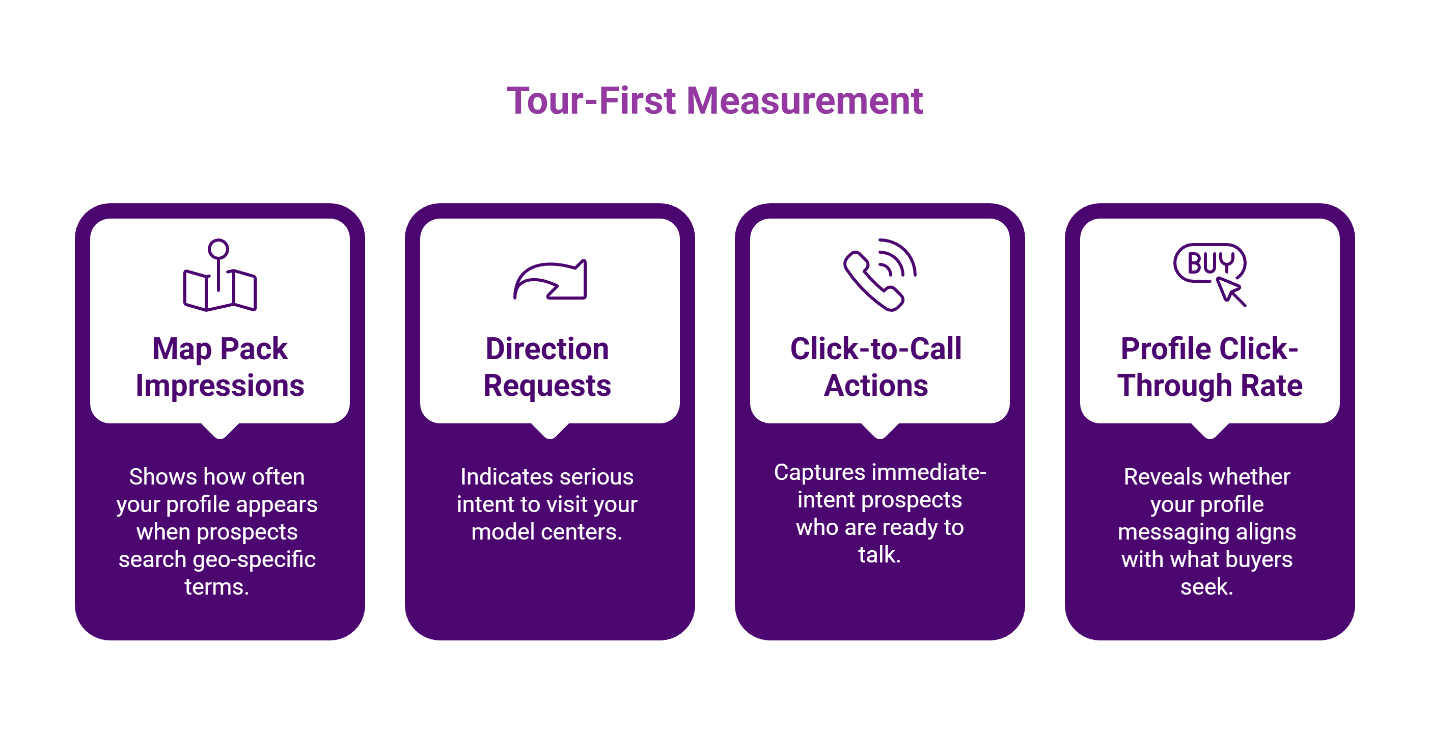
Brand-term rankings are navigational queries. When someone searches your company name, they've already heard of you through referrals, past visits, or advertising. That click confirms awareness but doesn't create new demand. Tour-first measurement shifts focus to the leading indicators that predict scheduled appointments: Map Pack impressions in affluent ZIP codes, direction requests to model centers, click-to-call actions from profiles, and the click-through rate from your profile to your booking page.
Leading vs. Lagging KPIs (Map Pack → Tours)
The KPI ladder connects visibility to revenue. At the top sits your lagging indicator—booked tours and design-center appointments. These validate everything else but arrive weeks after the marketing activity. Below that, your leading indicators provide early signals. Map Pack impressions show how often your profile appears when prospects search geo-specific terms. Direction requests indicate serious intent to visit. Profile-to-website click-through rates reveal whether your profile messaging aligns with what buyers seek. Phone calls from the profile capture immediate-intent prospects.
This hierarchy matters because most builders track only the lagging metrics, then wonder why their marketing feels reactive. By the time tour counts drop, you've already lost weeks of visibility. Leading indicators give you a weekly pulse check—are the right people seeing you in the right places?
UTM Conventions That Survive Real-World Handoffs
Attribution breaks when marketing and sales use incompatible systems. A standardized UTM structure prevents that failure. For profile links and all booking CTAs, apply this convention: source=gbp (for Google Business Profile clicks) or source=gbp-post (for GBP posts), medium=organic, and campaign=[community - slug]. When these parameters flow into your CRM alongside fields for Source, Campaign, Community, Appointment Type, and Tour Date, your sales team can trace every booked tour back to its originating profile or neighborhood page.
This isn't academic tracking. It's the difference between reporting "we got 40 website visits" and reporting "12 tours scheduled from the [Community Name] Map Pack profile, with 8 conversions from neighborhood cluster pages." Executive leadership understands the second statement. The first invites budget cuts.
Community-Level Visibility Blueprint
One model center, one Google Business Profile, one optimized landing page. This principle prevents the most common failure mode in builder SEO: profile conflation. When multiple communities share a single corporate profile, Google struggles to determine which location is relevant for geo-specific searches. The result is inconsistent Map Pack placement and missed visibility in the affluent ZIP codes where your prospects actually search.
One Profile per Community (NAP/Category/Hours/Photos)
Each community requires distinct name, address, and phone number (NAP) data in its profile. Use the model-center address—not your corporate office—as the business location. Select the most specific primary category that matches your offering; testing variations like "Custom Home Builder" versus "Home Builder" can help determine which resonates best for your luxury communities. Post your model-center hours, not corporate business hours, because direction requests convert into tours only when prospects arrive during open hours.
Photo cadence matters. Upload new exterior, interior, and amenity images monthly to signal active inventory and fresh content to Google's relevance algorithms. Prospects evaluating luxury homes expect visual proof of craftsmanship and lifestyle fit before they commit to traveling for a tour. Communities without a legitimate onsite presence—true "coming soon" properties—are typically better served via the nearest active community profile or corporate listing until a physical model center opens.
Model-Center Page Architecture
Your community landing page exists to convert profile clicks into tour bookings. Place a prominent "Book a Tour at [Community Name]" CTA above the fold, supported by inventory widgets showing available home sites and floor plans. Include your model-center address, directions, hours, and direct phone line. Embed a map widget for one-click navigation.
The page must answer the immediate question: "What do I do next?" For affluent buyers, that next step is rarely "fill out a generic contact form." It's "schedule a specific appointment at a specific location with a specific sales consultant." Make that path frictionless.
Reviews That Signal Fit
Review content shapes local relevance beyond star ratings. When reviews mention nearby schools, commute times to business districts, parks, shopping, and community amenities, Google associates your profile with those geographic and lifestyle entities. This improves your visibility for searches like "luxury homes near [School Name]" or "new construction walkable to [Park Name]."
Encourage buyers to mention the specific amenities and location factors that influenced their decision. These authentic signals strengthen your neighborhood relevance without manufactured keyword stuffing.
Neighborhood Clusters: Capture Non-Brand Geo Intent without Cannibalization
Affluent buyers rarely begin with brand searches. They search "new luxury homes in [City]," "custom builders [ZIP code]," or "master-planned communities near [Landmark]." Neighborhood content pages capture this non-brand intent by matching search queries to location-specific information, then routing visitors to the nearest relevant community profile and booking page.
Routing Rules (Clusters → Nearest Relevant Community)
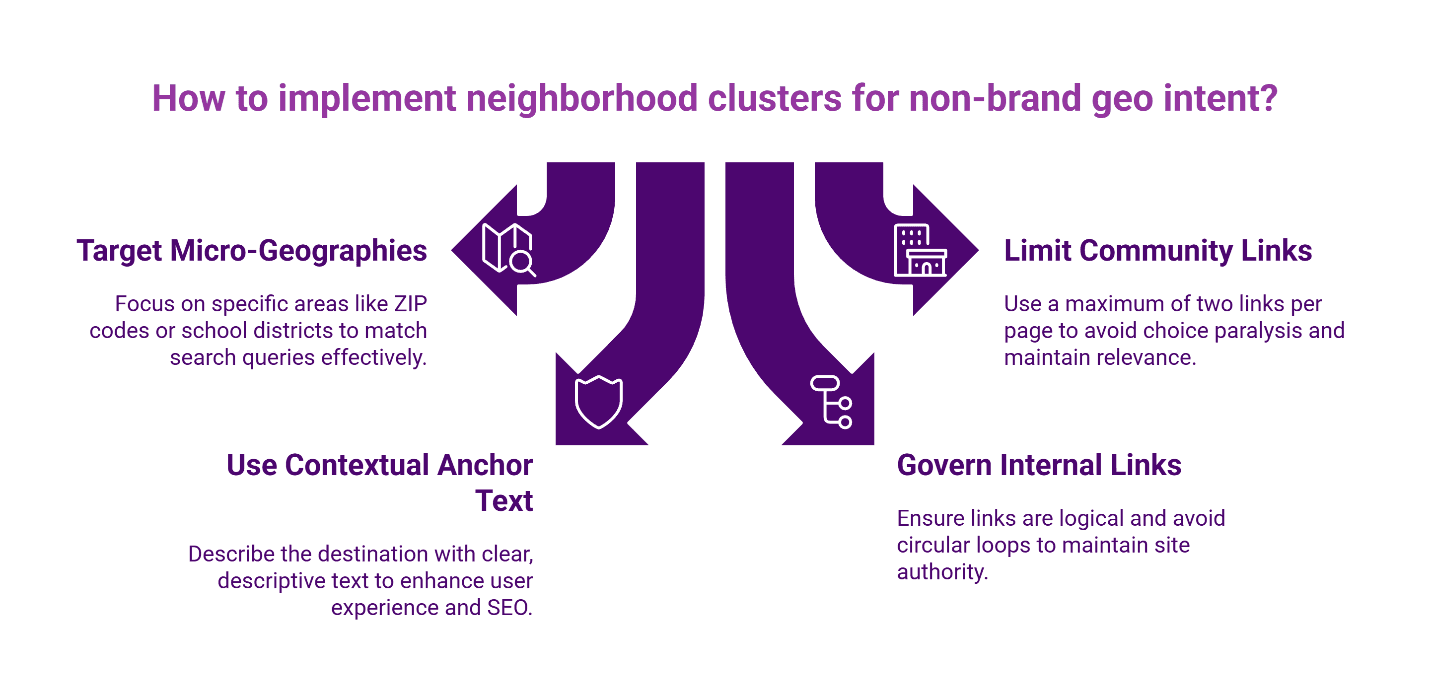
Each neighborhood page should target a specific micro-geography (a ZIP code, a school district, a recognized neighborhood name) and connect to one or two community profiles within a reasonable drive time. If your company operates communities in both north and south [City], your "Luxury Homes in North [City]" cluster page links exclusively to north-area communities. This prevents choice paralysis and maintains geographic relevance.
Use contextual anchor text that describes the destination: "Explore our [Community Name] model center, located in the heart of [ZIP]" rather than generic "Click here" links. This internal linking architecture reinforces topical relevance for both users and search engines.
Anchor Links & Internal Link Governance
Excessive internal linking dilutes authority. Apply a maximum of two community links per neighborhood page, prioritizing the closest and most relevant match. For broader service pages about custom home builders in [City], a single link to your Community Page Templates That Convert strategy guide provides educational value without competing for the same search intent.
Effective internal link governance requires editorial judgment: does this link help the reader take a logical next step, or does it create a circular loop that traps them in your site architecture?
Inspect What You Expect: The Weekly Map Pack Checklist
Tour-first Local SEO operates like a recurring job walk. Once a week, the marketing "site superintendent" inspects every profile and community-level KPI ladder. This 30-60 minute circuit ensures that profiles remain accurate, visually compelling, and aligned with actual on-the-ground schedules.
Data Verification & Freshness
Monday morning routine: Log into each community's GBP dashboard and verify that hours, address, phone number, primary category, and attributes (like "wheelchair accessible" or "appointment required") remain accurate. Confirm that your most recent photos uploaded successfully and appear in the gallery. Draft and publish one GBP post per community highlighting quick-move-in homes, new phases, or design tips.
This prevents the most damaging visibility failures: outdated hours that drive prospects to locked model centers, incorrect addresses that send direction requests to the wrong location, and stale photos that signal neglect.
KPI Snapshot & Trend View
Friday afternoon review: Download GBP Insights data for each community. Record impressions, direction requests, phone calls, website clicks, and profile views. Compare week-over-week trends. A sudden drop in impressions signals a data accuracy problem, a category change by a competitor, or a Google algorithm adjustment. A spike in direction requests with flat tour bookings indicates a sales follow-up issue, not a marketing problem.
Track profile-to-page CTR separately. Low click-through rates from profile views to your booking page suggest your profile messaging or photos aren't compelling enough to warrant deeper investigation.
Close the Loop with Sales: From Directions to Booked Tours
Marketing generates visibility. Sales converts visibility into revenue. The gap between these functions kills ROI attribution. Closing this loop requires CRM governance and executive reporting aligned around the same KPI ladder.
CRM Statuses & SLA for Model-Center Follow-Up
When a prospect clicks "Get Directions" from your GBP profile or submits a tour request from your landing page, your CRM must capture the originating community, campaign source, and timestamp. Establish a service-level agreement (SLA) that defines response times and follow-up expectations—for instance, that all Map Pack-sourced leads receive prompt contact during business hours, with tours scheduled or dispositioned according to your team's capacity and protocols.
This SLA transforms leading indicators into lagging conversions. Without it, you're measuring impressions in a vacuum while tours happen—or don't—for reasons no one tracks.
Executive KPI Ladder (One-Page Snapshot)
Your executive snapshot should fit on a single page and show week-over-week deltas for each rung of the KPI ladder:
Leading indicators: Map Pack impressions (by community), direction requests, profile clicks, phone calls from profile
Conversion metrics: Page CTR, tour request form submissions, scheduled appointments
Lagging indicators: Completed tours, contracts signed, revenue closed (with attribution to originating community and campaign)
This format connects visibility to revenue without requiring stakeholders to interpret raw analytics data or navigate multiple dashboards.
Next Steps (Pick 1 Community, 1 Neighborhood, 1 Week)
Transformation doesn't require simultaneous execution across every community. Prove the model with a time-boxed pilot.
Pilot Plan & Success Thresholds
Pick 1 community where tours matter most
Pick 1 neighborhood that regularly appears in buyer conversations
Pick 1 week to run a focused experiment
During that week:
- Clean and update the community's GBP (data, photos, posts)
- Align all profile links to the model-center page with standardized UTMs
- Publish or refine one neighborhood guide that routes clearly to the community
- Agree with sales on CRM fields and follow-up expectations for any new tour requests
Set a success threshold that's meaningful for your market: a measurable increase in direction requests week-over-week, or booked tours attributed to the optimized profile or cluster page within a defined timeframe. These metrics prove the strategy's validity through a clear before-and-after comparison. Once validated, replicate the process for your remaining communities on a phased schedule. Trying to optimize ten profiles simultaneously invites execution errors and makes it impossible to identify what's working.
Frequently Asked Questions
Ready to shift from vanity rankings to tour-driving visibility? Schedule Your Free Strategy Session to design a community-level SEO pilot for your highest-priority location, or Get the Tour-First KPI One-Pager to see the full measurement framework.
For deeper implementation guidance, explore our resources on Tracking What Matters in Local SEO, Map Pack Mastery for Model Centers, and Sales–Marketing Alignment for Tours.
Our Editorial Process: Our expert team uses AI tools to help organize and structure our initial drafts. Every piece is then extensively rewritten, fact-checked, and enriched with first-hand insights and experiences by expert humans on our Insights Team to ensure accuracy and clarity.
About the Brazos Valley Marketing Insights Team: The Brazos Valley Marketing Insights Team is our dedicated engine for synthesizing complex topics into clear, helpful guides. While our content is thoroughly reviewed for clarity and accuracy, it is for informational purposes and should not replace professional advice.

About the Author
Dustin Ogle
Dustin Ogle is the Founder and Head of Strategy at Brazos Valley Marketing. With over 9 years of experience as an SEO agency founder, he specializes in developing the advanced AI-driven strategies required to succeed in the new era of search.