
The Quality-First Pipeline: How to Filter Students and DIYers from Your RFQs
Last Updated: January 2026 • 12 min read
📌 Key Takeaways
Filtering unqualified RFQs starts upstream—before visitors ever reach your contact form—by aligning content and keywords with commercial intent.
- Intent Filtering Starts at Keywords: Prioritizing spec-driven, application-specific searches over "how to" tutorials attracts engineers ready to buy, not students researching projects.
- Gatekeeper Content Clarifies Fit: Adding industries served, minimum quantities, and explicit exclusions to product pages helps non-buyers self-select out without hostility.
- Form Fields Are Qualification Tools: Requiring company name, business email, quantity range, and drawing uploads filters hobbyists while preserving legitimate inquiries.
- Negative Personas Guide Audits: Tracking patterns like personal emails, single-unit requests, and missing specs reveals which content sources produce noise versus signal.
- Alternate Paths Reduce Friction: Routing non-fit visitors to educational resources answers their questions without clogging the sales queue.
Clean submissions come from clear fit criteria—not more forms or CAPTCHAs.
Marketing directors at mid-market manufacturers will gain a structured framework for improving RFQ quality, preparing them for the detailed implementation checklist that follows.
It's 4:47 PM. Another RFQ notification hits your inbox.
You click through—free email address, no company name, and a single line: "Need a quote ASAP." Your sales engineer opens the attachment expecting a drawing. Instead, it's a blurry photo of what looks like a high school robotics project.
Another 15 minutes gone.
If this sounds familiar, you're not alone. Marketing directors at mid-market manufacturers face a persistent problem: the website generates "leads," but sales says most of them are junk. Students researching class projects. Hobbyists who need one part. Competitors fishing for pricing. The real buyers—engineers and procurement officers with actual budgets and timelines—get buried in the noise.
The instinct is to blame spam or tighten the contact form. But that's treating symptoms, not the disease. The real issue starts upstream, long before anyone fills out a form. A quality-first pipeline fixes the problem at the source by filtering non-buyers before they ever reach sales.
When evaluating SEO services for manufacturing companies, this is the test that matters: does the site create qualified RFQs—or more noise?
Why Your Site Attracts Students and Hobbyists in the First Place
Your content is probably inviting them in.
When pages answer broad "how does this work" questions without setting boundaries, everyone feels welcome to request a quote. A student researching CNC machining for a paper lands on the same page as a procurement manager sourcing 500 brackets. If neither page nor form signals who you actually serve, the risk of unqualified submissions increases significantly, as users lack the context to self-select out.
This creates a signal-to-noise problem that compounds over time. Sales loses trust in marketing. Response times slow down. And serious buyers—the ones comparing three vendors with a purchase order ready—get the same delayed response as a teenager asking about a science fair project.
Common upstream causes include learning-first content that answers "how to" questions without constraints, product pages that describe capability but not buying context, and navigation that routes every visitor to the same RFQ doorway regardless of fit.
The fix isn't to publish less content. It's to publish content that attracts buyers and quietly discourages everyone else.
The Quality-First Pipeline: A 3-Layer Filter
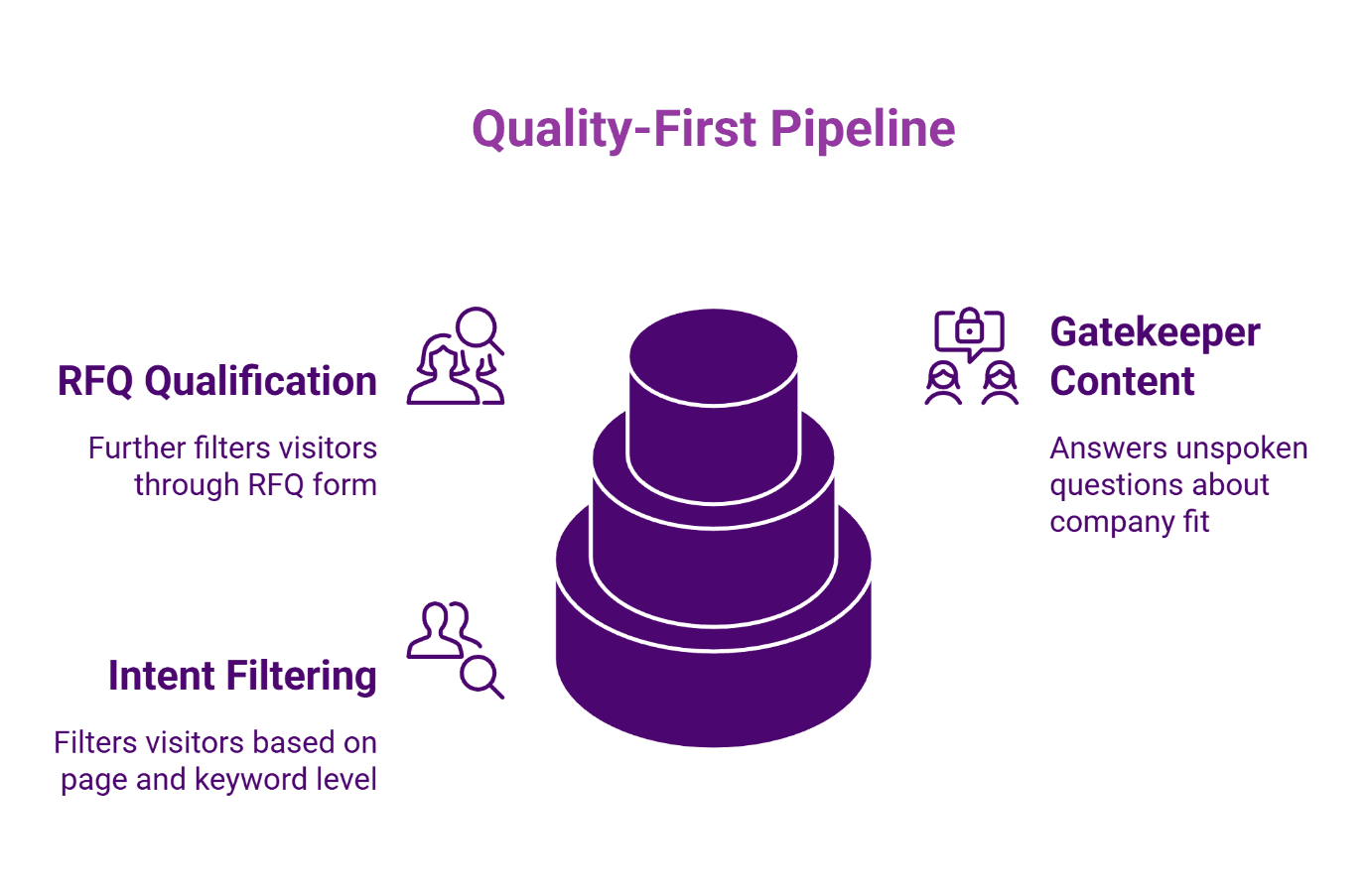
Think of your RFQ flow like an industrial filtration system. Contaminants need to be removed upstream—before they clog the works downstream. A quality-first pipeline uses three layers:
- Intent filtering at the keyword and content level to avoid research-only traffic
- Gatekeeper content on key pages that sets clear expectations about fit
- RFQ qualification that captures specs and routes requests correctly
Each layer removes a different type of non-buyer. Miss one, and the others have to work harder. Get all three right, and your sales team spends time on opportunities instead of explanations.
Layer 1: Intent Filtering on the Page and Keyword Level
The first filter happens before anyone lands on your site. It focuses on optimizing for high-intent commercial queries while strategically deprioritizing broad informational keywords that tend to attract research-only traffic.
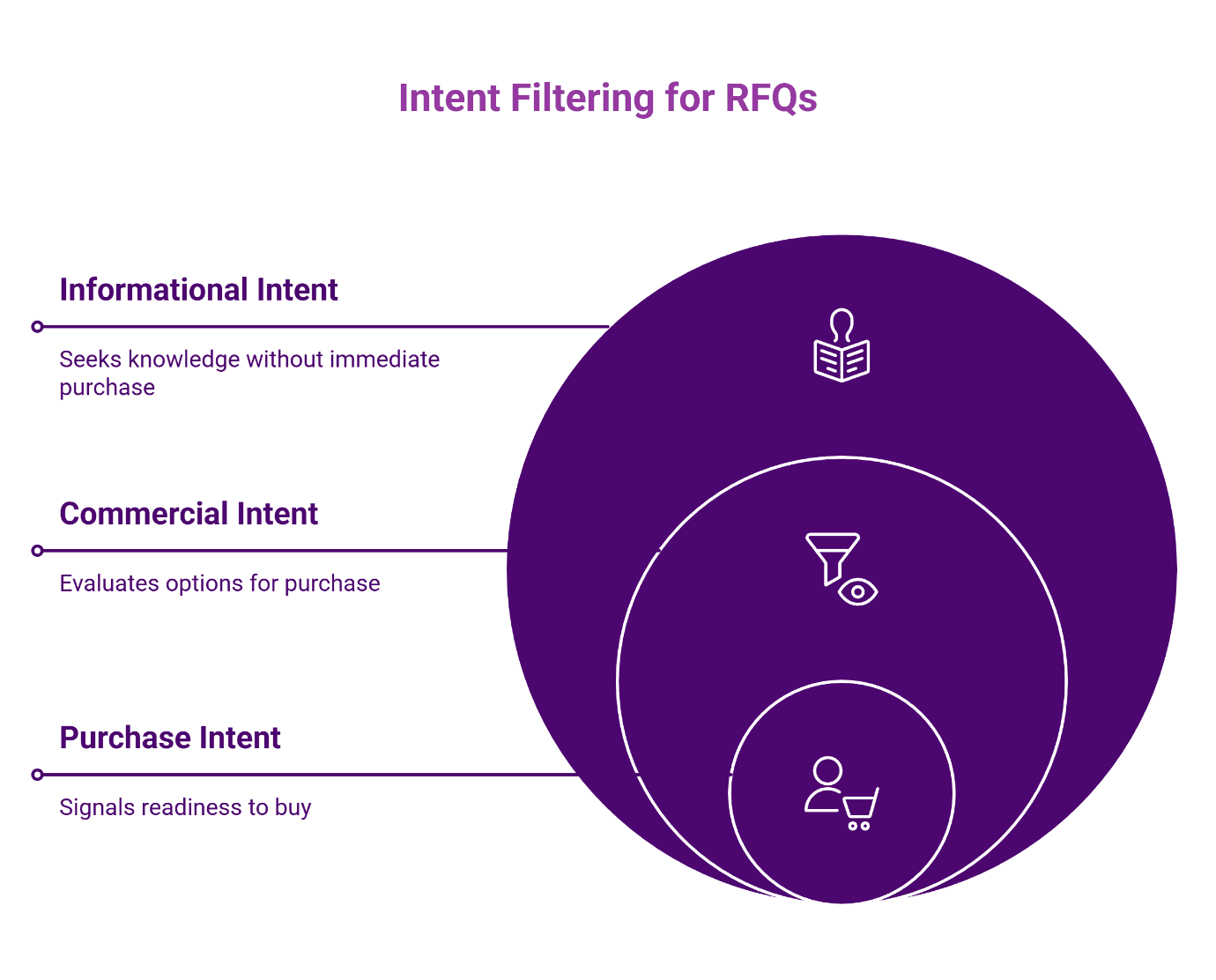
Engineers and procurement officers search differently than students. They use part numbers, material specs, tolerance ranges, and application-specific language. A buyer searches for "AS9100 certified titanium machining" or "custom hydraulic manifold manufacturer." A student searches for "how does CNC machining work" or "types of metal fabrication."
Both searches might be relevant to your business. But only one signals purchase intent.
This isn't a novel insight—it's established SEO practice. Search intent shapes lead quality. Informational queries tend to attract learners; commercial and transactional queries tend to attract evaluators and buyers.
Prioritize part, spec, and application searches over tutorial-style content. Use headings and internal links that reinforce commercial intent. If a page ranks for "what is precision grinding," make sure the content pivots quickly to capabilities, industries served, and quoting requirements—not a 2,000-word explainer that reads like a textbook.
A practical framework for this approach appears in the SKU-first manufacturing SEO resource, which shows how to prioritize product lines for commercial intent.
Layer 2: Gatekeeper Content That Filters Without Feeling Hostile
The second layer lives on your most-visited product and service pages. It's a short block—sometimes just a few sentences—that answers an unspoken question: Is this company right for me?
Effective gatekeeper content includes:
- Industries served and typical applications
- Capabilities and constraints (materials, tolerances, certifications)
- Minimum order quantities or typical order profiles
- What you don't do (prototyping only, no residential, etc.)
This isn't about being unfriendly. It's about clarity. Real buyers appreciate knowing upfront whether you're a fit. They're comparing three to five vendors and don't want to waste time on a company that can't meet their specs.
For visitors who clearly aren't a fit, offer an alternate path. A link to educational resources or industry associations gives them somewhere to go without clogging your RFQ queue. It's the difference between a locked door and a helpful redirect.
A manufacturing-specific framework for fit-first messaging appears in the manufacturing SEO lead generation resource.
Layer 3: RFQ Form Qualification
The third layer is your RFQ form itself. Many standard forms ask for little more than name, email, and 'tell us about your project." That's not qualification—it's an invitation for anyone with a keyboard.
A core UX principle applies here: unnecessary fields increase friction, while clear labels and instructions reduce errors. The form should capture what sales needs to quote—no more, no less.
A qualified RFQ form captures information that helps sales prioritize and route requests correctly:
- Company name and role (required fields, not optional)
- Business email domain (typically, public domains like Gmail and Yahoo are routed for manual review rather than automatically blocked, ensuring legitimate small-business inquiries are preserved).
- Part or application type (dropdown or short description)
- Quantity range (dropdown: 1-10, 11-100, 100-1,000, 1,000+)
- Timeline (dropdown: Immediate, 30 days, 60+ days, Budgetary only)
- Drawing or spec upload (with a note: "Attaching a detailed drawing significantly accelerates the quoting process.")
Group fields into short sections so the form feels manageable: Contact details first, then Part information, then Quantity and Timeline, then Upload. This structure moves the visitor through a logical sequence rather than presenting a wall of fields.
Keep everything else optional or collect it after first response. The goal isn't to create friction for real buyers. It's to create just enough structure that non-buyers self-select out. A student with no company, no specs, and a quantity of "1" either abandons the form or submits something sales can deprioritize in seconds.
The Negative Persona Filter: Signals That Identify Non-Buyers
Use this reference when auditing content targets or reviewing RFQ submissions. These patterns don't mean automatic rejection—but they warrant scrutiny.
Research and Learning Phrases
- "How to..." / "What is..." / "Types of..."
- "Explained" / "Tutorial" / "Guide"
- "For beginners" / "Introduction to..."
- "DIY" / "Homemade" / "Build your own"
- "Free" / "Open source"
Hobby and Student Signals
- "School project" / "Class assignment"
- "Personal use" / "Home shop"
- "One piece" / "Single unit"
- "Kit" / "Starter"
- No company name or personal email domain
Low-Fit Commercial Phrases
- "Lowest price" / "Budget option"
- "Rush" with no specs attached
- "Just need a quick quote"
- Vague application ("various uses")
- No drawings, tolerances, or material specs
When these signals appear in your search queries or form submissions, it's a prompt to review upstream content. Are you ranking for research phrases that attract the wrong audience? Does your gatekeeper content make fit criteria obvious?
What to Do Instead
Each bucket calls for a different response:
Research phrases: Keep the content if it serves a purpose, but add a Fit Check block and route visitors to a "How to request a quote" resource rather than the RFQ form itself.
Hobby and student phrases: Add explicit exclusions to relevant pages and create a resource path that answers their questions without triggering sales routing. A FAQ or educational section works well here.
Low-fit commercial phrases: Publish minimum order or typical order guidance prominently. Require quantity range and drawing upload before the RFQ can submit—this alone filters out many one-off requests.
Quick Implementation Checklist
Start this week:
- [ ] Audit your top 10 RFQ-driving pages. Which ones attract research traffic? Which ones convert serious buyers?
- [ ] Add a "Fit Check" block to your 5 most-visited service pages. Include industries, capabilities, constraints, and what you don't do.
- [ ] Update your RFQ form with 3-5 qualification fields. Company, role, quantity range, timeline, and upload option.
- [ ] Group form fields into logical sections: Contact → Part → Quantity/Timeline → Upload.
- [ ] Review submissions weekly for patterns. Track which content sources produce qualified vs. unqualified RFQs.
- [ ] Create an alternate path for non-fit visitors. A resources page or FAQ that answers their questions without inviting an RFQ.
From Noise to Signal
The fastest way to improve RFQ quality isn't publishing more content or adding a CAPTCHA. It's making your fit criteria obvious and aligning every page with commercial intent.
A quality-first pipeline protects your sales team's time. It surfaces serious industrial buyers and filters out the students, hobbyists, and tire-kickers before they ever reach the inbox. The result isn't fewer submissions—it's cleaner submissions that your team can quote confidently.
If your pipeline is noisy, start with intent. Browse our manufacturing resources to see how technical search strategy and lead qualification fit together. For teams ready to clean up their RFQ flow, schedule a free strategy session to discuss your specific situation.
Disclaimer: This content is provided for informational and educational purposes. Results vary based on industry, competition, and implementation. We recommend consulting with a qualified marketing professional to assess your specific situation.
Our Editorial Process: Our editorial process includes research and expert review to ensure accuracy and usefulness. We prioritize clear, actionable guidance that helps readers make confident decisions. Content is reviewed for clarity, relevance, and alignment with current best practices.
Written by the BVM Insights Team
The Insights Team is our dedicated engine for research and insights, exploring emerging trends, analyzing industry best practices, and translating complex topics into clear, actionable strategies. Our work is guided by editorial standards that prioritize accuracy, usefulness, and real-world impact.

About the Author
Dustin Ogle
Dustin Ogle is the Founder and Head of Strategy at Brazos Valley Marketing. With over 9 years of experience as an SEO agency founder, he specializes in developing the advanced AI-driven strategies required to succeed in the new era of search.