
The 'Invisible Expert' Syndrome: Why You Lose RFQs to Inferior Competitors
Last Updated: January 2026 • 12 min read
📌 Key Takeaways
Engineers build shortlists from search results—manufacturers absent from those results lose RFQs before sales conversations ever begin.
- Visibility Determines Shortlists: Procurement teams research suppliers online before issuing RFQs, eliminating companies they cannot find regardless of capability or quality.
- Technical Intent Wins Rankings: Engineers search by tolerance, material grade, and certification—not company name—so pages must match this specification-driven vocabulary to appear.
- Trust Signals Convert Browsers: Prominently displayed certifications, datasheets, equipment lists, and industries served convince technical buyers faster than marketing language ever will.
- Architecture Outperforms Random Content: A structured site mirroring how engineers think—by product line, material, and application—ranks for dozens of relevant searches while scattered blog posts attract unqualified traffic.
- Fifteen Minutes Reveals the Gap: Searching five buyer queries in incognito mode and auditing your top product page for specs, certifications, and clear RFQ paths exposes exactly where visibility breaks down.
Invisible online means invisible on shortlists—visibility is revenue defense.
Manufacturing and industrial marketing leaders seeking qualified RFQs will find a diagnostic framework and 30-day sprint plan here, preparing them for the detailed implementation guidance that follows.
It's 2 PM on a Tuesday. Somewhere, an engineer is searching for a supplier. They type in a tolerance, a material grade, maybe a compliance standard. Google returns a list. They open the first three results, skim for specs, and add two companies to their shortlist.
Your company isn't on it. Not because your product is worse. Not because your prices are too high. You simply didn't show up.
They never even knew you existed.
This is the "Invisible Expert" Syndrome—and it's costing manufacturers like yours qualified RFQs every week. The frustrating part? You've invested years building superior capabilities, earning certifications, and delivering for customers who found you through referrals or trade shows. But online, where modern shortlists get built, you're a ghost.
Here's why it happens—and what you can do about it this month.
The Moment You Lose the RFQ (And Never Know It Happened)
There's no rejection email. No phone call saying "we went with someone else." The loss is silent. A procurement manager searched, found your competitors, requested quotes from them, and moved on. You weren't in the running because you weren't in the results.
This creates a painful cycle inside your organization. Sales wonders why inbound leads have dried up. Marketing gets blamed for "not generating enough awareness." Leadership questions whether digital investment is worth it at all. Meanwhile, competitors with objectively inferior products keep winning work—because they're visible where buying decisions start.
The data supports this pattern. Gartner research shows that 61% of B2B buyers now prefer a rep-free buying experience, which means research happens online first—often before anyone picks up a phone. McKinsey's analysis of B2B buying behavior reinforces this, describing omnichannel behavior where buyers blend digital and human touchpoints throughout their journey. Shortlists increasingly form online, before Sales hears anything.
What the "Invisible Expert" Syndrome Looks Like in Manufacturing
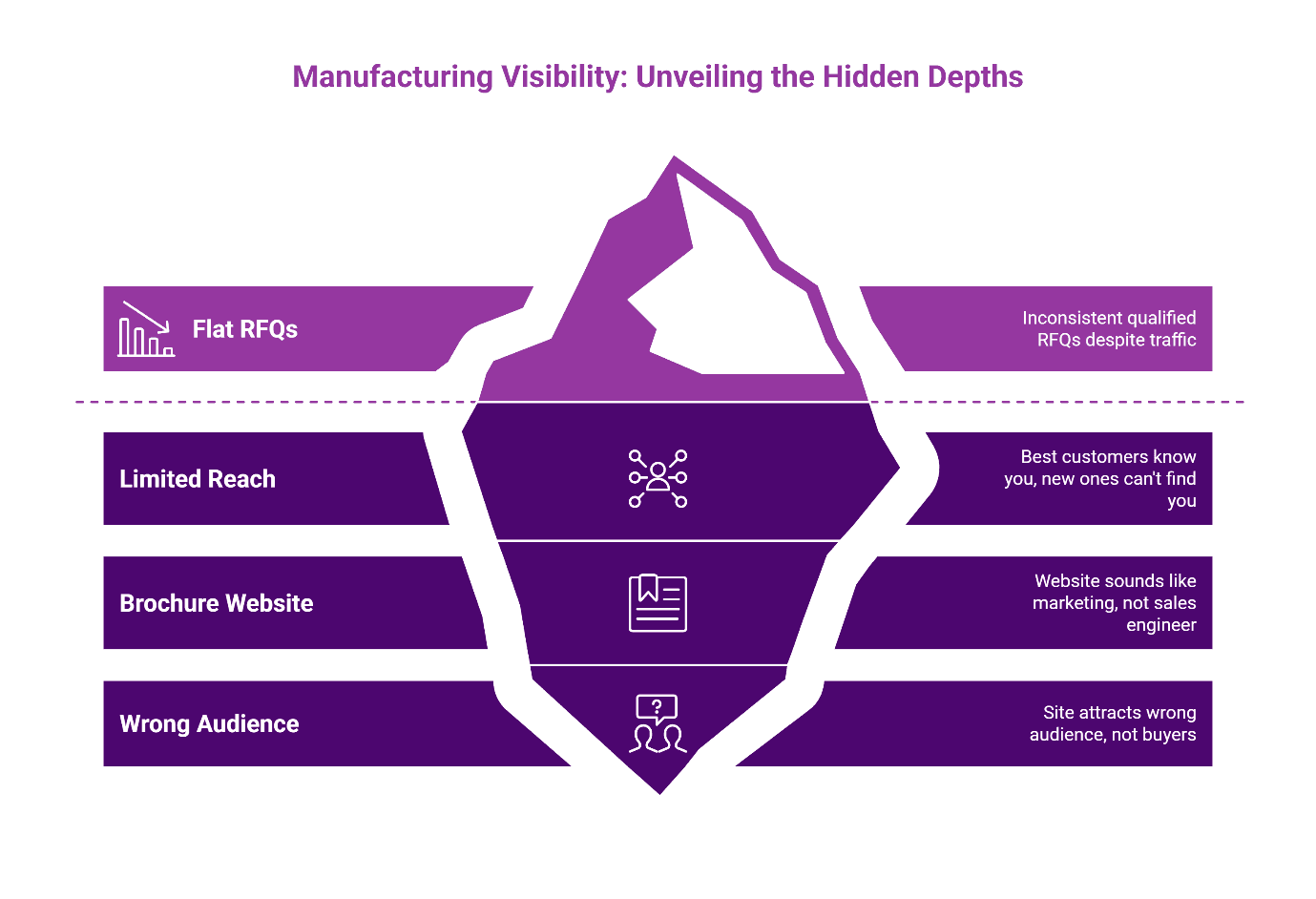
Your Best Customers Already Know You—New Customers Can't Find You
Referrals work. Trade shows work. But they don't scale. You can't attend every show, and your best customers can only refer so many people. Meanwhile, engineers at companies you've never heard of are searching right now for exactly what you make. If your site doesn't appear for those searches, you're invisible to your entire addressable market outside your existing network.
Your Website Sounds Like a Brochure, Not a Sales Engineer
Open your top product page. Does it read like marketing copy, or does it answer the questions an engineer would actually ask? Many manufacturing websites are filled with phrases like "industry-leading solutions" and "commitment to quality" but lack the specifics buyers need: tolerances, materials, compliance certifications, application examples, and a clear path to request a quote.
If your page doesn't pass the "engineer test," it won't convert—even if someone finds it.
Traffic Goes Up, RFQs Stay Flat
This is the vanity metric trap. Website traffic rises, reports look healthy, but qualified RFQs remain inconsistent. The disconnect usually means the site attracts the wrong audience— academic researchers looking for definitions, job seekers, competitors checking your pricing—instead of engineers and procurement professionals ready to buy.
Why Inferior Competitors Win Online (Even With Worse Products)
They Match Technical Intent Better Than You
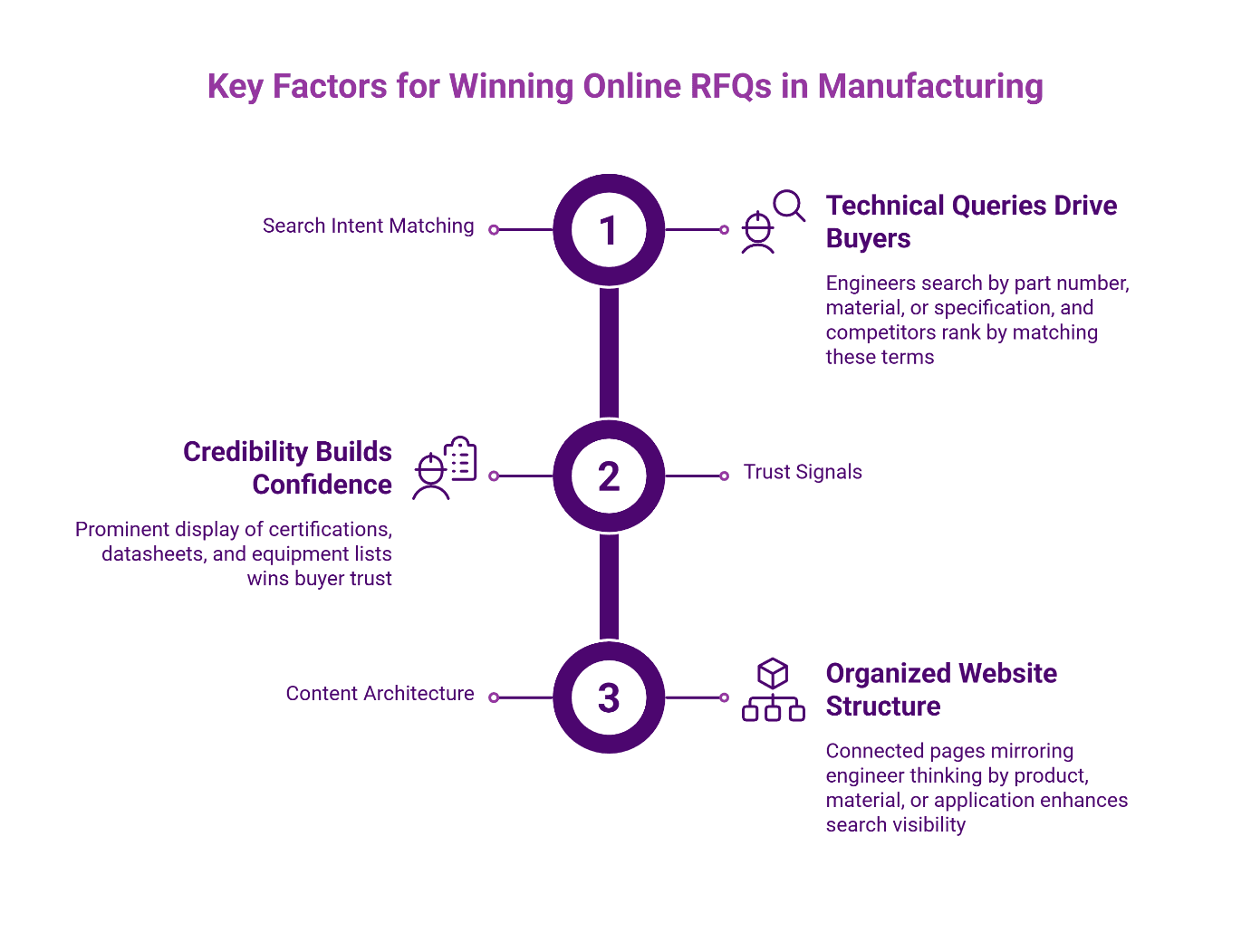
Engineers don't search for "best manufacturing company." They search by part number, material specification, tolerance, or application. Queries like "316L stainless CNC machining" or "AS9100 certified precision grinding" are how real buyers find suppliers.
Your competitors rank for these searches not because they're better manufacturers—but because they built pages that match this technical intent. Search engines rank pages based on how well they satisfy the query. If your page doesn't contain the vocabulary buyers use, it won't appear when those buyers search.
A practical way to organize this is Part/Spec/Application Intent Mapping: identifying which pages should exist (or be upgraded) so that part-focused searches land on part-focused pages, spec searches land on spec-ready pages, and application searches land on application pages.
They Signal Trust Faster
When an engineer lands on a page, they're scanning for proof: certifications displayed prominently, downloadable datasheets, equipment lists, industries served, typical lead times. Competitors who surface these trust signals immediately win credibility. If your page buries this information—or doesn't include it at all—buyers move on.
The important point isn't "add more content." It's surface the right proof in the right order, using language engineers and procurement professionals recognize.
They Built a Content Architecture While You Published Random Posts
"Content architecture" sounds technical, but it's simple: an organized set of connected pages tied to topics, entities, and the customer journey that makes it easy for Google (and buyers) to understand what you do. Think of it as your website mirroring how engineers think—by product line, by material, by specification, by application.
Competitors who built this structure rank for dozens of relevant searches. Companies that published random blog posts about 'lean manufacturing trends' attract informational traffic without purchase intent. When architecture is strong, a buyer can go from a high-level capability page to a specific spec/application page in two or three clicks, and each step reinforces trust.
A 15-Minute Visibility Gap Audit (Do This Today)
You don't need expensive tools to diagnose the problem. Set aside 15 minutes and run this quick audit.
Check 5 "RFQ Keywords" Your Buyers Would Actually Search
Open an incognito browser window. Search for five queries an engineer or procurement manager would use to find a company like yours. Think specifications, materials, certifications, applications—not your company name.
Who shows up? If it's your competitors on page one and you're nowhere to be found, you've identified the gap.
Open Your Top Product Page—Does It Pass the "Engineer Test"?
Pull up your most important service or product page and check:
- Are specifications, tolerances, and materials clearly listed?
- Are compliance certifications (ISO, AS9100, ITAR, etc.) visible?
- Are applications and use-cases explained?
- Is there a clear RFQ path—not just a generic "contact us" link?
If the answer to any of these is no, that page isn't doing its job.
Does Your Site Make It Easy to Understand What You Manufacture?
Can a visitor get from your homepage to a specific product or capability page in two or three clicks? Does your navigation mirror how buyers think—by product line, material, or application? If your site requires digging to find basic information, engineers will leave before they find it.
For foundational SEO best practices that apply across industries, the Google Search Central SEO Starter Guide provides a reliable reference point.
The 30-Day Visibility Sprint: Your First Fix
You don't need to overhaul everything at once. Here's a focused four-week plan using a SKU-first approach.
Week 1: Pick 5-10 High-Margin SKUs or Services
Don't boil the ocean. Choose the products or services where wins matter most—your highest-margin offerings or the capabilities that differentiate you. Work with Sales to define what a "qualified RFQ" looks like for these specific lines.
Week 2: Map Keywords by Part, Spec, and Application
For each priority SKU, list the searches buyers would use:
- Part-based: specific part numbers, component names
- Spec-based: tolerances, materials, compliance standards
- Application-based: industry use-cases, problem-solution pairs
This three-bucket approach matches how technical buyers actually search.
Week 3: Build 3-5 "Perfect Pages"
Create one page per high-intent keyword cluster. Each page needs: clear intent match (the page answers exactly what the searcher asked), proof (specs, certs, equipment, industries served), logical structure, and a direct RFQ path. This is what makes a page "perfect"—it works for both Google and the engineer reading it.
Week 4: Track What Matters (RFQs, Not Pageviews)
Set up conversion tracking (Goal/Event setup in GA4). While organic rankings take months to mature, you must verify now that your RFQ forms are correctly firing data events so you capture the first wave of traffic when it arrives.
For a deeper look at connecting SEO to qualified leads, see our guide on manufacturing SEO lead generation.
What to Tell Leadership: Visibility Is Infrastructure, Not Fluff
When you bring this to your CEO or CFO, skip the marketing jargon. Frame it in terms they care about:
- Market legitimacy: Buyers who can't find you online question whether you're a serious player.
- Digital real estate: Search visibility is shelf space. Competitors who own it capture demand you're missing.
- Capital efficiency: Visibility reduces wasted spend on traffic that doesn't convert.
- Market share protection: Every invisible RFQ is market share handed to a competitor.
- Predictable pipeline: Qualified RFQs from search create measurable, repeatable inputs for forecasting.
Visibility isn't a branding exercise. It's revenue defense.
Next Step: Get a Visibility Roadmap
You've diagnosed the problem. Now you have two paths forward.
If you want to learn more first: Explore our resources on manufacturing SEO and the frameworks that drive qualified RFQs—not vanity traffic.
If you're ready for a plan: Schedule your free strategy session. We'll identify your highest-value RFQ keywords, audit which pages need work first, and build a roadmap for tracking qualified leads—not pageviews.
Frequently Asked Questions
Disclaimer: This article provides general guidance on manufacturing SEO strategy. Results vary based on competitive landscape, current website status, and implementation quality.
Our Editorial Process
This article was written by the BVM Insights Team and reviewed by a strategist familiar with B2B and technical SEO. We avoid hype and focus on practical guidance you can apply. Where we reference third-party research, we link to original sources when available.
About the BVM Insights Team
BVM's Insights Team publishes practical, evidence-first guidance for industrial and technical B2B marketers. We specialize in SEO systems that drive qualified RFQs—not vanity traffic.

About the Author
Dustin Ogle
Dustin Ogle is the Founder and Head of Strategy at Brazos Valley Marketing. With over 9 years of experience as an SEO agency founder, he specializes in developing the advanced AI-driven strategies required to succeed in the new era of search.