
The Failure of Generic SEO: Why Manufacturers Need a Technical Search Strategy to Dominate
Last Updated: January 2026 • 12 min read
📌 Key Takeaways
Generic SEO fails manufacturers because it chases traffic volume instead of targeting the technical queries engineers actually use when building supplier shortlists.
- Traffic Without Trust Loses Deals: Ranking for broad terms means nothing if your pages lack the specifications, tolerances, and certifications technical buyers need to shortlist you.
- Engineers Search by Specs, Not Categories: Queries like "AS9100 titanium machining ±0.0005" signal real purchase intent—high-volume generic terms attract students and competitors instead.
- Structure Content Around Engineering Logic: Site architecture should mirror how buyers navigate—by application, material, and specification—not just product categories.
- Proof Assets Are Non-Negotiable: Downloadable datasheets, CAD models, and certification documents reduce buyer uncertainty faster than any marketing copy.
- Start With Five to Ten Priority SKUs: A focused pilot on high-margin products with clear technical differentiation proves ROI before scaling across your catalog.
Technical depth converts; generic visibility commoditizes.
Manufacturing marketers and industrial SEO strategists seeking to connect search visibility to qualified RFQs will find a practical framework here, preparing them for the detailed implementation guidance that follows.
The quarterly SEO report lands in your inbox. Rankings are up. Traffic increased 23%. The agency calls it a win.
But your RFQ inbox? Still quiet. The sales team is still chasing the same old referrals. And leadership is asking—again—what exactly marketing is contributing to pipeline.
That disconnect isn't a performance problem. It's a strategy mismatch. The SEO playbook your agency learned was built for e-commerce stores and lifestyle brands, not for companies selling precision-machined components to engineers who search by tolerance class and material grade.
Generic SEO optimizes for volume. Manufacturing buyers search for validation. And that gap is costing you deals you never knew existed.
A quick filter before going further: this guide is not built for bargain SEO, quick fixes, or traffic goals disconnected from qualified demand. The focus is technical intent, information structure, and credibility signals that help engineers and procurement confidently shortlist a supplier.
For a category-level overview of this approach, see Industrial & Manufacturing SEO.
Your SEO Was Designed for Simpler Buying Cycles
Most SEO strategies assume a relatively straightforward path: someone searches, lands on a page, and either buys or bounces. Maybe they sign up for a newsletter. The metrics are clean. The attribution is simple.
Manufacturing doesn't work that way.
When a procurement manager needs a supplier for API-certified gate valves, they aren't browsing. They're building a shortlist. They're cross-referencing specifications against project requirements. They're downloading datasheets to attach to internal approval documents. They're validating that you can meet tolerances before they ever fill out a contact form.
According to 6sense research, 69% of the B2B purchase process happens before buyers engage with sellers—and 81% have already chosen a preferred vendor before that first sales conversation.
In manufacturing, that research phase is even more technical. Engineers search for "AS9100 titanium machining ±0.0005" or "ITAR-compliant precision parts." They need proof of capability, not persuasion.
The Hidden Failure Mode: Visibility Without Confidence
Here's what generic SEO gets wrong: it assumes that ranking equals relevance.
You can rank on the first page for "CNC machining services" and still lose to a competitor who ranks lower—because that competitor's page showed the certifications, tolerances, and material capabilities the buyer actually needed to see.
Visibility without technical confidence is just noise. The buyer sees you, scans your page, doesn't find the proof they need, and moves on. Your analytics show a visit. Your pipeline shows nothing.
Five Ways Generic SEO Breaks in Manufacturing
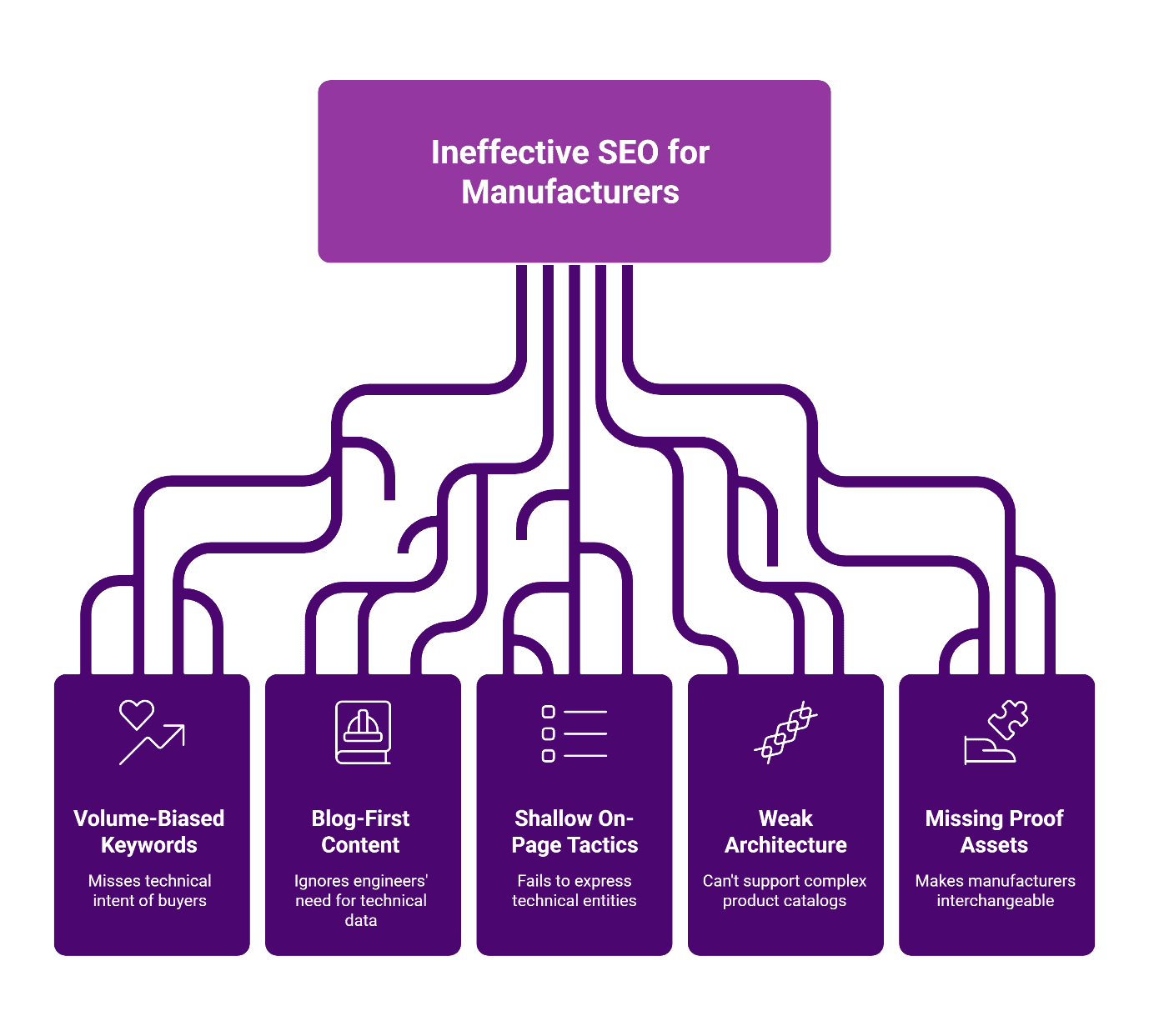
1. Volume-Biased Keyword Selection Misses Technical Intent
Traditional keyword research prioritizes search volume. The logic seems sound: more searches mean more opportunities.
But in manufacturing, the highest-volume terms are often the lowest-intent. "CNC machining" gets thousands of searches monthly. Most of those searchers are students, hobbyists, or competitors. The procurement engineer searching for "5-axis CNC machining aerospace aluminum 6061-T6" represents real revenue—but that query barely registers in standard keyword tools.
Generic SEO chases the crowd. Technical search strategy targets the buyer.
2. Blog-First Content Ignores What Engineers Actually Need
The standard content playbook says to publish blog posts. Build thought leadership. Create awareness.
Engineers don't need your awareness content. They need your spec sheets, application guides, and technical documentation. They need to know if you can hold ±0.001" on a 316 stainless steel housing. A blog post about "5 trends in precision manufacturing" doesn't answer that question.
When your content strategy prioritizes blogs over product and specification pages, you're optimizing for the wrong audience entirely.
3. Shallow On-Page Tactics Can't Express Technical Entities
Generic SEO treats on-page optimization as a checklist: title tag, meta description, H1, keyword density. Done.
But search engines—and buyers—need more than keywords to understand what you actually do. They need to see the relationships between your capabilities, the materials you work with, the standards you meet, and the applications you serve.
A page optimized for "precision machining" that doesn't mention specific tolerances, certifications, or material grades fails to communicate your technical authority. It looks interchangeable with every other machine shop claiming the same generic capabilities.
Clear, descriptive information architecture and precise terminology help both search systems and human evaluators. The Google SEO Starter Guide reinforces why structure and clarity matter at every step.
4. Weak Architecture Can't Support Complex Catalogs
Manufacturing companies often have hundreds or thousands of products, organized by material, process, industry, and application. Generic SEO treats site architecture as an afterthought—flatten everything, add some internal links, call it done.
That approach falls apart when buyers navigate by application ("hydraulic system components") rather than product category ("fittings"). It breaks when engineers need to cross-reference specifications across multiple product families. It fails when your site structure doesn't mirror how technical buyers actually think.
5. Missing Proof Assets Make You Interchangeable
The final breakdown: generic SEO doesn't account for trust signals that matter in technical sales.
Buyers want to download CAD models. They need ISO certificates. They look for test reports, material certifications, and technical datasheets. When these assets are missing—or buried—your site signals that you're not ready for serious technical evaluation.
Every missing download is a reason to move to the next supplier on the shortlist.
Consider a buyer searching for a specific material and tolerance combination. They click three suppliers. One site provides a clear spec table and a downloadable datasheet within seconds. That supplier reduces uncertainty faster and is more likely to make the shortlist. The other two sites offer vague capability statements and a contact form. Those suppliers become interchangeable commodities.
| Dimension | Generic SEO | Technical Search Strategy |
|---|---|---|
| Keyword Focus | High-volume category terms | Part/spec/application queries |
| Primary Pages | Blog posts and service overviews | Product, specification, and application pages |
| Content Depth | Surface-level descriptions | Technical entities: tolerances, materials, standards |
| Site Architecture | Flat or blog-centric | Catalog-aligned, cross-linked by application |
| Success Signals | Traffic, rankings | Technical engagement: downloads, RFQ quality |
| Risk | Attracts mixed intent | Builds high-fit shortlists |
What a Technical Search Strategy Actually Means
A technical search strategy for manufacturers is an SEO approach built around engineering intent—part numbers, specifications, tolerances, materials, and applications. Instead of chasing broad traffic, it structures pages and internal links so technical buyers can find proof fast and confidently add you to their shortlist.
This isn't about adding jargon to your pages. It's not synonymous with "technical SEO" in the crawling-and-indexing sense—though that foundation matters.
Technical does not mean dense. It means precise. A technical search strategy can still be readable at an eighth- to ninth-grade level while being deeply useful to technical buyers. The goal is clarity, not complexity.
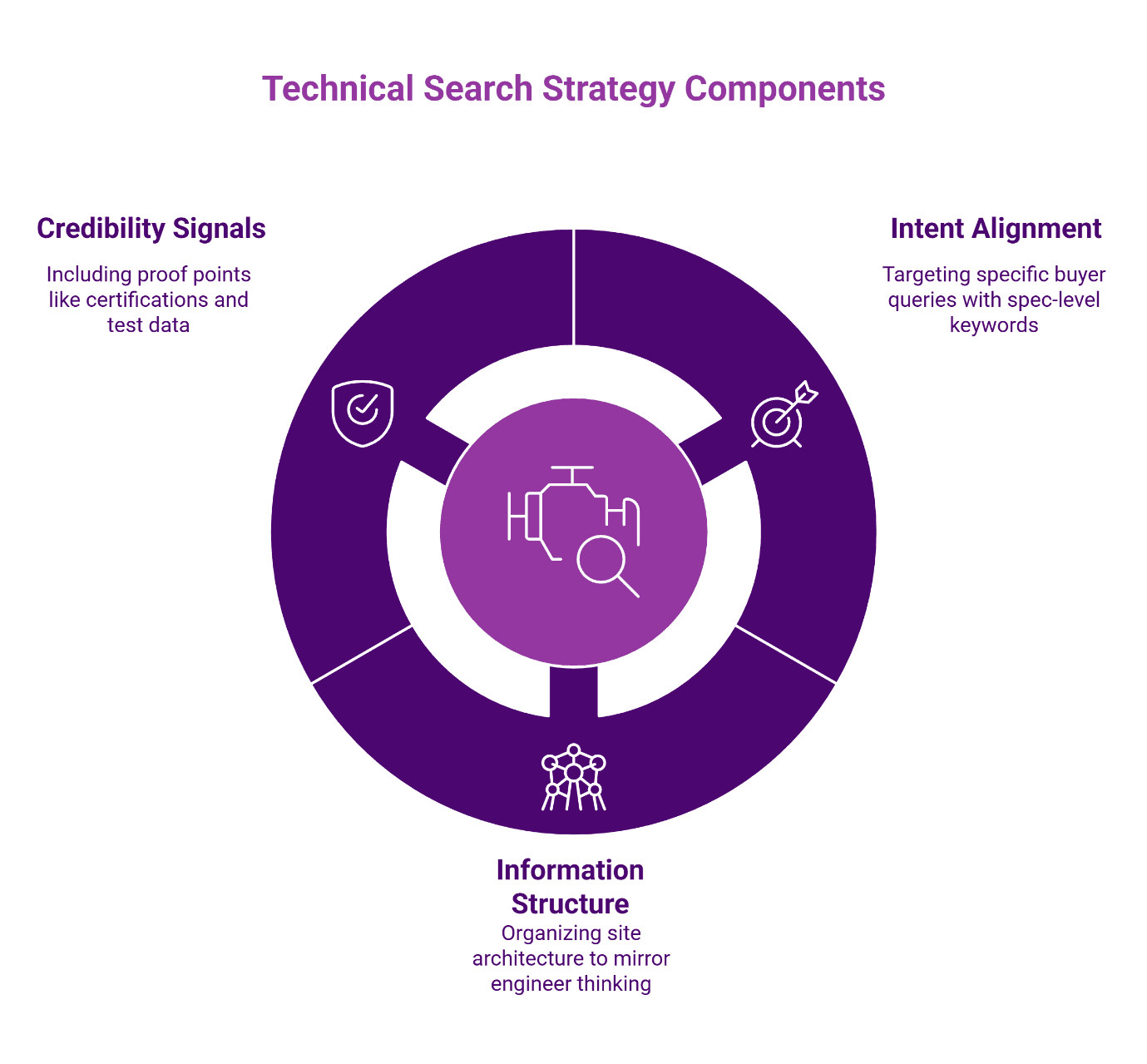
Technical search strategy has three components:
Intent alignment. Your pages target the specific queries buyers use when they're validating suppliers, not just researching categories. That means spec-level keywords, application-specific phrases, and comparison queries.
Information structure. Your site architecture mirrors how engineers think. Specifications connect to materials. Materials connect to applications. Applications connect to industries. Buyers can navigate by the path that matches their project requirements.
Credibility signals. Every page that matters includes the proof points technical buyers need: certifications, tolerances, downloadable assets, test data. These aren't nice-to-haves. They're the difference between consideration and dismissal.
This approach aligns with how Google understands and serves content: by recognizing entities and relationships, not just keywords.
Technical search strategy also needs to perform across classic search results and emerging AI answer experiences. That doesn't mean chasing hype or assuming guaranteed visibility. It means building clarity, structure, and evidence that can be interpreted consistently across search interfaces.
The Industrial Search Maturity Model
Where does your manufacturing company sit today? Most fall into one of three stages—and knowing your starting point clarifies what to fix next.
Stage 1: Invisible
Symptoms:
- Great engineering capabilities, minimal search visibility
- Competitors appear for searches you should own
- RFQs come almost exclusively from referrals and trade shows
What's missing:
- Pages targeting technical search queries
- Basic on-page optimization for capabilities you actually have
Next move: Audit your top 10 products or capabilities. Do dedicated pages exist? Do they mention specific tolerances, materials, and certifications? Start there.
Stage 2: Commodity
Symptoms:
- You rank for some industry terms, but traffic quality is mixed
- Visitors browse but don't engage with technical content
- RFQs include many unqualified requests outside your sweet spot
What's missing:
- Differentiation through technical depth
- Internal linking that guides buyers to relevant proof
Next move: Enhance your highest-traffic pages with specification details, downloadable assets, and application context. Filter for fit, not just visibility.
Stage 3: Market Leader
Symptoms:
- You own the searches that matter: spec-driven, application-specific queries
- Visitors download datasheets, request quotes, reference specific capabilities
- Sales reports that organic leads arrive better-informed and more qualified
What's missing:
- Potentially nothing major—focus shifts to defense and expansion
Next move: Protect your position with fresh content addressing emerging applications. Expand into adjacent technical territories.
Two-Minute Self-Diagnostic
Score yourself honestly:
- Do you have dedicated pages for your top 10 products or capabilities? (Yes = 1 point)
- Do those pages include specific tolerances, materials, and certifications? (Yes = 1 point)
- Can visitors download technical assets (datasheets, drawings, certificates) without contacting sales? (Yes = 1 point)
- Does your site architecture allow navigation by application or industry? (Yes = 1 point)
- Do your RFQs reference specific capabilities mentioned on your website? (Yes = 1 point)
- Do you rank on page one for at least three spec-level or application-specific queries? (Yes = 1 point)
0-2 points: Invisible stage. Start with foundational pages. 3-4 points: Commodity stage. Add depth and differentiation. 5-6 points: Market Leader trajectory. Defend and expand.
The Technical Search Stack: Pages, Architecture, and Proof
Building a technical search strategy requires three interconnected layers.
Page Types That Matter
Product and SKU pages serve buyers who know what they need. These pages should include specifications, materials, tolerances, and compliance information—not just marketing descriptions.
Specification pages aggregate products by technical attribute. A page for "tight-tolerance machining (±0.0005)" helps buyers who search by capability rather than product name.
Application pages connect capabilities to use cases. "Hydraulic system components" or "medical device housings" help buyers who think in terms of their project, not your catalog structure.
Industry pages address vertical-specific requirements. Aerospace buyers need AS9100 context. Medical device buyers need to see FDA compliance understanding. These pages build trust by demonstrating relevant experience.
Architecture That Mirrors Engineering Logic
Your internal linking should reflect how technical buyers navigate decisions.
Specification pages link to relevant products. Products link to applicable industries. Applications link back to the capabilities that serve them. This creates a web of relationships that both search engines and engineers can follow.
The goal isn't just crawlability—it's discoverability through multiple pathways that match different buyer starting points.
A practical method for mapping this intent and building a coherent structure is detailed in Part/Spec/Application Intent Mapping.
Proof as Foundation
Technical credibility requires visible evidence. Every capability claim should be backed by:
- Downloadable certifications and compliance documentation
- Technical datasheets with actual specifications
- CAD models or drawings where applicable
- Case studies with quantified outcomes
- Test reports and quality documentation
These assets serve dual purposes: they provide the proof buyers need to shortlist you, and they signal to search engines that your pages offer substantive technical value.
Structured data can help search engines interpret this content and enable enhanced presentation, but it cannot replace technical substance.
How to Start Without Boiling the Ocean
You don't need to rebuild your entire site to begin. A focused pilot proves the model and builds internal momentum.
Choose Five to Ten Priority Products
Select products or capabilities that meet three criteria:
- High margin or strategic importance — Changes here impact revenue meaningfully
- Clear technical differentiation — You have specifications worth highlighting
- Existing search demand — Buyers are actively looking for these capabilities
This approach—sometimes called SKU-first manufacturing SEO—concentrates effort where results will be most visible.
Map the Intent Landscape
For each priority product, identify the queries buyers actually use. Part/spec/application intent mapping categorizes searches by buyer mindset:
- Part queries: Buyers searching for specific components or part numbers
- Spec queries: Buyers searching by technical requirement (tolerance, material, standard)
- Application queries: Buyers searching by use case or industry context
Each query type requires different page content and structure.
Build Three to Five Perfect Pages First
Create comprehensive pages for your top-priority products. Each page should include:
- Complete technical specifications
- Materials and tolerance capabilities
- Relevant certifications and standards
- Downloadable assets (datasheets, drawings, certificates)
- Application context and industry relevance
- Clear paths to related capabilities
These pages become templates. Once the pattern proves results, you can scale systematically.
Governance: Keeping Content Technically Accurate Over Time
Technical content has a shelf life. Certifications expire. Capabilities evolve. New applications emerge. Without governance, even well-built pages drift into inaccuracy.
A Lightweight SME Review Workflow
You don't need engineers writing content. You need engineers validating it.
Establish a quarterly review cycle where subject matter experts verify technical accuracy on priority pages. Keep the ask small: "Is this still accurate? What's changed?" A 15-minute review prevents months of misleading information.
Definition of Done
Every technical page should meet four criteria before publishing—and during every review:
Accuracy: Specifications, tolerances, and capabilities reflect current reality.
Completeness: The page includes all proof points a technical buyer would need to shortlist you.
Findability: The page targets relevant queries and connects logically to related content.
Proof: Evidence is present, current, and easy to access.
If a page fails any criterion, it's not ready. The connection between technical search visibility and manufacturing SEO lead generation depends on content that buyers can trust.
Your competitors are building technical search visibility while you're still measuring success in traffic. Every month that passes, they're capturing the engineers and procurement managers who are actively building shortlists—shortlists you'll never appear on if your SEO strategy wasn't designed for technical buyers.
The gap between generic SEO and technical search strategy is the gap between visibility and pipeline. Between reports that look good and RFQs that actually close.
The frameworks exist. The approach is proven. The question is whether you'll adapt before your competitors lock in their position.
Explore the resources and frameworks that turn technical intent into findable, qualified opportunities: browse the complete resource library.
For additional context on our approach and credibility standards, visit About BVM.
Disclaimer: This content provides general strategic guidance for manufacturing marketing professionals. Specific SEO outcomes depend on competitive landscape, existing website infrastructure, and implementation quality. Organizations should evaluate recommendations against their unique business context.
Our Editorial Process
Our content is written by experienced SEO strategists with deep expertise in B2B and service-based marketing. We never outsource to content mills or publish generic, surface-level advice. Every article is built to help business leaders make confident, informed decisions—based on strategy, not hype.
About the BVM Insights Team
The BVM Insights Team is a group of SEO strategists and content specialists focused on helping service-based businesses grow with clear, evidence-driven search strategy. We publish practical guidance based on real campaign experience and current best practices.

About the Author
Dustin Ogle
Dustin Ogle is the Founder and Head of Strategy at Brazos Valley Marketing. With over 9 years of experience as an SEO agency founder, he specializes in developing the advanced AI-driven strategies required to succeed in the new era of search.