The End of the Cold Call: How Inbound RFQs Change Manufacturing Sales
Last Updated: January 2026 • 12 min read
📌 Key Takeaways
Inbound RFQs arrive pre-qualified with specifications, quantities, and compliance questions—transforming sales conversations from pitches into constraint-solving sessions.
- Self-Directed Buyers Complete Research First: Engineers and procurement officers finish over half their purchase decision before contacting any vendor, making interruption-based selling increasingly ineffective.
- Technical Content Attracts High-Intent Leads: Pages optimized for constraint-based searches like "AS9100 titanium machining ±0.0005" generate RFQs with specifications, MOQs, and application details already defined.
- Speed-to-Quote Becomes Competitive Advantage: Firms responding within one hour are nearly seven times more likely to qualify leads than those waiting longer.
- Start with 5–10 High-Margin SKUs: A focused 90-day pilot on your strongest product lines proves ROI and earns internal buy-in before expanding your inbound strategy.
Inbound RFQs make cold calling optional, not obsolete.
Manufacturing sales leaders transitioning to digital-first pipelines will find a complete 90-day implementation framework below, setting up the operational playbook that follows.
Three RFQs. Before your second coffee. Each one includes the exact spec, the target MOQ, and a compliance question that proves they've already read your capabilities page.
This is what happens when your website works like a sales engineer—qualifying buyers around the clock while your actual sales engineers focus on solving problems instead of chasing strangers.
An inbound RFQ, in manufacturing terms, is a buyer-initiated request for quotation that arrives after the prospect discovers your company through search and technical content. These requests typically include part specifications, application constraints, and qualification signals like prints, compliance questions, quantity, and timing. The contrast with cold calling—seller-initiated outreach to prospects who may not have an active requirement—could not be sharper.
Yet most manufacturers still build their pipeline the hard way. Talented engineers spend hours dialing into voicemail. Gatekeepers block access. Spam filters eat carefully crafted emails. And somewhere out there, a less capable competitor wins the contract because they showed up in the search results when the buyer was ready.
The shift from cold outreach to inbound RFQs changes everything: shorter sales cycles, clearer requirements from day one, and conversations that start with collaboration instead of a pitch.
Why Cold Calling Is Losing Its Edge in Manufacturing
Cold calling worked when buyers had fewer options and less information. That dynamic has inverted.
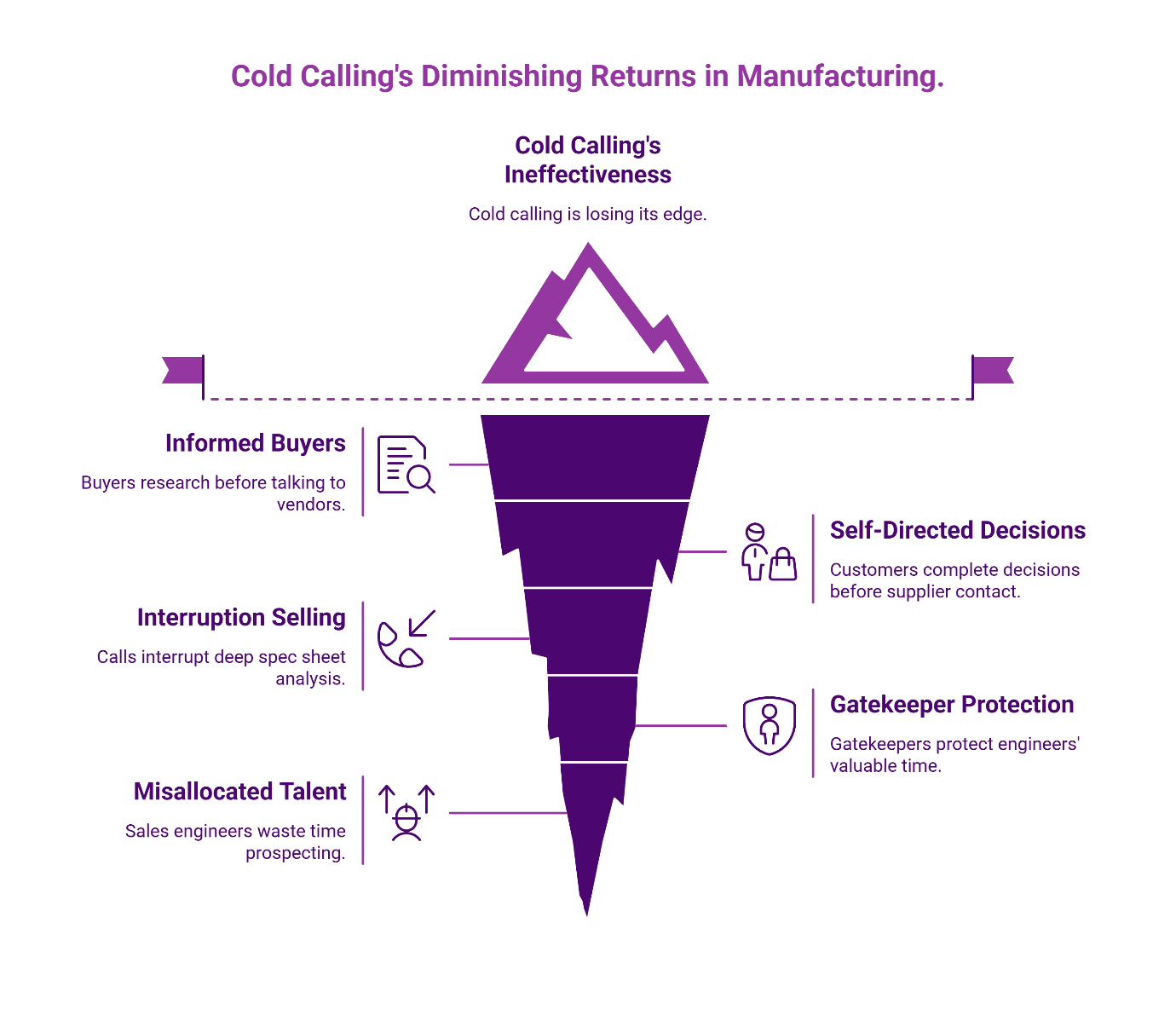
Today's engineers and procurement officers do their homework before they ever talk to a vendor. Research from Gartner shows that B2B buyers spend only 17% of their total purchase journey meeting with potential suppliers—and when multiple vendors are involved, each rep gets a sliver of that time. A widely cited CEB study published via Think with Google found that customers complete more than half of the purchase decision process before engaging a supplier representative.
The exact percentages vary by study and industry segment. Forrester has cautioned that popular percentage soundbites are frequently misinterpreted. Still, the practical implication holds: the first real conversation often happens after requirements are already taking shape.
Interruption selling collides with this self-directed behavior. Your call arrives while they're deep in a spec sheet from your competitor. Your email lands in a folder they'll never open. The gatekeeper you're trying to charm has explicit instructions to protect their engineers' time.
And here's the hidden cost most manufacturers miss: your highest-paid talent—the sales engineers who can actually solve complex problems—spend their days prospecting instead of closing. That's an expensive misallocation. Activity looks busy, but it doesn't reliably produce qualified opportunities.
| Factor | Cold Calling | Inbound RFQs |
|---|---|---|
| Buyer intent | Unknown/low | High (self-selected) |
| Data quality | Minimal context | Specs, MOQ, application details |
| Sales cycle | Extended discovery | Requirements pre-clarified |
| Sales effort | High per opportunity | Focused on qualified leads |
| Close rate | Lower | Higher |
What an Inbound RFQ Looks Like (and Why It Closes Differently)
The signals are unmistakable. They're asking about tolerances for a specific alloy. They want to know your certifications for aerospace applications. They've downloaded your CAD files and are asking about lead times for quantities that match their production schedule.
These aren't tire-kickers. They've already shortlisted you based on evidence.
High-intent signals that typically travel with inbound RFQs include part, spec, and application language that puts constraints first. Print and CAD requests or detailed drawings. Compliance and certification questions. Quantity, MOQ fit, and timing clarity. Lead time alignment and packaging or handling constraints. When these elements arrive together, qualification becomes straightforward.
Inbound RFQs close differently because the fit is clearer before anyone picks up the phone. The buyer knows what they need. They've seen your capabilities. The first conversation becomes constraint mapping—not convincing them you're worth their time.
Deal values often run higher too. When buyers self-select based on technical fit rather than price alone, you're competing on capability instead of commodity.
The Bridge: From Pitching to Consulting
Inbound leads expect a different conversation. They've done research. They have specific questions. Walking them through a standard pitch deck wastes their time and yours.
This requires a cultural shift. Sales moves from "pitcher" back to "sales engineer"—consultative by default. The first response isn't a capabilities overview; it's a discovery call that confirms specs, clarifies application constraints, and identifies any gaps in the requirements.
The key to making this work across your organization is a Lead Quality Definition. Marketing and Sales need to agree on what constitutes a qualified inbound RFQ versus noise. Without this alignment, marketing celebrates form submissions while sales complains about lead quality. A Lead Quality Definition is a short, shared standard that says what counts as a qualified RFQ in plain operational terms. It should include minimum technical information required (spec, application, material), minimum commercial viability (quantity and timeline fit), and clear disqualifiers—segments or requirements that consistently fail to convert.
This shifts the organization away from vanity numbers and toward transparent measurement that Sales and Finance can defend.
Structured approaches like Deep Content Architecture™ and Perfect Page Blueprint™ help operationalize technical buyer intent without turning content into a sales pitch. The goal is pages that do the work of qualification before your team ever responds.
Build the Inbound RFQ Engine (Start with a 90-Day Pilot)
You don't need to overhaul everything at once. A focused pilot proves the concept and earns internal buy-in.
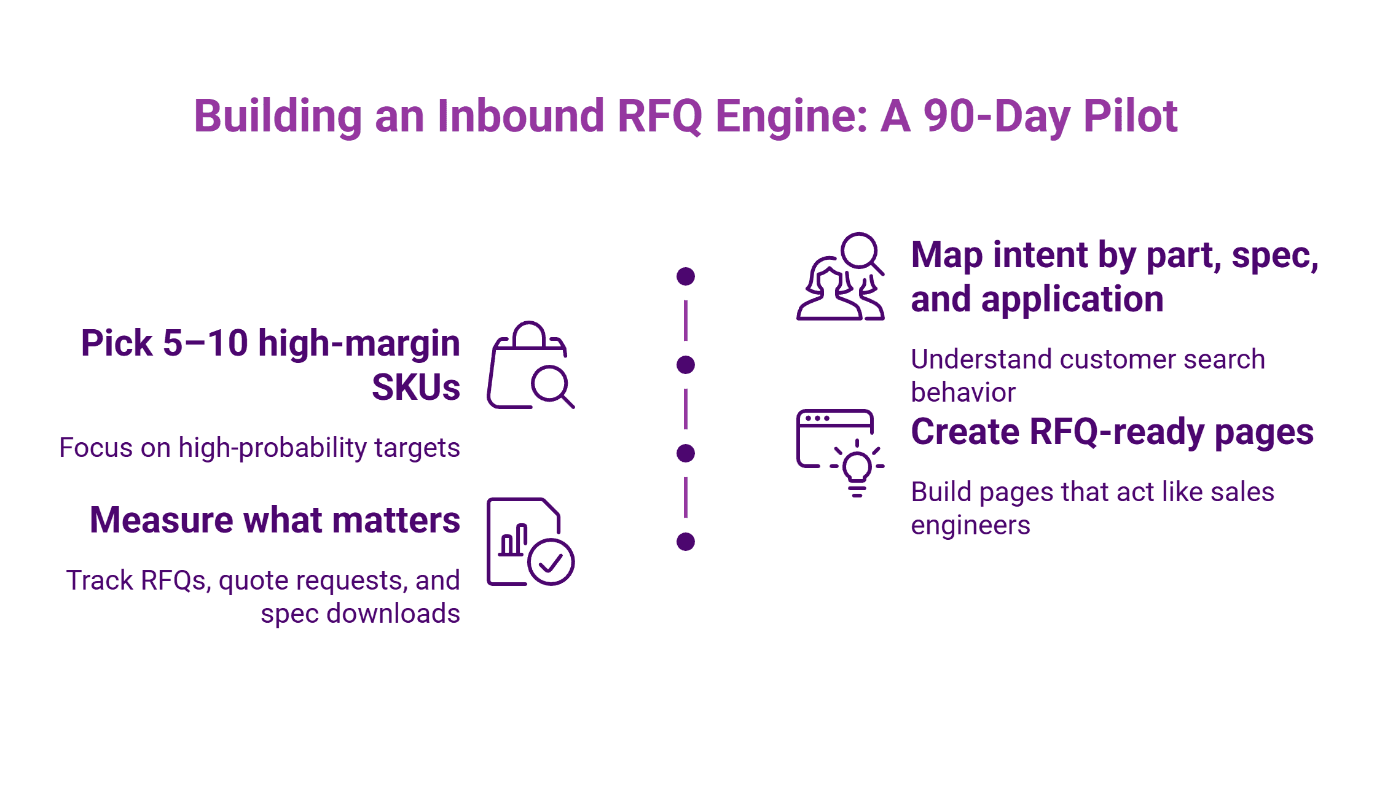
Map intent by part, spec, and application. Engineers don't search like consumers. They search by constraints: "AS9100 titanium machining ±0.0005" or "FDA-compliant injection molding medical devices." Your content strategy starts with understanding how your best customers search. The Part/Spec/Application Intent Mapping framework helps structure this research.
Pick 5–10 high-margin SKUs. Focus on high-probability targets first. Select product lines where you have clear competitive advantage and healthy margins. This is the SKU-First Manufacturing SEO approach—prove ROI on a focused set before expanding.
Create RFQ-ready pages. Each priority product needs a page that does the work of a sales engineer: specifications and tolerances, application use cases, relevant certifications, trust signals like case examples, and a clear path to request a quote. Remove friction wherever possible.
Measure what matters. Track RFQs, quote requests, and spec downloads—not pageviews. Connect these to your CRM so you can trace revenue back to content. This is manufacturing SEO lead generation done right: attribution tied to pipeline, not vanity metrics.
Sales Culture Shift Guide: 3 Tips to Help Outbound Teams Win with Inbound
Transitioning from cold outreach to inbound requires more than new lead sources. Your sales process needs adjustment too.
Replace the pitch with a first-response discovery script. When an inbound RFQ arrives, the first call isn't about your capabilities—they've already reviewed those. Instead, confirm what you know: "I see you're looking for [spec] with [MOQ] for [application]. Walk me through the constraints we should know about." Ask one fit-risk question that surfaces real concerns: environment, load conditions, temperature range, duty cycle, or tolerance stack-up. This positions your rep as a problem-solver from the first interaction.
Set a speed-to-quote SLA. Response time matters. Foundational research published in the Harvard Business Review established that firms contacting leads within an hour were nearly seven times more likely to qualify the lead than those waiting even an hour longer—a benchmark that has only tightened with the rise of real-time digital expectations. Define clear ownership: who responds, within what timeframe, and what happens if that window is missed.
Build a closed-loop feedback routine. Track which RFQs converted to quotes, which quotes became orders, and why deals were lost. Feed this intelligence back to marketing. If certain search terms generate high-volume but low-quality leads, adjust the content strategy. If a specific application drives strong close rates, double down. This turns inbound into a learning system instead of a random feed.
Common Questions About Inbound RFQs
The easiest cold call is the one you never have to make.
When your website attracts engineers searching for exactly what you manufacture—complete with specs, certifications, and application context—your pipeline becomes more predictable. Sales conversations start further along. Close rates improve. Your best technical talent spends time solving problems instead of hunting for opportunities.
This isn't about abandoning outbound entirely. It's about building a foundation where inbound RFQs carry the load, and cold outreach becomes a strategic choice rather than a daily grind.
Start with a 90-day pilot. Pick your strongest SKUs. Align Sales and Marketing around a shared definition of quality. Measure RFQs and revenue, not traffic.
Disclaimer: This content is provided for informational and educational purposes. Results vary based on industry, competition, and implementation. We recommend consulting with a qualified marketing professional to assess your specific situation.
Our Editorial Process: Our editorial process includes research and expert review to ensure accuracy and usefulness. We prioritize clear, actionable guidance that helps readers make confident decisions. Content is reviewed for clarity, relevance, and alignment with current best practices.
Written by the BVM Insights Team
The Insights Team is our dedicated engine for research and insights, exploring emerging trends, analyzing industry best practices, and translating complex topics into clear, actionable strategies. Our work is guided by editorial standards that prioritize accuracy, usefulness, and real-world impact.

About the Author
Dustin Ogle
Dustin Ogle is the Founder and Head of Strategy at Brazos Valley Marketing. With over 9 years of experience as an SEO agency founder, he specializes in developing the advanced AI-driven strategies required to succeed in the new era of search.