
Stop Marketing Fluff: How to Use Governance Workflows to Prevent Intent Drift
Last Updated: January 2026 • 12 min read
📌 Key Takeaways
Technical content loses credibility—and RFQs—when specs drift from reality, making governance essential for manufacturing marketing.
- Define Intent Before Writing: An intent contract specifying audience, success action, and core question prevents drift at the source by giving writers a clear spec sheet for content itself.
- Build a Source-of-Truth Pack: A single reference document containing verified specs, compliance requirements, and approved claims ensures writers never fill gaps with unverifiable marketing language.
- Risk-Tier Your Review Process: High-risk content like product pages needs full SME review, while blog posts can move through fast-lane approval—maintaining speed without exposing credibility.
- Track Buying Signals, Not Vanity Metrics: Spec sheet downloads and RFQ submissions reveal whether content attracts real buyers; page views alone mask drift until pipeline damage is done.
- Schedule Quarterly Content QA: Specs change and standards update, so reviewing high-traffic technical pages every quarter prevents the slow decay that kills performance over long sales cycles.
Governance is quality control for credibility—treat content like you treat parts.
Manufacturing marketers managing technical content portfolios will gain a practical seven-step framework here, preparing them for the 30-day implementation checklist that follows.
The draft looked ready. Three rounds of edits, approved by the content lead, scheduled to publish in two hours. Then your sales engineer replies to the preview link: "This tolerance spec is wrong. We don't machine to ±0.005—we do ±0.001. If a procurement officer sees this before our call tomorrow, we're done."
The typo gets fixed. But the real damage runs deeper than one number. Every time technical content drifts from reality, engineers notice. Procurement officers notice. And your RFQ pipeline quietly shrinks while you wonder why traffic isn't converting.
This is intent drift. And it happens to good teams all the time.
The solution is a governance workflow that treats content like quality control—not endless debate. Define the intent contract, build a source of truth, assign clear roles, draft with guardrails, run tiered reviews, publish with intent signals, and audit quarterly. That seven-step system, with roles, review gates, and a checklist, keeps technical content aligned to buyer intent even when you're publishing at speed.
What Intent Drift Looks Like in Manufacturing Marketing
Intent drift rarely happens overnight. It's a slow slide.
Your application-focused product pages gradually become vague, benefit-heavy copy that "sounds good" but says nothing an engineer can verify. Spec sheets get simplified for readability until they no longer contain the specs. Case studies become success stories stripped of the technical details that made them credible.
The early warning signs are subtle:
- Spec sheet downloads drop while page visits stay flat
- Inbound inquiries shift from qualified buyers to students and DIY hobbyists
- Sales starts pushing back: "This isn't what we do" or "Where did this number come from?"
- Your RFQ-to-close rate declines even as lead volume stays constant
Engineers and procurement officers punish fluff because their jobs depend on accuracy. When they're evaluating vendors for a $200,000 precision machining contract, they need tolerance specs, material certifications, and application compatibility—not "industry-leading quality" and "best-in-class service."
Content that fails this test doesn't just bounce visitors. It actively damages your credibility with the exact buyers you need.
Why Intent Drift Happens (Even With a Good Team)
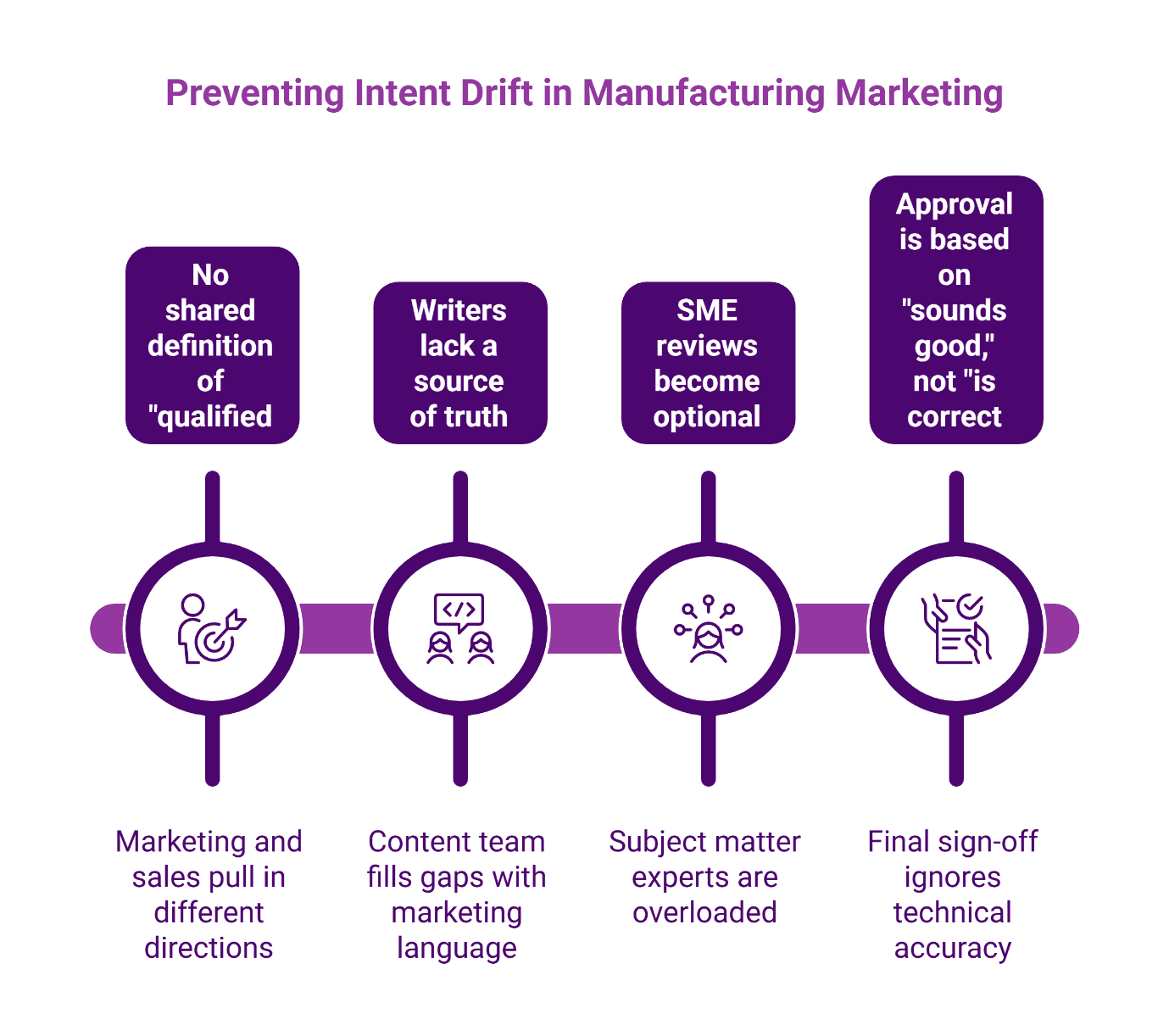
Nobody sets out to publish inaccurate content. Drift creeps in through four gaps that most teams don't notice until the damage is done.
No shared definition of "qualified." Marketing optimizes for traffic and form fills. Sales wants buyers ready to discuss specs. Without a shared definition of what makes content successful, each team pulls in different directions.
Writers lack a source of truth. Your content team is talented, but they're not metallurgical engineers. Without a curated pack of verified specs, standards, and approved claims, they fill gaps with marketing language that sounds right but isn't verifiable.
SME reviews become optional. Your subject matter experts are overloaded. They're running production, solving customer problems, and quoting jobs. Content review falls to the bottom of the list—until something embarrassing goes live.
Approval is based on "sounds good," not "is correct." Final sign-off happens based on tone, grammar, and brand alignment. Nobody is explicitly checking whether the technical claims would survive scrutiny from a buyer who actually knows the domain.
The part/spec/application intent mapping framework can help you identify where these gaps create the biggest exposure in your content portfolio.
The 7-Step Governance Workflow That Prevents Drift
Think of this as quality control for content. The same way you wouldn't ship a machined part without inspection, you shouldn't publish technical content without verification gates. Governance works best when it's treated like inspection—not debate. The goal is fewer "opinions-only" edits and more verification against a defined source of truth.
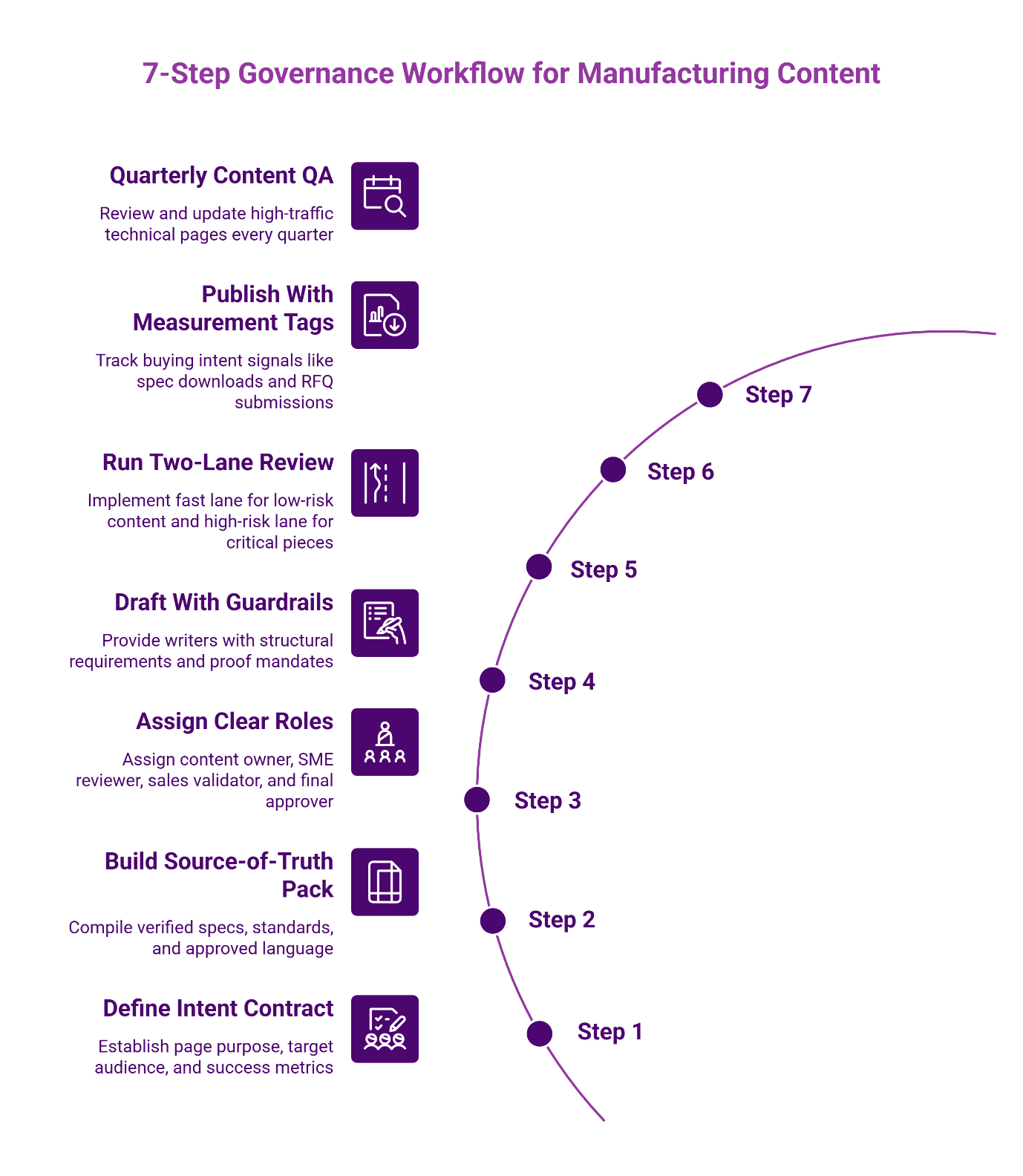
Step 1: Define the Intent Contract
Before any content gets written, answer three questions in writing:
- Who is this page for? (Job role, buying stage, technical sophistication)
- What action proves the page worked? (Spec download, RFQ submission, application configurator use)
- What question does this page answer better than any alternative?
This intent contract becomes the spec sheet for the content itself. Every draft gets evaluated against it.
Step 2: Build a One-Page Source-of-Truth Pack
Create a single document for each content piece that contains:
- Verified specifications (tolerances, materials, certifications)
- Standards and compliance requirements (ISO 9001, AS9100, ITAR registration)
- Approved claims and language (what you can say, what you can't)
- Competitor differentiation points that are factually defensible
This pack is the writer's reference. If it's not in the pack, it doesn't go in the content. If a claim cannot be traced to a controlled source, it should not ship.
Step 3: Assign Clear Roles
Four roles, clearly assigned:
- Content Owner: Responsible for the piece meeting its intent contract
- SME Reviewer: Verifies technical accuracy (tolerance specs, process descriptions, application claims)
- Sales Validator: Confirms the page helps—not hurts—active sales conversations
- Final Approver: Signs off that all gates passed before publish
One person can hold multiple roles on low-risk content. High-risk content (new product launches, compliance-heavy pages) needs separation. Decision rights must be explicit. Governance fails when everyone can veto and no one can decide.
Step 4: Draft With Guardrails
Give writers structural requirements, not just topics:
- Required sections (problem, solution, specs, proof)
- Proof requirements (every claim needs a source-of-truth reference)
- Explicit "no filler" policy (cut any sentence that doesn't help a buyer decide)
This prevents drift at the source. Writers know what's expected before they start.
Step 5: Run a Two-Lane Review
Not all content carries equal risk. Create two review paths:
- Fast lane: Blog posts, general industry content, culture pieces. Content owner reviews, spot-check SME sampling, publish within 48 hours.
- High-risk lane: Product pages, spec sheets, application guides, anything with compliance implications. Full SME review, sales validation, minimum 5-day cycle.
Risk-tiering lets you maintain publishing velocity without exposing your credibility on the content that matters most.
Step 6: Publish With Measurement Tags
Track signals that indicate real buying intent, not vanity metrics:
- Spec sheet downloads (not page views)
- RFQ submissions from the page (not total form fills)
- Time on page for technical sections (not overall session duration)
- Return visits from the same company domain
These signals tell you whether the content is attracting engineers doing real evaluation or students doing homework.
Step 7: Quarterly Content QA
Specs change. Standards update. Products evolve. Content that was accurate 18 months ago may be misleading today.
Every quarter, review your highest-traffic technical pages:
- Verify specs still match current capabilities
- Check that standards references are current
- Prune any claims that are no longer defensible
- Update measurement tags if conversion actions have changed
This prevents the slow decay that kills performance over long sales cycles. When your content stays accurate, it keeps working for years.
How to Scale Governance Without Slowing Output
The objection you're already thinking: "This sounds like bureaucracy. We'll never publish anything."
Here's how to make governance fast:
- Risk-tier everything. Typically, a focused segment of your content—often estimated at 20-30%—needs the full high-risk workflow. Culture posts, industry news roundups, and general thought leadership can move through fast-lane review.
- SME office hours, not ad-hoc requests. Block 90 minutes weekly for SME content review. Writers batch their questions. SMEs protect their focus time the rest of the week.
- Sampling, not line-by-line. For low-risk content, SMEs review a representative sample (2-3 pieces per month) rather than every piece. Patterns emerge quickly.
- Governance board cadence. A 30-minute weekly sync between content, sales, and one SME representative. Review what's publishing, flag issues early, course-correct before problems go live.
The SKU-first prioritization approach can help you identify which content pieces deserve high-risk treatment and which can move through faster review.
Manufacturing Content Governance Checklist
Before any technical content publishes, verify:
Technical Accuracy
- Is every specification tied to a source-of-truth document?
- Would an engineer agree this is accurate without caveats?
- Are all standards references current and correctly cited?
- Are internal terms consistent with published datasheets and product naming?
Buyer Alignment
- Does this page answer a question a real buyer would ask?
- Is there a clear next action tied to buying intent (spec download, RFQ, configurator)?
- Does this attract qualified RFQs—or student/DIY traffic?
- Does the page avoid attracting low-intent audiences unrelated to buying?
Sales Compatibility
- Would Sales use this page in an active deal?
- Does any claim conflict with what Sales tells customers directly?
- Are competitive differentiation points factually defensible?
Publish Decision
- Score 10-11 yes: Publish
- Score 7-9 yes: Revise and re-review
- Score below 7: Escalate to SME before proceeding
Common Objections (and Fixes That Work)
"Our SMEs don't have time."
They don't have time for ad-hoc interruptions. They do have time for 90 minutes of blocked, predictable review each week. The batch-and-protect model works because it respects their real constraints. SMEs should verify, not rewrite. A strong source-of-truth pack plus a structured checklist turns review into quick validation.
"We'll lose speed."
You'll lose speed on high-risk content. That's intentional. The alternative—publishing inaccurate specs—costs more in credibility repair and lost deals than a few extra days of review.
"Sales and marketing never agree."
The intent contract forces alignment upfront. When both teams sign off on "who is this for" and "what action proves success" before writing starts, disagreements at the end disappear.
30-Day Rollout Plan
Week 1: Foundation. Pick 5 priority pages (highest traffic, highest sales impact). Define the intent contract for each. Identify which need high-risk vs. fast-lane treatment.
Week 2: Build the System. Create source-of-truth packs for the 5 priority pages. Map roles and assign owners. Set up the SME office hours block.
Week 3: Pilot. Run 2 content pieces through the full workflow. Document friction points. Adjust the checklist based on what you learn.
Week 4: Install the Rhythm. Launch the 30-minute weekly governance sync. Set up quarterly QA calendar. Track lead quality signals (RFQ source, spec downloads) to measure impact.
If your pipeline feels stalled despite steady content output, governance gaps are often the hidden cause. For additional process guides, the Resources library provides related frameworks.
Frequently Asked Questions
Governance isn't bureaucracy. It's quality control for the content that represents your capabilities to engineers and procurement officers who can spot fluff from across the room.
The workflow here works because it respects real constraints: SMEs are busy, speed matters, and not all content carries equal risk. Start with 5 pages, install the rhythm, and measure what changes in your RFQ quality.
If you're ready to build content systems that survive technical scrutiny, explore how we approach this challenge.
Our expert team uses AI tools to support research, outlining, and drafting. Every article is fact-checked, edited, and refined by a human strategist to ensure accuracy, clarity, and usefulness.
By: BVM Insights Team
The BVM team helps technical and industrial companies build search visibility that holds up under real buyer scrutiny—by focusing on intent, accuracy, and measurable lead quality (RFQs), not vanity metrics.

About the Author
BVM Insights Team
The BVM team helps technical and industrial companies build search visibility that holds up under real buyer scrutiny—by focusing on intent, accuracy, and measurable lead quality (RFQs), not vanity metrics.