
SKU-First Manufacturing SEO: How to Prioritize Product Lines for Fast RFQ Wins
Last Updated: January 2026 • 12 min read
📌 Key Takeaways
Optimizing your entire manufacturing catalog at once dilutes effort and delays results—start with 5–10 high-priority SKUs to prove ROI fast.
- Focus Beats Breadth: Concentrating SEO resources on a small pilot of priority products creates visible wins that earn internal buy-in for expansion.
- Match How Engineers Search: Technical buyers search by part number, material specs, tolerances, and applications—not generic category terms—so pages must mirror that language.
- Prioritize by Demand and Strategy: Score candidates using both measurable demand signals and internal strategic value to identify SKUs worth optimizing first.
- Build Pages That Pass Engineer Scrutiny: Spec tables, certifications, CAD downloads, and application guidance establish the technical credibility required to convert RFQ requests.
- Scale Through Repeatable Systems: Document templates, governance workflows, and CRM-attributed tracking transform a successful pilot into a catalog-wide program.
Focused pilots win quotes; scattered optimization wins nothing.
Manufacturing marketers and industrial marketing teams seeking qualified RFQs from technical buyers will find a clear prioritization framework here, preparing them for the detailed implementation steps that follow.
The spreadsheet is open. Twelve hundred SKUs. The cursor blinks.
You scroll past valve assemblies, past the fastener variations, past three pages of custom brackets—and the question settles in: Where do we even start? Leadership wants organic visibility. Sales wants more qualified RFQs. And the catalog sits there, massive and indifferent, daring you to optimize it all at once.
Here's the uncomfortable truth most SEO advice ignores: you can't. Not with a manufacturing catalog. Not with the resources you actually have. Trying to optimize everything simultaneously spreads effort so thin that nothing becomes definitive—and nothing ranks.
But there's a different path. SKU-first manufacturing SEO flips the script: instead of boiling the ocean, you select 5–10 priority product lines, map the specific ways engineers and procurement officers search for them, and build pages with enough technical credibility to win both the click and the quote request. The rest of the catalog waits its turn.
Why "Optimize the Whole Catalog" Fails in Manufacturing
The instinct makes sense: more pages optimized means more chances to rank. In reality, breadth-first SEO creates three compounding problems that bury manufacturing companies.
The dilution problem. When you have 47 variations of the same fitting—each with a thin product page—Google struggles to identify which page deserves to rank. Your own pages compete against each other. None becomes the definitive answer. Meanwhile, a competitor with one comprehensive page for that product family captures the traffic you split across dozens.
The intent mismatch problem. Engineering buyers and procurement officers don't search like consumers. They search by part number, by material and tolerance combination, by compliance standard, by application. Generic category pages built around broad keywords miss these high-intent moments entirely. The buyer searching "316 stainless ball valve 1500 PSI API 607" isn't browsing—they're specifying. If your page doesn't speak that language, you're invisible at the exact moment that matters.
The organizational patience problem. Complex manufacturing or capital equipment sales cycles often run 6 to 18 months, though MRO (maintenance, repair, and operations) cycles can be significantly shorter. SEO compounds over time, but leadership often expects visible progress in quarters, not years. When you optimize everything at a surface level, early wins stay invisible. Stakeholders lose confidence. Budgets get questioned. The channel gets abandoned before it has a chance to mature.
A focused pilot solves all three: it concentrates effort where results are most likely, matches the specific intent patterns of technical buyers, and creates visible momentum that earns the internal buy-in to expand.
What SKU-First SEO Is (and What It Isn't)
SKU-first SEO is a sequencing strategy, not a limitation. You start with your highest-priority products—the ones where technical differentiation, margin potential, and buyer intent align—and build pages that can withstand the scrutiny of an engineer evaluating suppliers.
What it is:
- A focused pilot of 5–10 SKUs or product lines
- Pages built to match how technical buyers actually search (part numbers, specs, applications, compliance requirements)
- A repeatable system that scales to the rest of the catalog once the pilot proves out
- Infrastructure you're building in modules, starting with the modules that matter most
What it isn't:
- A traffic hack or shortcut
- "Narrow marketing" that ignores the rest of your catalog
- A one-time project with no path forward
This approach aligns with what we call the Perfect Page Blueprint—a methodology for building pages that satisfy both search engines and the technical buyers who land on them. Every element serves a purpose: clear specs, proper schema markup, logical hierarchy, conversion paths that mirror how engineers request quotes.
Step-by-Step: How to Pick Your First 10 SKUs
This is where SKU-first SEO becomes operational. Follow these five steps to identify the products that deserve your focused attention first.
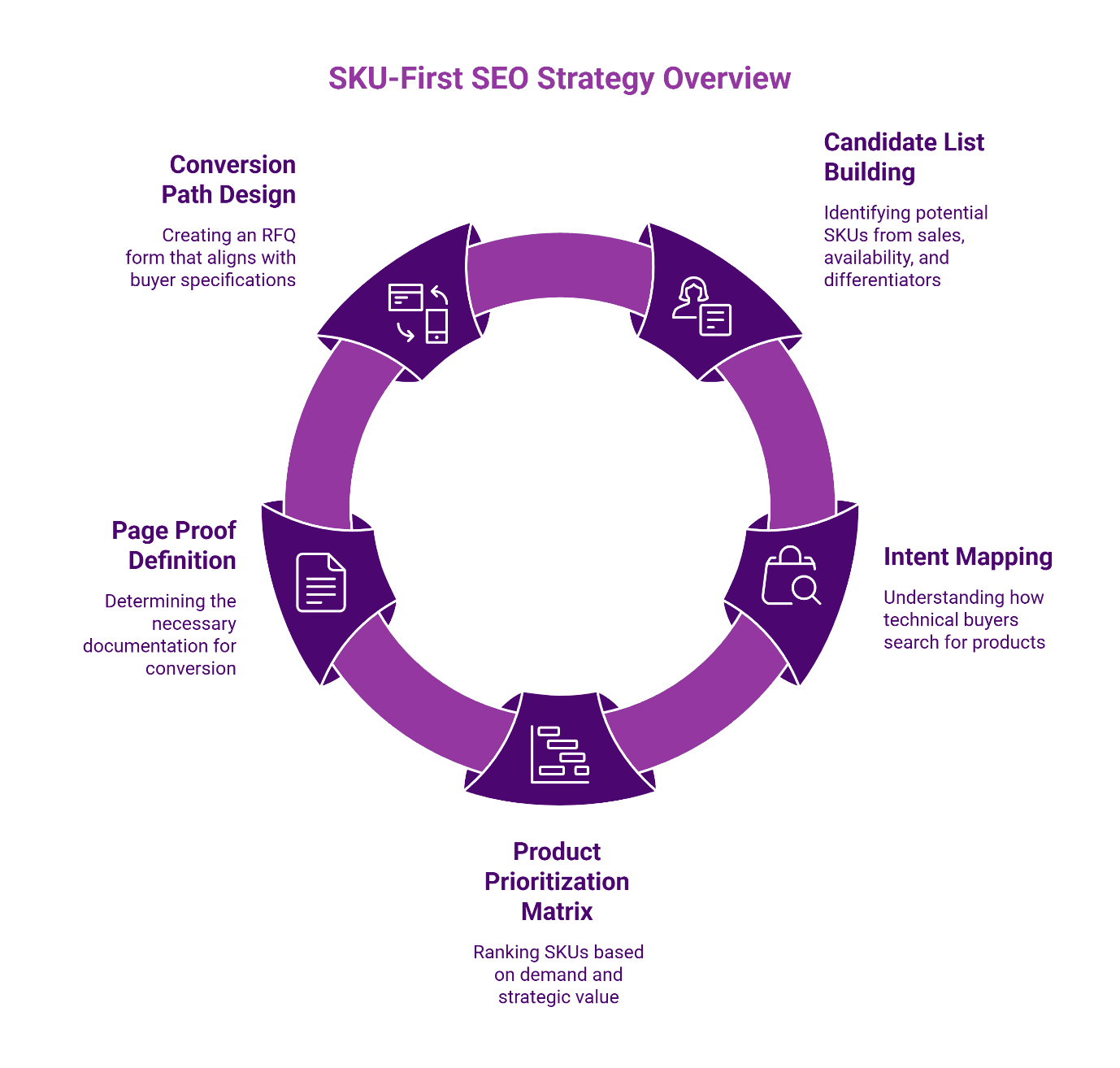
Step 1: Build Your Candidate List
Start with 20–30 potential SKUs or product lines. Pull from three sources:
- Sales wish list: Which products does your sales team want more RFQs for? They know where conversations stall because buyers went elsewhere.
- Stable availability: Avoid products with frequent stockouts, long lead times, or constant specification changes. You need pages that can stay accurate.
- Clear differentiators: Focus on products where you have a genuine technical advantage—tighter tolerances, superior materials, certifications competitors lack, process capabilities that matter.
Don't overthink this first pass. You're creating a pool to evaluate, not making final decisions.
Validation checkpoint: Does each candidate have a clear name, stable scope, and a buyer who searches for it in specific ways?
Step 2: Map Intent for Each Candidate
For every SKU on your list, identify how technical buyers search for it. Engineers and procurement officers typically use three intent patterns:
- Part intent: Searches by model number, part code, or product name. These buyers often know exactly what they want and are comparing suppliers.
- Spec intent: Searches by material, tolerance, dimension, or performance characteristic. "0.5mm wall thickness 304 stainless tubing" signals a buyer specifying requirements.
- Application intent: Searches by use case or industry context. "Heat exchanger tubing for pharmaceutical" indicates a buyer working backward from their problem.
Most SKUs have a dominant intent type. Knowing which one shapes everything—your keyword targets, your page structure, your proof points.
Validation checkpoint: Does the page plan match how a real buyer searches—part/spec/application—not how your internal team names the product?
Step 3: Score with the Product Prioritization Matrix
Now rank your candidates using two dimensions: demand signals and strategic value.
Demand signals (what you can measure):
- Search Console queries mentioning the product
- Historical RFQ volume for that SKU
- Distributor or rep inquiries
- Trade show FAQ patterns
- Competitor visibility for similar products
Strategic value signals (what you know internally):
- Margin potential
- Lead quality likelihood (does this product attract serious buyers or tire-kickers?)
- Capability fit (can you actually deliver at the specs buyers need?)
- Long-term positioning (is this a growth category?)
Plot each candidate on a simple 2×2 grid:
| Low Strategic Value | High Strategic Value | |
|---|---|---|
| High Demand | Consider (volume play) | Prioritize first |
| Low Demand | Deprioritize | Build for positioning |
Your first 10 SKUs should come primarily from the upper-right quadrant.
Validation checkpoint: Is there a plausible demand signal and a reason to prefer this product over others for pilot focus?
Step 4: Define the Page Proof Required
For each priority SKU, identify what evidence the page needs to convert a technical buyer. This isn't marketing copy—it's documentation:
- Spec table: Dimensions, tolerances, materials, performance ratings. What matters, stated plainly.
- Certifications, standards, and regulatory registrations: ISO, ASME, API, AS9100, or ITAR registration—whatever applies. Engineers validate suppliers against these.
- Downloadable assets: CAD files, spec sheets, compliance certificates, test reports.
- Application guidance: Where does this product fit? What problems does it solve?
- Lead time and MOQ notes: Factual, not promotional.
If you're missing critical proof for a candidate, that affects its "page readiness" score. A high-priority SKU with no CAD files and outdated specs may need to wait until you can build a credible page.
Validation checkpoint: Could an engineer validate fit in under two minutes using specs, standards, and downloads?
Step 5: Choose the Conversion Path
Your RFQ form should mirror how engineers specify. Generic "contact us" forms create friction; spec-aligned forms reduce it.
Consider fields like:
- Material required
- Dimensions or size range
- Tolerance requirements
- Quantity needed
- Applicable standard or compliance requirement
- Drawing upload option
- Application or end-use context
The goal: make requesting a quote feel like completing a technical specification, not filling out a marketing form.
Validation checkpoint: Do the form fields filter unqualified leads by asking for the same details buyers already think in?
Product Prioritization Matrix — Scoring Worksheet
| SKU / Line | Intent Type | Demand Score (1-5) | Demand Proxy Used | Strategic Value (1-5) | Value Proxy Used | Page Readiness (1-5) | Missing Assets | Priority Rank |
|---|---|---|---|---|---|---|---|---|
| 316SS Ball Valve Series | Spec | 4 | Search Console + RFQ history | 5 | High margin, capability fit | 3 | Needs updated CAD | 1 |
Use this template to score your candidate list. Products scoring highest across all three dimensions—demand, strategic value, and page readiness—become your pilot.
How to Build a "Perfect SKU Page" That Converts Into RFQs
Once you've selected your priority SKUs, each page needs to accomplish one thing: make the buyer confident enough to request a quote. Technical credibility isn't optional—it's the entire point.
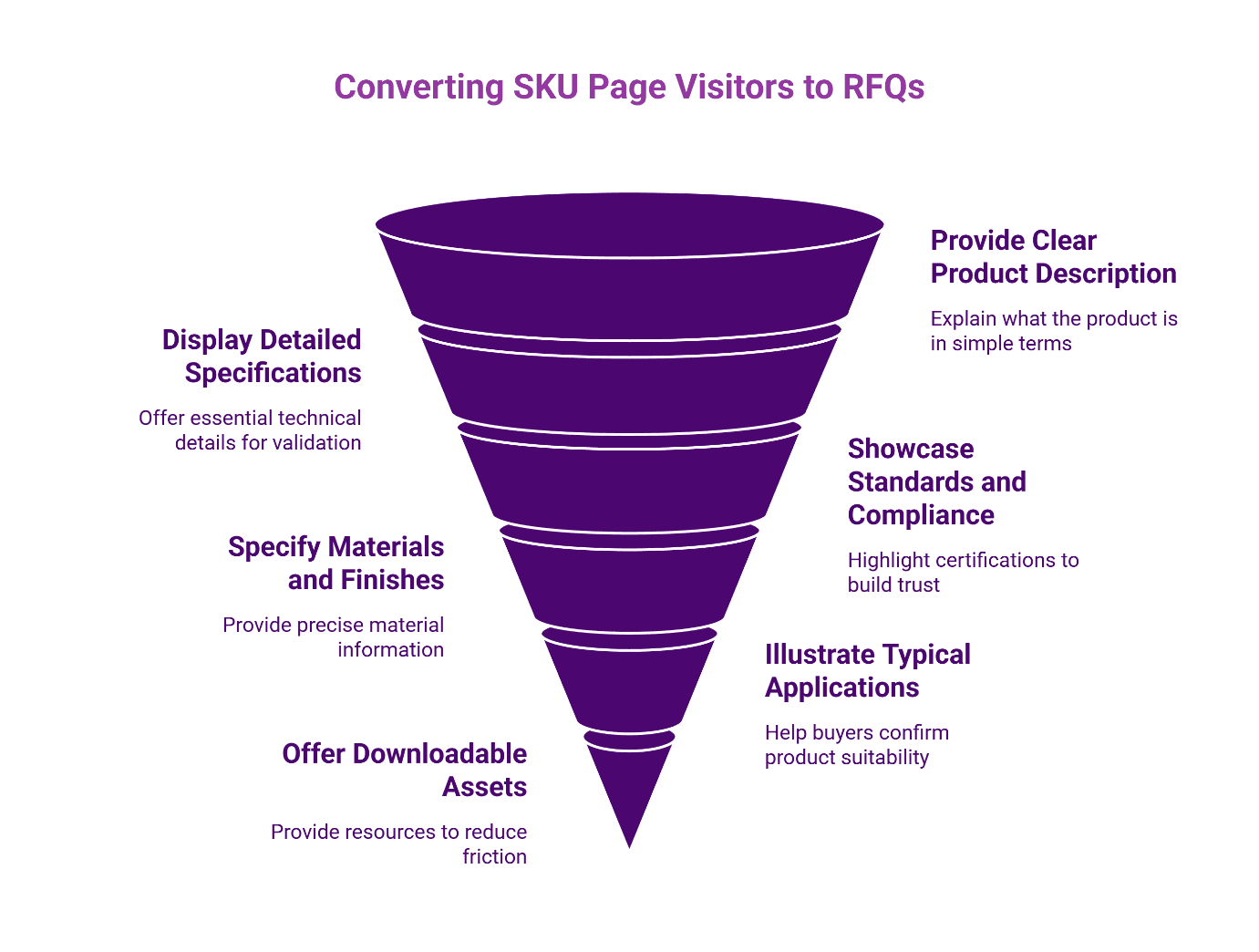
Required page elements:
What it is (one paragraph, plain language): State clearly what the product does and where it fits. No puffery.
Specifications table: The heart of the page. Dimensions, tolerances, materials, pressure ratings, temperature ranges—whatever engineers need to validate fit. Place this near the top.
Standards and compliance: Certifications displayed prominently. Engineers filter suppliers by compliance; make it easy. Include only what is accurate for your products.
Materials and finishes: Be specific. "Stainless steel" isn't enough when the buyer needs to know grade, finish, and heat treatment.
Typical applications: Help buyers confirm they're in the right place. Industry context matters. Include constraints (temperature, corrosion, load, environment) as applicable.
Downloads: CAD files, datasheets, certificates, test reports. Every asset that reduces friction between interest and RFQ. Use file names and descriptions that match buyer intent.
RFQ module: Place it above and below the spec table. Don't make buyers hunt for the next step. Include drawing upload and spec fields that mirror real quoting workflows.
Technical FAQs: Address spec variations, lead times, minimum orders, compliance questions.
The credibility test: Read every claim on the page. Can you back it with a spec, a standard, a process capability, or a document? If not, cut it. Marketing language erodes trust with technical buyers faster than no page at all.
For SKU pages, consider implementing Product structured data to help search engines understand your offerings and potentially display rich results. The Google Search Central: Product structured data documentation provides specific implementation guidance for rich result eligibility, while Schema.org defines the available properties.
Architecture: How to Connect SKU-First Pages So Google (and Buyers) Understand Your Catalog
Individual pages don't exist in isolation. How you connect them determines whether Google sees a coherent catalog or a pile of disconnected product sheets.
Recommended structure:
Product Family Hub → Individual SKU Pages → Application Pages (where meaningful)
A product family hub (e.g., "Ball Valves") links to individual SKU pages (e.g., "316SS Ball Valve – 1/2" to 4""). Application pages connect multiple SKUs to specific use cases when that adds genuine value.
When catalog architecture needs a name internally, think of it as Deep Content Architecture—a consistent hub-to-SKU-to-application system that scales without duplicating intent.
Breadcrumbs matter. They reinforce hierarchy for both users and search engines. Implement breadcrumb structured data to make the relationship explicit.
Internal links reinforce relevance. Link from SKU pages to related products, from application pages to the SKUs that serve them, from hub pages to everything beneath them. This isn't just navigation—it's signaling.
Watch for faceted navigation traps. Filters and facets (by material, by size, by pressure rating) can generate thousands of URL variations that dilute crawl budget and create duplicate content. Google's faceted navigation guidance covers the technical controls—canonicalization, parameter handling, indexing rules—that keep this under control.
For deeper manufacturing-specific SEO context, see the Industrial Manufacturing SEO service overview.
Quality Control: Preventing "Intent Drift" on Technical Product Pages
The pilot pages you build today will degrade over time unless you govern them. Specifications change. New standards emerge. Marketing teams add "value messaging" that obscures technical facts. This is intent drift, and it kills page credibility.
Establish an SME review checklist:
- Terminology matches current industry usage
- Specifications are accurate and current
- Compliance language reflects actual certifications
- Downloadable assets are up to date
- No marketing fluff has crept in
Define change control triggers:
- New material option added → page update required
- Tolerance capability changes → page update required
- New certification achieved → page update required
- Standard revised (e.g., new API revision) → page review required
The accuracy beats frequency rule: A technically correct page updated quarterly outperforms a frequently refreshed page full of errors. Engineering buyers will find the mistakes. They won't come back.
Scaling Beyond the First 10 SKUs (Without Starting Over)
The pilot isn't the end—it's proof of concept. Once you've validated the approach with your first 10 SKUs, scaling becomes methodical rather than chaotic.
Turn the pilot into a program:
- Document the page template (what elements, what order, what proof required)
- Standardize the prioritization matrix
- Create a governance workflow that new SKUs follow automatically
- Track what matters: visibility for priority queries, RFQ volume attributed to pilot pages, lead quality feedback from Sales
Expand in clusters:
- Adjacent SKUs: Products in the same family as your pilot pages. You've already built the hub; add the spokes.
- High-intent spec variants: Where a specification difference justifies a dedicated page (different material grade, different pressure class).
- Application pages: When multiple SKUs serve a common use case, an application page can capture that intent and distribute traffic.
- Long tail: Eventually, the rest of the catalog—but by then, you have templates, governance, and proof that the system works.
Pilot success signals:
- Improved visibility for priority part/spec/application queries
- Fewer unqualified leads (less "lead noise" for Sales)
- More quote-ready, spec-complete qualified RFQs tied to the pilot pages
Clear specs, consistent entities, and schema-informed structure support discoverability not only in traditional search but also across AI assistants and other search-everywhere environments. Implementation varies by platform, but the foundation remains the same.
For more on connecting SEO to pipeline through CRM tracking and governance workflows, see the attribution model documentation. For teams that want a deeper intent framework, explore Part/Spec/Application Intent Mapping and the related overview on Manufacturing SEO lead generation.
FAQ
Ready to apply this framework to your catalog? Explore more manufacturing SEO resources or schedule a strategy session to discuss your specific product lines.
Disclaimer: This content is educational and informational. Specific results depend on your market, catalog, and execution. The frameworks described here represent our methodology; applying them requires adapting to your specific technical products and buyer expectations.
Our Editorial Process: Our editorial process includes research and expert review to ensure accuracy and usefulness. We prioritize clear, actionable guidance that helps readers make confident decisions. Content is reviewed for clarity, relevance, and alignment with current best practices.
Written by the BVM Insights Team
The Insights Team is our dedicated engine for research and insights, exploring emerging trends, analyzing industry best practices, and translating complex topics into clear, actionable strategies. Our work is guided by editorial standards that prioritize accuracy, usefulness, and real-world impact.

About the Author
Dustin Ogle
Dustin Ogle is the Founder and Head of Strategy at Brazos Valley Marketing. With over 9 years of experience as an SEO agency founder, he specializes in developing the advanced AI-driven strategies required to succeed in the new era of search.