SEO Services for Luxury Homebuilders: A Schedule-Aware, Tours-First Program Aligned to Community Release Cycles
Last Updated: January 14, 2026 • 16 min read
📌 Key Takeaways
SEO services for luxury homebuilders must align content, technical, and local visibility work to community release schedules—measuring success by booked tours rather than traffic volume.
- Schedule-Aware Execution Prevents Late Visibility: Mapping SEO deliverables to community launch timelines ensures pages are indexed and profiles are verified before model centers open.
- Three Parallel Tracks Require Coordination: Content, technical, and local teams work simultaneously with weekly standups and shared backlogs prioritized by release dates.
- Tours-First Measurement Reveals Real Performance: The KPI ladder progresses from leading indicators like map impressions through engagement signals to lagging outcomes like booked appointments.
- New Construction Requires Address Data Lead Time: Submitting road and address information to map partners at T-6 weeks prevents profile verification failures on addresses that don't yet exist.
- Template-Driven Architecture Enables Scale: CMS templates for communities, models, and floor plans turn new launches into content population exercises rather than development projects.
Visibility without booked tours is just expensive activity.
Marketing directors and operations leaders at luxury homebuilding companies will gain immediate clarity on coordinating SEO work with construction schedules, preparing them for the detailed release-cycle timeline that follows.
The model center opens next month. Marketing has traffic reports. Sales has an empty appointment calendar.
This disconnect haunts luxury homebuilders more than any ranking chart ever could. The community launch date is fixed, construction crews are finishing punch lists, and somewhere between "organic sessions up 40%" and "zero tours booked this week," the SEO program lost its way.
SEO services for luxury homebuilders represent a coordinated program that aligns content creation, technical infrastructure, and local visibility work to community release cycles—measuring success not by traffic volume, but by booked tours and design-center appointments. Think of it like a site superintendent coordinating trades on a critical path: the framing crew, electricians, and plumbers all work in parallel, but their handoffs are sequenced to hit certificate of occupancy on schedule. A builder-focused SEO program operates the same way, with content, technical, and local tracks running simultaneously toward a launch milestone that ends with buyers walking through model homes.
When a prospective buyer searches "luxury homes in [City]" or "new construction communities near [ZIP]," they should land on a tour-ready community page—complete with model availability, floor plan options, and a clear path to schedule a visit. The Program Roadmap One-Pager and Release-Cycle Timeline that follow will show exactly how to make that happen.
Ready to align your SEO program with your build schedule? Explore our solutions to see how schedule-aware execution works in practice.
Why Most SEO Programs Underperform for Luxury Builders
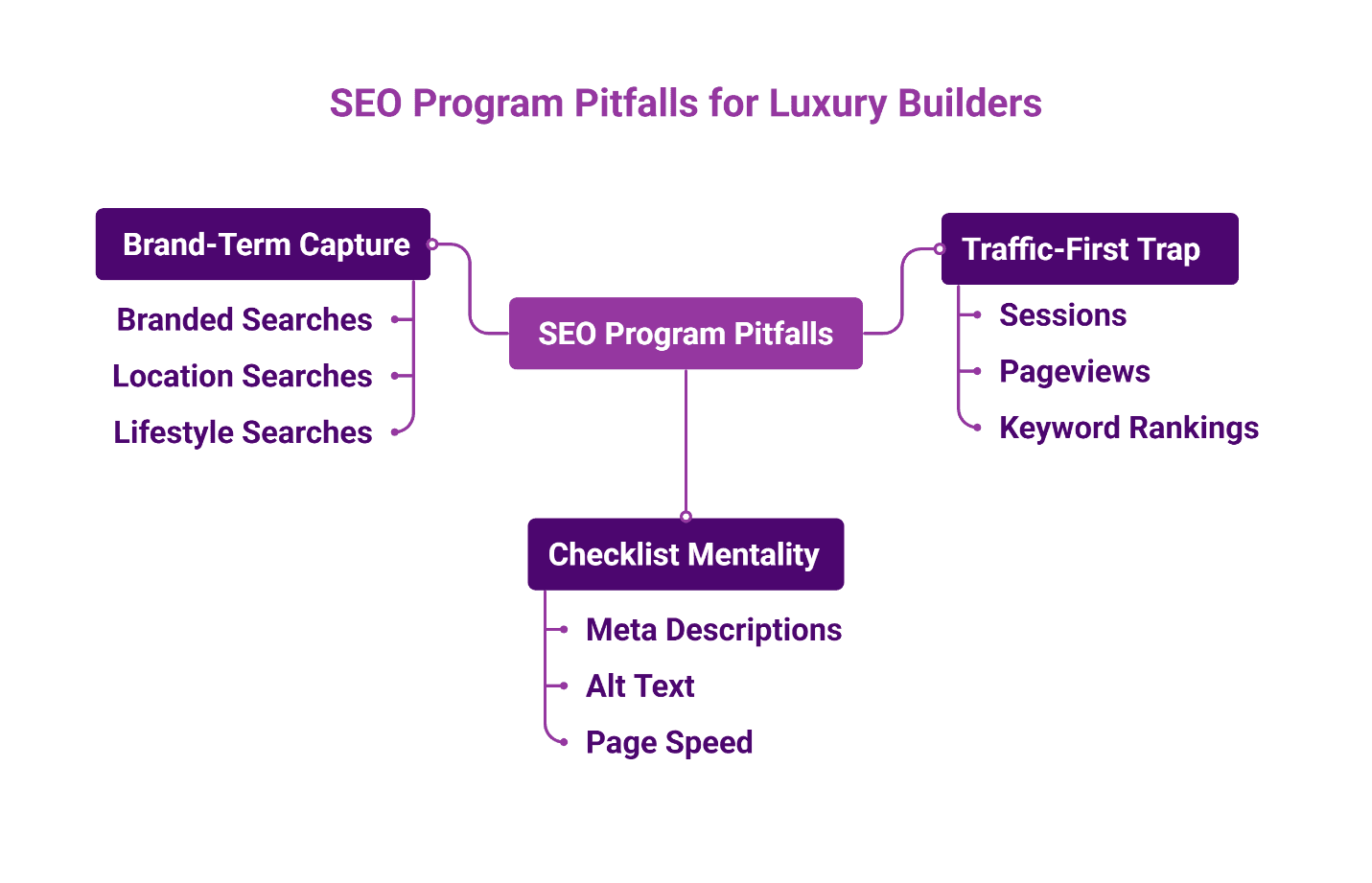
Three patterns consistently undermine SEO efforts for homebuilders, and recognizing them is the first step toward building something better.
The traffic-first trap. Generic SEO programs optimize for sessions, pageviews, and keyword rankings. These metrics feel productive in monthly reports but often fail to connect with the business outcome that matters: someone walking into a model center. A community page ranking third for a competitive term means nothing if the page lacks tour scheduling functionality or if the content targets buyers in the wrong price range.
The checklist mentality. Standard SEO audits produce impressive spreadsheets—fix these meta descriptions, add alt text to those images, improve page speed by 200 milliseconds. These tasks have value, but they treat every website the same way. A luxury homebuilder's site has unique architectural requirements: community pages, model pages, floor plan pages, inventory feeds, and location-specific content that must work together as a system, not as isolated optimization targets.
Brand-term capture as the ceiling. Some programs focus heavily on branded searches—people already looking for your company by name. This protects existing demand but does nothing to capture the far larger pool of buyers searching by location, price range, lifestyle, or home features. When someone searches "gated communities with golf course [City]," they have high purchase intent but may not know your brand exists.
The consequence of these patterns is predictable: communities launch, but search visibility arrives late. The first three months of a new community's life—when buyer interest peaks and the sales team needs momentum—pass without organic discovery contributing to the pipeline.
What Schedule-Aware, Tours-First SEO Services Actually Mean
Schedule-aware execution means tying SEO work to the calendar that already governs your business: release dates, inventory availability windows, model home openings, and events like the Parade of Homes. Rather than running SEO as a continuous background process with quarterly reviews, schedule-aware programs treat each community launch as a fixed milestone with a critical path of deliverables that must be complete before opening day.
This approach recognizes that SEO work has lead time. A community page needs to be indexed and earning authority before the model center opens, not after. Local business profiles need reviews and engagement before buyers start searching, not as an afterthought when sales asks why map visibility is weak.
Tours-first measurement flips the traditional reporting model. Instead of leading with traffic and engagement metrics, the KPI ladder ends where the business outcome begins: booked tours and design-center appointments. Traffic becomes a leading indicator rather than a success metric. The question shifts from "how many people visited the community page?" to "how many of those visitors scheduled a tour, and what percentage actually showed up?"
This measurement philosophy requires tighter integration between marketing systems and sales processes. UTM parameters must flow through to CRM records. Tour booking forms must distinguish between organic discovery and other channels. Sales teams must update lead statuses in ways that allow attribution analysis. The operational overhead is real, but so is the clarity it provides.
The Three-Track Operating Model: Content, Technical, and Local
A builder-focused SEO program runs on three parallel tracks, each with distinct deliverables, owners, and handoff points.
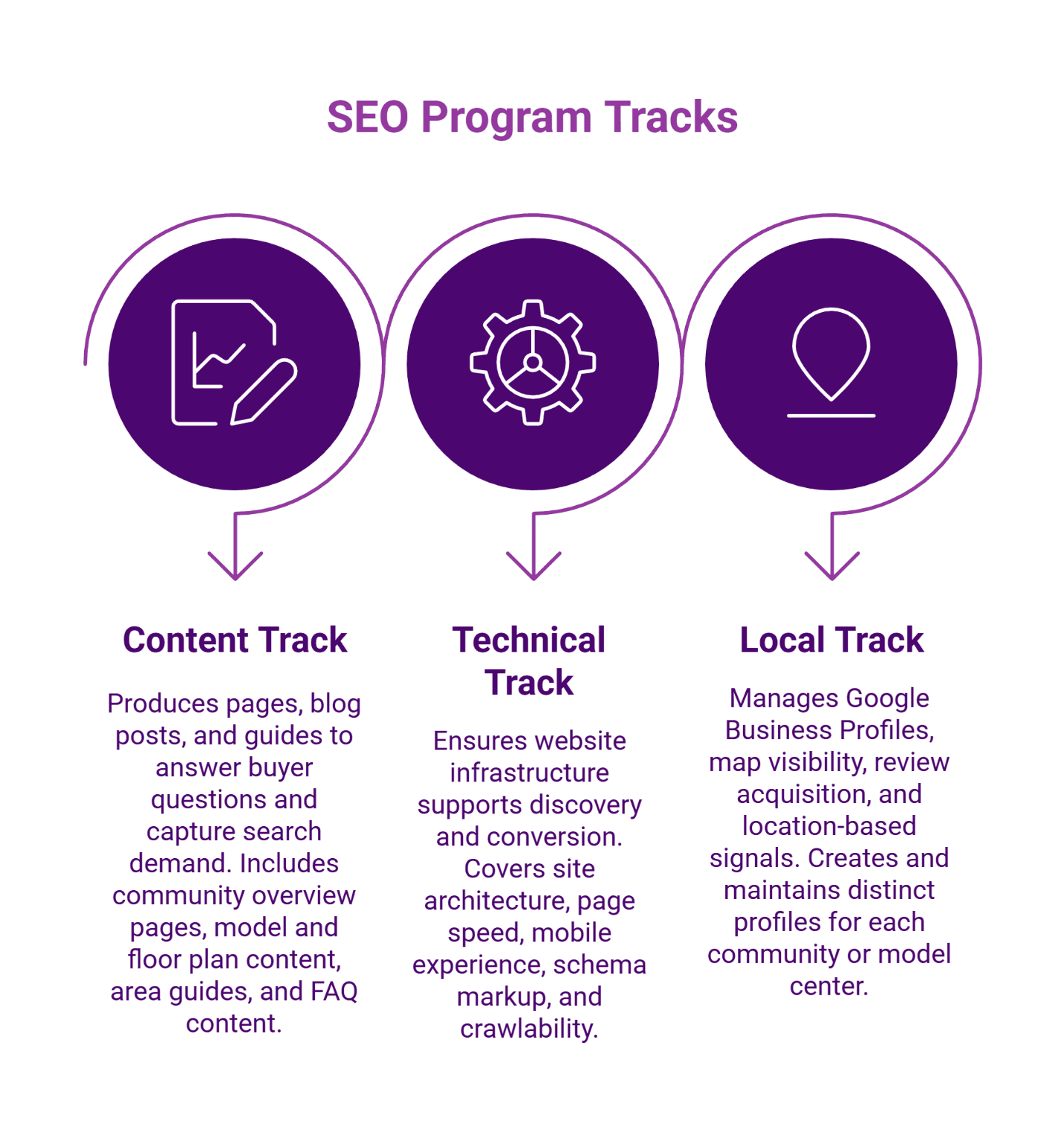
The content track produces the pages, blog posts, and neighborhood guides that answer buyer questions and capture search demand. This includes community overview pages, model and floor plan content, area guides, and FAQ content addressing common buyer concerns. The content track also handles ongoing optimization—updating pages as inventory changes, refreshing neighborhood content seasonally, and creating event-specific landing pages for Parade of Homes or grand opening weekends.
The technical track ensures the website infrastructure supports discovery and conversion. This covers site architecture, page speed, mobile experience, schema markup, and crawlability. For builders, the technical track has specialized concerns: CMS templating that scales across communities, dynamic inventory integration, intelligent content differentiation for similar floor plans across communities (or cross-domain canonicalization where differentiation isn't possible), and structured data that helps search engines understand the relationship between communities, models, and available homes.
The local track manages Google Business Profiles, map visibility, review acquisition, and location-based signals. For luxury builders, this means creating and maintaining distinct profiles for each community or model center—not consolidating everything under a single corporate listing. The local track coordinates with sales teams on review requests, monitors profile performance, and ensures NAP (name, address, phone) consistency across directories.
These tracks operate in parallel with regular coordination points. A weekly standup keeps all three tracks aligned on priorities and blockers. A shared backlog allows work to be sequenced based on community launch dates rather than arbitrary sprint boundaries.
RACI Matrix: Who Owns What
| Task | Marketing | Sales | Ops/Construction | Agency |
|---|---|---|---|---|
| Community launch milestone calendar | A | C | R | C |
| Community page content requirements | A | C | C | R |
| Model/plan content accuracy + availability | C | C | A/R | C |
| Technical site audits | I | - | I | R/A |
| Local profile setup & governance | C | C | R | A/R |
| Review acquisition | C | R | I | A |
| UTM standards + lead routing | A/R | R | C | C |
| Tour attribution tracking | A | R | I | C |
| Launch readiness QA | A | C | C | R |
| Reporting cadence + KPI ladder | A | C | C | R |
R = Responsible, A = Accountable, C = Consulted, I = Informed
Release-Cycle Planning: How SEO Work Maps to Community Milestones
Treating SEO as a continuous process without milestone awareness creates the "late visibility" problem. The solution is mapping SEO deliverables to the community release cycle, working backward from launch date to ensure everything is ready when buyers start searching.
Release-Cycle Timeline
| Timeframe | Content Track | Technical Track | Local Track |
|---|---|---|---|
| T-6 weeks | Draft community page copy; identify target keywords | Confirm CMS template readiness; schema markup spec | Submit new road/address data to Map partners; Create Google Business Profile (unverified) |
| T-4 weeks | Finalize community page; begin neighborhood guide | Implement structured data; page speed audit | Confirm base map data update; Verify profile; begin photo uploads |
| T-2 weeks | Publish floor plan pages; internal linking | Mobile experience QA; form tracking setup | NAP consistency check; first review outreach |
| T-1 week | Pre-launch content QA | Indexation verification; sitemap update | Profile optimization; category refinement |
| Launch (T-0) | Event landing page live | Monitor Core Web Vitals | Respond to profile activity |
| T+2 weeks | Performance review; content gaps identified | Technical issues resolved | Review velocity tracking begins |
| T+4 weeks | Optimization based on early data | Ongoing monitoring | Second review outreach wave |
The critical path items—those that cannot slip without launch risk—include community page publication, Google Business Profile verification, and form tracking implementation. Everything else can be accelerated or deferred based on resource availability, but these three gates must clear before launch.
On-Site Architecture: Communities, Models, Plans, and Inventory
Scalability in builder SEO comes from template-driven architecture, not one-off page creation. When the site structure is designed correctly, adding a new community or model becomes a content population exercise rather than a development project.
Community pages serve as the hub for each development. They contain overview content, lifestyle positioning, location context, and links to available models and floor plans. Each community page should have a consistent structure that allows search engines to understand what the page represents and helps buyers quickly find key information.
Model pages showcase specific home designs available within a community. These pages feature floor plan details, included features, customization options, and photo galleries. Models may appear in multiple communities, which creates canonicalization considerations—each community's version of a model should be unique enough to avoid duplicate content issues while maintaining efficiency in content production.
Floor plan pages go deeper into specifications: square footage, bedroom and bathroom counts, garage capacity, and lot requirements. For buyers who know what they want, these pages capture high-intent long-tail searches like "4 bedroom single story floor plan 3000 sq ft [City]."
Inventory feeds connect available quick move-in homes to the site. When integrated properly, inventory pages capture the most urgent buyer intent—people searching for homes they can purchase and occupy within weeks rather than months.
Template Field Dictionary
| Page Type | Required Fields | Conversion Modules | Governance Notes |
|---|---|---|---|
| Community | Community name; [City]/[ZIP]; address; model center hours; amenities; lifestyle; schools (if applicable); "why here" narrative | Sticky Tour CTA; Directions; trust proof; FAQ; map embed | Must stay current; release notes should update the same URL |
| Model | Model name; base specs; key differentiators; media; available elevations; design highlights | "Schedule a Tour" CTA; compare models; related plans | Avoid duplicating plan content across communities without routing rules |
| Plan | Plan name; beds/baths; sqft range (if used); options; structural upgrades; "fits who" use-case | Tour CTA; "request design appointment" module | Keep plan pages stable; use availability status without nuking URLs |
| Inventory / Quick Move-In | Status; community routing; key attributes; address (if permitted); timelines | Tour CTA; call module; directions | If inventory changes quickly, ensure no-index rules don't block discovery |
When these templates are implemented correctly, launching a new community means populating fields rather than building pages from scratch. The content track focuses on quality and differentiation rather than structural decisions that should already be resolved.
Local Visibility at the Community Level
Map pack visibility for luxury builders requires a different approach than single-location businesses. Each community with a model center represents a distinct location where buyers can visit, tour, and make purchase decisions. Consolidating all communities under a single Google Business Profile dilutes visibility and confuses the algorithm about where the business actually serves customers.
Distinct profiles per community allow each location to rank for its specific geographic area. When someone searches "new homes near [neighborhood]" or "luxury builders [ZIP code]," the closest relevant community profile has the best chance of appearing in map results. A corporate profile miles away from the searcher's location cannot compete effectively.
Profile conflation—using one profile for multiple communities or failing to maintain separate identities—creates several problems. Reviews get attributed to the wrong location. Hours and contact information become inconsistent. The algorithm cannot determine which location is most relevant for a given search, so it may show none of them.
Profile actions that drive tours:
- Direction requests indicate serious visit intent
- Calls from the profile suggest high-quality leads
- Website clicks to community pages create attribution opportunities
- "Book appointment" actions (where available) directly generate pipeline
Tracking these actions by community provides insight into which locations are generating discovery-driven interest versus relying entirely on direct brand searches.
Content System: Neighborhood Clusters and Intent Routing
Capturing non-brand search demand requires content that addresses how buyers actually search: by location, lifestyle, school district, commute corridor, or community amenities. Neighborhood content clusters serve this purpose, but they must be structured carefully to avoid cannibalizing the brand navigational terms that community pages should own.
The routing principle: Neighborhood and area guide content captures discovery intent, then routes visitors to the most relevant community page based on proximity and lifestyle fit. A guide about "best neighborhoods for families in [City]" should link to communities that match that profile, with clear calls-to-action driving toward tour scheduling.
Avoiding cannibalization: Brand terms and community names should be owned by their dedicated pages. Neighborhood content should target informational and location-based queries that the community pages cannot rank for effectively. When both a neighborhood guide and a community page try to rank for the same term, they compete against each other and often both lose.
Content hierarchy matters. Community pages sit at the center, optimized for navigational and commercial intent. Neighborhood clusters surround them, capturing the broader discovery searches that feed interested buyers into the funnel. Blog content and FAQ pages handle informational queries that may be months away from a purchase decision but build authority and trust over time.
For more on building content systems that establish authority, see our Deep Content Architecture guide.
Trust Signals: Reviews, Reputation, and On-Page Proof
Reviews drive conversion at multiple points in the buyer journey. They influence click-through rates from search results, time-on-site once visitors arrive, and ultimately the decision to schedule a tour. For luxury purchases where the stakes are high, buyers scrutinize reputation signals more carefully than they might for smaller transactions.
Review acquisition cadence matters more than volume spikes. A steady flow of two to four reviews per month per community signals ongoing activity and current buyer satisfaction. A burst of twenty reviews in one week followed by months of silence looks manufactured and may trigger platform skepticism. The goal is sustainable velocity, not manufactured peaks.
Review content that converts mentions specific elements buyers care about: the quality of finishes, responsiveness of the sales team, accuracy of the timeline, neighborhood amenities, or the design-center experience. Generic five-star ratings help, but reviews that reference specific touchpoints give prospective buyers concrete reasons to trust.
On-page proof elements:
- Testimonial quotes with attribution (first name, community, move-in year)
- Awards and recognition badges
- Builder certifications and warranties
- Quality ratings and energy efficiency certifications
- Gallery images showing completed homes and happy buyers
These elements should appear on community pages where buying decisions happen, not buried in an "About Us" section that visitors rarely find.
Measurement Reset: The KPI Ladder From Visibility to Tours
Traditional SEO reporting emphasizes metrics that make agencies look productive but may not reflect business outcomes. A tours-first measurement framework restructures the hierarchy, treating visibility metrics as leading indicators while elevating conversion events to primary success measures.
KPI Ladder
| Category | Metric | Owner | Frequency |
|---|---|---|---|
| Leading | Map pack impressions | Agency | Weekly |
| Leading | Direction requests | Agency | Weekly |
| Leading | Calls from local profiles | Agency/Sales | Weekly |
| Engagement | Tour CTA clicks | Marketing | Weekly |
| Engagement | Form starts | Marketing | Weekly |
| Lagging | Booked tours | Sales | Weekly |
| Lagging | Design-center appointments | Sales | Weekly |
| Lagging | Tour-to-contract rate | Sales | Monthly |
This structure makes the relationship between activities and outcomes visible. When leading indicators are strong but lagging indicators are weak, the problem is conversion—something about the experience between discovery and booking is failing. When leading indicators are weak, the problem is visibility—the SEO program itself needs adjustment.
"Visibility is potential; booked tours are the proof."
Governance: UTM Standards, CRM Stitching, and Reporting Cadence
Attribution durability requires operational discipline. Without consistent tracking standards, the connection between SEO activity and business outcomes breaks down within weeks.
Lightweight Governance Specification
UTM naming conventions should encode enough information to trace any visitor back to their source. A recommended structure:
- utm_source=google
- utm_medium=organic
- utm_campaign=community-[community-name]
- utm_content=tour-cta
Example in practice:
- utm_campaign=community-riverstone
- utm_source=gbp
- utm_medium=local
- utm_content=directions
When a lead enters the CRM, these parameters should persist through the record, allowing sales to see not just that a lead came from organic search, but which community page and what type of content drove the discovery.
CRM status alignment ensures marketing and sales speak the same language about pipeline progression. Statuses should distinguish between:
- Tour requested
- Tour booked
- Tour held
- Tour no-show
- Design appointment booked
- Not qualified / not ready
This granularity allows conversion rate analysis at each stage, identifying whether the problem is getting tours scheduled or getting scheduled tours to actually happen.
Reporting rhythm:
- Weekly: Leading indicators and engagement metrics reviewed by agency and marketing
- Bi-weekly: Conversion metrics reviewed with sales leadership
- Monthly: Full-funnel analysis with attribution breakdown by community
- Quarterly: Strategic review comparing performance against business targets
What a Monthly Retainer Looks Like Across Pre-Launch, Launch, and Sustain
SEO retainers for builders should be structured around program phases, not hourly allocations or generic "monthly SEO" packages. The work intensity and focus areas shift significantly depending on where each community sits in its lifecycle.
Pre-launch phase (T-8 to T-2 weeks): Heavy emphasis on content production, technical readiness, and local profile setup. This phase consumes the most agency hours as foundational assets are created. Deliverables include community page development, template configuration, schema implementation, and profile verification.
Launch phase (T-2 to T+4 weeks): Focus shifts to monitoring, rapid response, and early optimization. The agency watches indexation status, responds to technical issues, manages profile activity, and coordinates first-wave review outreach. Hours decrease from pre-launch but require faster turnaround on individual tasks.
Sustain phase (T+4 weeks onward): Ongoing optimization based on performance data, content refreshes as inventory changes, continued review acquisition, and iterative improvements to underperforming pages. This phase runs at a lower intensity but never fully stops—communities in sustain mode still need attention to maintain and improve visibility.
For builders with multiple communities at different stages, the retainer covers all active phases simultaneously. A typical month might include pre-launch work for one community, launch support for another, and sustain optimization for three or four established developments.
Explore our full solutions overview to see how phased programs work in practice.
How to Choose and Manage an SEO Partner for Release-Cycle Reliability
Not every SEO agency understands the homebuilder business model. The evaluation process should assess specific competencies that matter for schedule-aware, tours-first execution.
Partner Evaluation Checklist
- Schedule governance evidence: Does the agency use timeline artifacts, milestone tracking, and critical path documentation? Ask to see examples from previous builder clients.
- Conversion measurement capability: Can they demonstrate attribution models that connect organic visibility to booked tours, not just traffic? Request sample reports showing the full funnel.
- Template and scalability thinking: How do they approach multi-community architecture? Look for CMS templating experience and an understanding of the community/model/plan hierarchy.
- Cross-functional enablement: Do they have experience working with sales teams on review acquisition and lead handoff? Builders need agencies that can operate beyond the marketing silo.
- Local SEO depth: Is local visibility a specialty or an afterthought? Multi-location expertise is essential for builders with multiple communities.
Management Practices That Sustain Partnership Value
Establish a shared backlog visible to both internal teams and the agency. Prioritize work based on community launch dates rather than generic importance rankings. Hold regular standups that include sales representation when discussing tour attribution. Review performance against the KPI ladder monthly, not just traffic reports quarterly.
Learn more about our approach to builder-focused partnerships.
Program Roadmap One-Pager
| Phase | Deliverables | Owner | Definition of Done | KPI Focus |
|---|---|---|---|---|
| Discovery (Weeks 1-2) | Competitive analysis, keyword research, technical audit, community prioritization | Agency (with Marketing input) | Strategy document approved; community launch calendar confirmed | Baseline metrics established |
| Foundation (Weeks 3-6) | CMS template configuration, schema markup implementation, tracking setup, content briefs | Agency + Development | Templates tested; tracking verified; content production ready | Technical health score established |
| Pre-Launch (Weeks 7-10) | Community pages, model content, local profile setup, initial review outreach | Agency (with Sales coordination) | All launch-critical pages indexed; profiles verified; forms tested | Indexation complete; profiles active |
| Launch (Weeks 11-14) | Launch QA, monitoring, rapid response, performance tracking | Agency + Marketing | No critical issues; attribution flowing; first tour data captured | Leading indicators trending positive |
| Sustain (Ongoing) | Content optimization, review velocity maintenance, performance iteration | Agency (ongoing coordination) | Monthly performance within target ranges | Booked tours meeting community targets |
Critical Path Items (Cannot Slip)
- Community page publication (T-2 weeks minimum)
- Google Business Profile verification (T-4 weeks minimum, after base map data confirmation)
- Form tracking and UTM implementation (T-1 week minimum)
Frequently Asked Questions
Moving From Traffic Reports to Tour Results
The gap between "organic traffic increased" and "tours booked from organic" is where most SEO programs fail luxury builders. Closing that gap requires treating SEO not as a marketing tactic but as an operating system—one that runs on schedules, coordinates parallel workstreams, and measures success by the same outcomes the sales team cares about.
When the model center opens next month, the question should not be whether traffic is up. The question should be whether buyers who searched for homes in that area found your community, understood what makes it distinctive, and scheduled a tour. Everything else is just activity.
Start your strategy session to explore how a schedule-aware, tours-first SEO program aligns with your community release calendar, or browse additional frameworks in our resources library.
Our Editorial Process: Our expert team uses AI tools to help organize and structure our initial drafts. Every piece is then extensively rewritten, fact-checked, and enriched with first-hand insights and experiences by expert humans on our Insights Team to ensure accuracy and clarity.
About the Brazos Valley Marketing Insights Team: The Brazos Valley Marketing Insights Team is our dedicated engine for synthesizing complex topics into clear, helpful guides. While our content is thoroughly reviewed for clarity and accuracy, it is for informational purposes and should not replace professional advice.

About the Author
Dustin Ogle
Dustin Ogle is the Founder and Head of Strategy at Brazos Valley Marketing. With over 9 years of experience as an SEO agency founder, he specializes in developing the advanced AI-driven strategies required to succeed in the new era of search.