
Reviews & Reputation for Luxury Communities: A Playbook to Earn and Leverage High-Trust Signals
Last Updated: 16 December 2025 • 12 min read
📌 Key Takeaways
In affluent ZIP codes, reviews are the difference between map-pack visibility and booked model-center tours.
- Review Velocity Drives Local Rankings: Steady, recent reviews signal community activity to both search algorithms and buyers, directly improving map-pack placement for city and ZIP-specific searches.
- Amenity-Rich Language Converts Browsers to Bookers: Reviews mentioning specific schools, parks, trailheads, and dining options strengthen neighborhood relevance and reduce purchase anxiety by painting concrete lifestyle pictures.
- Separate Profiles Prevent Signal Dilution: Each community needs its own Google Business Profile with location-specific reviews—generic corporate pages blur geographic signals and weaken performance in affluent ZIP searches.
- Ethical Timing Beats Manipulation: Request reviews at natural satisfaction moments (walkthroughs, design-center milestones, 30/90-day check-ins) with amenity prompts, not incentives or selective gating.
- UTM Tracking Proves Tour ROI: Connecting the path from Google Business Profile impression through review engagement to booked model-center tours reveals which communities and strategies drive actual conversion, not just traffic.
Systematic review programs transform high-trust signals into scheduled visits.
Marketing and sales leaders at luxury homebuilders and community developers will find the strategic framework here, guiding them into the detailed implementation playbook that follows.
Now that we've established why community-level local SEO wins affluent geographic intent, this playbook shows how reviews become the trust engine that turns visibility into tours.
Think of reviews as your digital site superintendent. When a prospective buyer searches "luxury home builder + [city/ZIP]," Google doesn't just show your location—it surfaces your reputation. A steady flow of recent, amenity-rich reviews signals to both search algorithms and buyers that your community is active, desirable, and worth visiting.
Picture this scenario: A marketing director at a luxury homebuilder watches map-pack impressions climb month after month, but tour bookings remain flat. The culprit? A thin review profile with outdated feedback and generic praise that fails to connect the community to its neighborhood context. Without recent, location-specific social proof, prospects click away to competitors whose reviews paint a vivid picture of the lifestyle they're seeking.
Here's the practical application. Reviews aren't just testimonials—they're structured data that feeds local relevance. When managed strategically, they increase map-pack visibility, improve profile engagement, and ultimately convert more model-center tours. This article provides a builder-ready framework to earn and leverage high-trust signals ethically and effectively.
Why Underperforming Reviews Stall Map-Pack Wins in Affluent ZIPs
Most luxury homebuilders understand that reviews matter. What they often miss is how review velocity and recency correlate with local visibility. Search algorithms prioritize businesses that demonstrate consistent activity and engagement. A profile with three reviews from 18 months ago signals stagnation, regardless of how positive those reviews are.
The mathematics work against passive approaches. Competitors who implement systematic review programs accumulate fresh social proof at a steady pace, steadily increasing their authority for neighborhood-specific queries. This creates a compounding advantage in local search results that's difficult to overcome without a deliberate strategy.
Research demonstrates the stakes clearly. Studies show that negative reviews draw disproportionate attention and can significantly reduce purchase probability—an effect that becomes magnified when total review volume is low.[^1] A thin review profile means a single negative experience can dominate the narrative, while a healthier volume and steady cadence ensure no single voice distorts the overall picture.
How do we increase high-quality reviews without "gaming the system"?
The answer lies in timing, not manipulation. Request reviews at moments when homebuyers naturally feel positive about their experience—after a successful walkthrough, following design-center milestones, or during 30-day and 90-day check-ins. These touchpoints align with genuine satisfaction, making requests feel natural rather than forced.
The Federal Trade Commission's Endorsement Guides establish clear boundaries for review solicitation.[^2] Reviews must reflect honest opinions, any material connections must be disclosed, and businesses must avoid practices that mislead consumers about the nature or origin of reviews. Recent FTC rulemaking around fake online reviews adds enforcement teeth, including potential civil penalties for deceptive review practices.
For luxury communities, ethical influence means designing repeatable moments to ask for honest, voluntary reviews within clear guardrails. Three practices to strictly avoid:
Review gating — Do not selectively invite only satisfied buyers to leave public reviews while routing others to private surveys. All customers who reach designated touchpoints should receive the same review request opportunity.
Undisclosed incentives — Do not offer compensation tied directly to reviews without proper disclosure.
Requiring positive feedback — Make it clear that honest perspectives, whether positive or constructive, are welcome.
The content of those reviews matters just as much as the quantity. Amenity- and neighborhood-rich reviews improve relevance for local searches. When a review mentions "the elementary school three blocks away" or "the trail system behind the community," it strengthens your profile's connection to specific geographic and lifestyle queries that affluent buyers use.
The hidden risk of brand cannibalization when reviews live on generic pages
Many builders inadvertently dilute their local SEO by funneling all reviews to a single corporate profile. This approach prevents search engines from understanding that distinct location profiles serve different markets. When reviews for multiple communities flow to one generic page, Google struggles to associate feedback with specific neighborhoods, and high-intent city/ZIP queries are more likely to surface competitors whose signals are community-specific.
Neighborhood clusters increase topical authority when each community maintains its own review ecosystem tied to its specific geographic context. The solution requires deliberate separation. Each community needs its own Google Business Profile with reviews that reflect its unique location and amenities. This prevents conflation and allows each property to compete effectively for its specific affluent ZIP code searches. That structure also supports broader Deep Content Architecture™ where each community page internally links to nearby neighborhood guides and location pages.
What "Good" Looks Like for Luxury Communities
Setting realistic benchmarks prevents both complacency and unsustainable burst behavior that triggers algorithmic suspicion. The goal is steady, authentic growth that mirrors natural buying cycles in luxury real estate.
Velocity & recency targets for steady growth
A healthy luxury community profile should aim for a consistent trickle of new reviews rather than sporadic bursts. This pace demonstrates ongoing activity without appearing artificial. Target keeping reviews from the last 30-60 days visible in your profile, not just pre-opening promotional waves.
More important than the monthly count is maintaining momentum across your sales cycle. New move-ins, design milestones, and warranty touchpoints should routinely feed fresh reviews. Avoid "review blitzes" where dozens of reviews land in a single week followed by months of silence—this pattern can appear inauthentic and undermines long-term visibility.
Seasonal fluctuations are normal and expected in real estate. A spike during spring buying season followed by slower summer months creates a natural pattern that search engines recognize as legitimate. The key is maintaining some activity year-round rather than long periods of silence.
Amenity-anchored language that signals neighborhood fit
Generic praise like "great experience" or "highly recommend" provides minimal value for local search optimization. The most effective reviews reference specific nearby landmarks, schools, parks, and lifestyle amenities that prospects actively search for when evaluating neighborhoods.
Consider the difference between these two reviews: "Beautiful community with excellent service" versus "We love how the trailhead is five minutes from our door, and the kids can walk to Oakmont Elementary." The second review reduces purchase anxiety by painting a concrete picture of daily life while simultaneously improving relevance for searches like "[community name] near [school/park]" or "new construction homes by [trail/lake]."
Those amenity-rich details make neighborhood SEO clusters perform. When the Google Business Profile, community page, and nearby-area content all echo the same local entities—schools, parks, trailheads, dining corridors—the cumulative effect strengthens your authority for location-specific queries.
At this strategic point, the three core principles that drive results deserve explicit reinforcement:
- Review velocity and recency correlate with local visibility
- Amenity- and neighborhood-rich reviews improve relevance
- On-page surfacing of reviews increases engagement and dwell time
The Builder's Review Program—Ethical, Steady, Tour-First
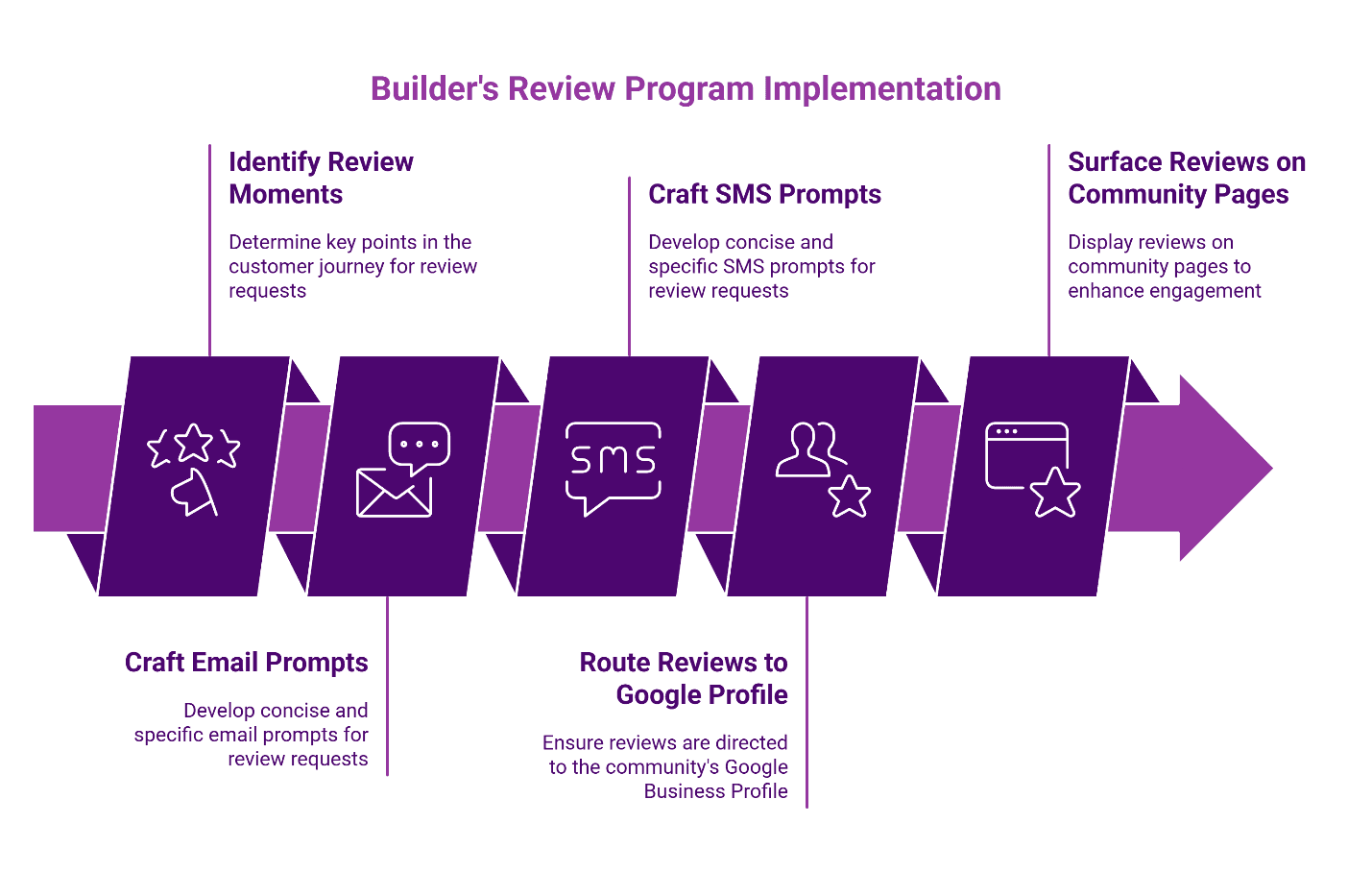
Implementation begins with identifying the right moments and providing clear, helpful guidance that respects the reviewer's time while capturing location-specific details.
Sources & moments: walkthroughs, design-center milestones, 30/90-day check-ins
The customer journey in luxury homebuilding creates natural opportunities for review requests:
Post-walkthrough phase — Prospects who toured but haven't purchased yet can provide valuable feedback about the experience and neighborhood impressions
Design-center completion — Buyers who finalized selections often feel excited and appreciative of the guidance they received
30-day check-in — New residents settling in have fresh perspectives on nearby amenities they're discovering
90-day milestone — Established residents can speak to the full lifestyle experience and community integration
Each of these moments represents genuine satisfaction points where a review request feels appropriate rather than intrusive. The key is anchoring requests to times when buyers naturally reflect on their experience, not arbitrary intervals disconnected from their journey.
Request mechanics: email/SMS prompts with amenity cues & photo guidance
Effective prompts make it easy to respond while subtly guiding toward location-rich content. Here's ready-to-use language:
Email prompt (post-walkthrough):
Subject: Quick favor about your experience at [Community]
Body: We hope you're loving [model/plan]. If a minute allows, would you share a few words about nearby amenities you liked (e.g., [park/school/trail])? Your perspective helps neighbors discover the right fit. [Direct review link]
SMS (90-day check-in):
Hi [First Name]—glad you're settling in at [Community]. If you can, a quick note about your favorite nearby spot (cafés, parks, trails) really helps future neighbors. [Short review URL]
These templates work because they're concise, provide specific prompts about what to mention, and frame the request as helping others rather than boosting rankings. To make reviews more useful without over-scripting, include one to two amenity prompts focusing on parks, schools, trailheads, or retail, and encourage a single photo that shows what they love—whether it's a view, nearby park, or streetscape.
Routing & surfacing: where reviews live and how they feed tours
Reviews should live primarily on your Google Business Profile for each community, where they directly influence map-pack rankings and profile engagement. Route review links to the specific community profile, not a corporate umbrella page.
On-page surfacing of reviews increases engagement and dwell time on community pages, creating a secondary conversion opportunity. An effective on-page module might look like this:
What residents love nearby — Curated quotes (2-3 lines each), link to full reviews, "Book a Tour" CTA adjacent.
This approach provides social proof at the moment prospects are evaluating whether to schedule a visit, directly supporting the research-online-buy-offline journey that defines luxury homebuying. For systematic implementation, consider how The Perfect Page Blueprint™ structures these modules with proper schema markup and internal linking to maximize both user experience and search visibility.
Governance: Categories, Attributes, and UTM Hygiene Tie Reviews to Tours
Measurement requires connecting review activity to actual business outcomes. Tracking the full path from profile impression to booked tour reveals which review strategies drive results and which need refinement.
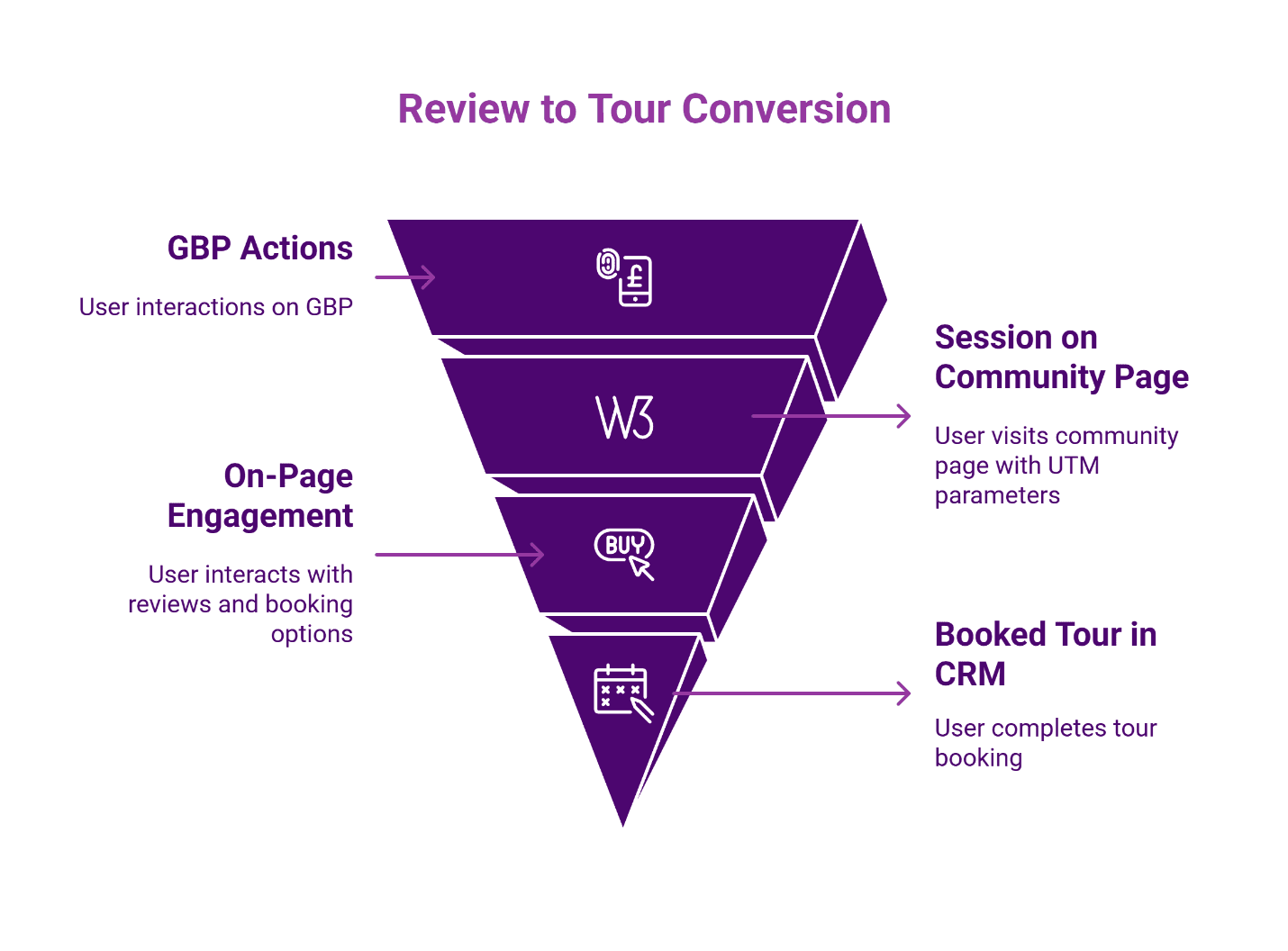
Tracking: profile → session → CTA → booked tour
Treat every Google Business Profile visit as the top of a measurable funnel. A simple "Impressions → Directions → Session → CTA → Booking" flow allows complete attribution:
Stage 1: Impressions & actions in GBP
Track views, calls, directions, and website clicks per community through Google Business Profile insights.
Stage 2: Session on community page
Append UTM parameters to the GBP "Website" URL:
utm_source=google
utm_medium=organic
utm_campaign=gbp_[community-name]
utm_content=primary_cta
Stage 3: On-page engagement
Configure analytics events for scroll to review module, clicks to "Read all reviews," and clicks on "Book a Tour."
Stage 4: Booked tour in CRM
Pass UTM fields into the tour form as hidden inputs and map them into CRM fields (Source, Campaign, First Touch). Report on booked tours where first touch equals GBP and review engagement event equals true.
This structure demonstrates, for example, that a community with stronger review velocity generates both more map-pack clicks and more tour-ready leads—not just undifferentiated traffic. The measurement framework should track leading indicators (GBP impressions, direction requests, profile-to-session CTR, review response time), quality indicators (percentage of reviews with amenity keywords, average monthly velocity, median review age), and lagging indicators (booked model-center tours, design-center appointments tracked in CRM).
Moderation & risk: FTC compliance and conflict-of-interest policy
A simple governance checklist keeps the program compliant and defensible:
No incentives tied directly to reviews — Or if used, they must be clearly disclosed and compliant with FTC guidance
No review gating — Do not filter who receives public review links based on sentiment signals
Clear conflict-of-interest policy — Employees, agents, and partners must not pose as customers; any shared experiences require relationship disclosure
Timely responses — Set a response SLA, ideally within 48 hours for all reviews
Escalation path — Route serious complaints to operations and legal, not just marketing
Recent FTC actions against deceptive reviews and testimonials underscore that regulators actively enforce these standards, particularly around fake or manipulated reviews. A documented moderation policy protects both reputation and compliance, signaling to prospects and algorithms alike that you take feedback seriously.
Activation: Using Reviews Inside Community Pages
Strategic placement transforms reviews from passive social proof into active conversion tools. The key is integrating them at decision points without cannibalizing broader brand terms or creating confusing duplicate content.
On-page, the goal is to localize trust without diluting core brand keywords. Place the "What residents love nearby" module mid-page, above or beside the primary "Book a Tour" call-to-action. Use short, amenity-rich excerpts clearly labeled as "Based on Google reviews" to maintain transparency.
Link to the full review set with descriptive anchors like "See more resident reviews for [Community] in [City]" rather than generic brand-level phrasing that could compete with your primary corporate keywords. Implement appropriate schema (LocalBusiness or ResidentialBuilding) with review and rating properties tied to the specific community entity.
Reviews should anchor to the specific community they reference. A testimonial about the Riverside Estates community belongs on the Riverside Estates page with internal links that guide prospects towardscheduling a consultation. For corporate and regional presence—such as a location page like Houston SEO Expert—keep reviews focused on the service region, while community pages maintain their neighborhood-specific focus. This separation ensures distinct location profiles prevent conflation.
Objections & Narrative Defense
Two concerns consistently surface when luxury builders consider systematic review programs. Both reflect valid considerations that strategic framing addresses.
"Reviews can't be influenced ethically in luxury markets"
In luxury categories, teams often worry that asking for reviews feels unseemly or beneath the brand. The reality contradicts this assumption. Affluent buyers encounter feedback loops in every major purchase—financial advisors, private schools, even high-end hospitality all actively solicit input at appropriate moments.
Research on online reviews reveals why passive approaches fail. Negative reviews draw disproportionate attention and can significantly reduce purchase probability, especially when total review volume is low.[^3] If only the most frustrated voices speak up because satisfied clients never receive a request, the public record will not reflect the typical resident experience.
Ethical influence means requesting feedback at natural moments when the relationship is strong, emphasizing that any honest perspective is welcome, and giving residents a graceful option to decline if they're not comfortable. This isn't manipulation—it's ensuring that satisfied customers have the same opportunity to share their experiences as dissatisfied ones.
"User-generated content lowers our brand polish"
This concern stems from an outdated view of luxury marketing. Today's affluent buyers conduct extensive online research and specifically seek authentic peer perspectives to validate marketing claims. A profile with only generic corporate responses appears less credible than one with genuine resident voices.
The solution isn't avoiding user-generated content but curating presentation without controlling content. Surface only short, on-brand excerpts on the community page (2-3 lines each) while letting the full, unedited reviews live on Google for those who want complete transparency. Match typography and spacing so review modules feel intentionally designed rather than hastily added.
Done well, authentic feedback actually raises perceived quality because it proves the builder is confident enough to let residents speak. Prospects recognize the difference between sterile perfection and earned trust.
Turn High-Trust Signals into Booked Tours—Your Week-by-Week Starter Plan
Implementation doesn't require a complete overhaul. Start with a focused pilot and scale what works. Here's a practical four-week framework to launch a tour-first review program.
Week 1: Baseline & structure
Identify 3-5 priority communities in affluent ZIP codes. Confirm each has its own Google Business Profile and dedicated community page. Add UTM parameters to GBP website URLs following the structure outlined earlier. Configure basic review engagement events in your analytics platform to track module visibility and click-through to full reviews.
Week 2: Launch the Review Request Kit
Deploy email and SMS templates at walkthroughs, design-center milestones, and 30/90-day check-ins. Train sales, design, and warranty teams on when and how to ask, emphasizing the voluntary nature of requests and the value of amenity-specific details. Begin tracking "requests sent" and "reviews received" per community in a simple "Weekly Review Ops" checklist that monitors requests, responses, and median review age.
Week 3: Activate on-page modules
Build "What residents love nearby" modules on each pilot community page using the placement guidance from this playbook. Position a "Book a Tour" CTA directly adjacent to the review module. Ensure alt text for any images, implement proper schema markup, and verify internal linking aligns with your broader content architecture approach as outlined in Deep Content Architecture™.
Week 4: Tie reviews to tours
Create a standard CRM report showing the path from GBP visit through community session to booked tour. Compare communities with stronger review velocity to those with weaker pipelines to identify patterns. Use these insights to refine prompts, adjust timing, and optimize on-page placement for maximum conversion impact.
From this foundation, reviews become part of routine operations rather than a one-off campaign. Review velocity improves local relevance, amenity-rich language strengthens neighborhood fit signals, and strategically placed on-page modules convert that accumulated trust into scheduled model-center visits.
For ongoing guidance on building comprehensive neighborhood SEO clusters and connecting all elements of community-level visibility, explore our Resources or learn more about our approach on our About Uspage. When you're ready to align reviews, community local SEO, and model-center visibility with your tour targets, schedule a consultation to discuss your specific markets and goals.
Our Editorial Process: Our expert team uses AI tools to help organize and structure our initial drafts. Every piece is then extensively rewritten, fact-checked, and enriched with first-hand insights and experiences by expert humans on our Insights Team to ensure accuracy and clarity.
About the Brazos Valley Marketing Insights Team: The Brazos Valley Marketing Insights Team is our dedicated engine for synthesizing complex topics into clear, helpful guides. While our content is thoroughly reviewed for clarity and accuracy, it is for informational purposes and should not replace professional advice.
We help luxury homebuilders and community developers win affluent local intent and convert it into scheduled tours with schedule-aware, tour-first SEO programs.
References
[^1]: INSEAD Research, "The Impact of Negative Reviews on Online Search and Purchase"
[^2]: Federal Trade Commission, "The FTC's Endorsement Guides: What People Are Asking"

About the Author
Dustin Ogle
Dustin Ogle is the Founder and Head of Strategy at Brazos Valley Marketing. With over 9 years of experience as an SEO agency founder, he specializes in developing the advanced AI-driven strategies required to succeed in the new era of search.