Parade of Homes SEO Sprint: A Two-Week Acceleration Framework
Last Updated: January 03, 2026 • 10 min read
📌 Key Takeaways
A two-week SEO sprint transforms showcase events into booked tours by running content, local, and technical SEO tracks in parallel before buyers search.
- Tours Measure Success, Not Traffic: Leading indicators like Map Pack impressions and direction requests predict demand, but booked model-center tours and design-center appointments prove the sprint worked.
- Consolidate Page Build and Schema: Building the event landing page and implementing Event structured data on the same day prevents re-opening the codebase and ensures tour-ready pages pass validation before indexation requests.
- Front-Load Indexation Requests: Submitting sitemaps and running URL Inspection on Day -12 rather than Day -7 maximizes the crawl window and provides buffer time to resolve errors before the event.
- Each Model Center Needs Its Own Profile: Separate Google Business Profiles for each community prevent profile conflation and capture affluent ZIP-code searches that a single corporate listing misses.
- Broker Packs Prevent Attribution Breakdown: Pre-approved copy with consistent UTM parameters for email and social channels lets teams trace conversions back to partner efforts while respecting MLS link restrictions.
Visibility is scaffolding; scheduled tours are the inspection that passes.
Marketing and sales leaders at luxury homebuilders preparing for a Parade of Homes or grand opening will find a day-by-day checklist here, guiding them into the track-specific implementation details that follow.
Think of it like prepping a model home for opening day. The site superintendent doesn't wait until the morning of the ribbon-cutting to schedule inspections, line up trades, and confirm utilities. Everything gets pulled forward, sequenced, and checked off so the home is tour-ready when buyers walk through the door.
This two-week SEO sprint works the same way. When a showcase event like the Parade of Homes hits the calendar, scattered last-minute tasks won't cut it. What works is a schedule-aware acceleration framework—content, local, and technical tracks running in parallel—so your communities show up in search exactly when affluent buyers are looking.
Who this is for: Marketing and sales leaders at luxury homebuilders and community developers who have a showcase event in roughly 14 days and want to convert that visibility window into booked tours.
What you'll do: Execute a day-by-day checklist spanning three tracks—content updates, local profile readiness, and technical hygiene—with clear owners and outputs.
What you'll measure: Not pageviews. Booked tours and design-center appointments. The sprint treats visibility as potential and scheduled tours as proof.
In brief: This two-week sprint is a repeatable, tour-driven SEO framework for builder showcase events. In 14 days, you'll lock tour-first KPIs, publish or refresh a single event landing page plus tour-ready community pages, harden map-pack readiness for each model center, and add compliant structured data so search understands the event and the path to a tour. Success is not "more traffic." It's more tracked actions that reliably predict tours—directions, calls, booking clicks—plus the lagging proof: booked tours and design-center appointments.
What This Two-Week Sprint Is (and What It Isn't)
A sprint is not a panic response. It's a compressed, repeatable motion with defined inputs, owners, and success criteria. The framework below works whether your event is a regional Parade of Homes, a grand opening weekend, or a broker preview. The dates shift; the structure stays.
This is also not a replacement for ongoing local SEO for luxury home communities. Think of the sprint as an acceleration layer—tightening what already exists so it performs when search demand spikes.
Luxury homebuyers and their influencers behave like classic ROBO buyers: research online, then buy (or book) offline. Your job is to make the online path to the model center frictionless, accurate, and measurable.
The goal is simple: when someone searches "new luxury homes near me" or "Parade of Homes [CITY]," your community pages and event landing page surface with clear next steps. Map directions. Model details. A "Book a Tour" button that actually works.
Tour-First Measurement: Set KPIs Before You Touch Pages
Before editing a single page, define what success looks like. Vanity metrics—impressions, clicks, time on page—tell you visibility exists. They don't tell you whether that visibility converted into a scheduled tour.
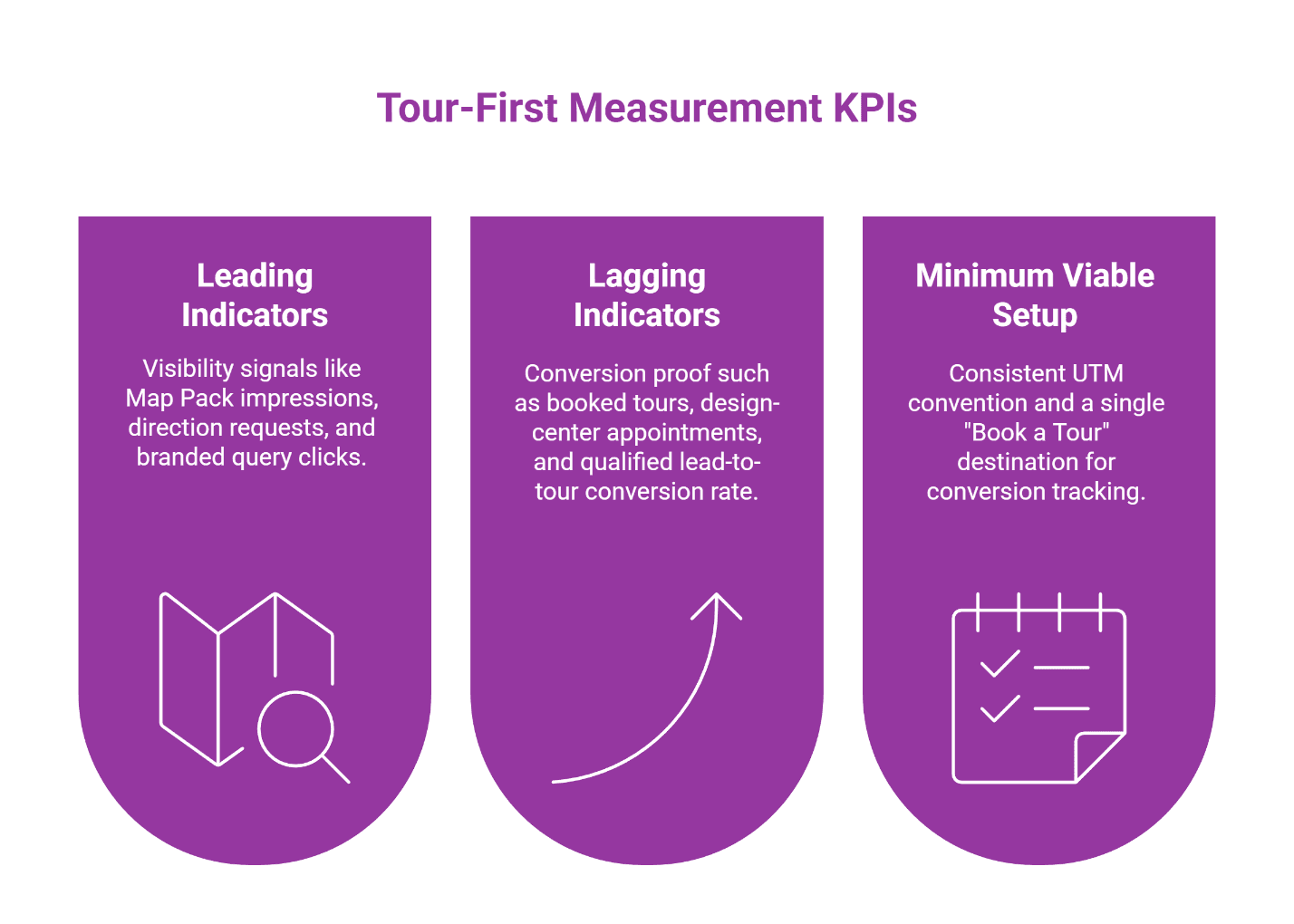
Structure your KPIs as a ladder:
Leading indicators (visibility signals):
- Map Pack impressions for each model center
- Direction requests and click-to-call actions
- Branded and geo-modified query clicks (e.g., "[Community Name] tours," "Parade of Homes [CITY]")
- Event landing page engagement (scroll depth, CTA clicks)
Lagging indicators (conversion proof):
- Booked model-center tours
- Design-center appointments
- Qualified lead-to-tour conversion rate (as tracked in CRM stages)
The sprint succeeds when the lagging indicators move. Everything else is scaffolding. For a deeper breakdown of this measurement philosophy, see Tracking What Matters in Local SEO.
Minimum viable sprint measurement setup:
- A consistent UTM convention for every event and community link you control
- A single "Book a Tour" destination that fires a conversion event (and maps to a CRM status field, if possible)
Day-by-Day Plan: The Sprint Checklist
The checklist below covers 14 days of sequenced actions. Owners vary by organization, but the roles typically include Marketing, Web/CMS, Sales Ops, the Community Manager at each model center, and an Agency or SEO lead if external support is involved.
| Day | Objective | Owner | Actions | Output | Done |
|---|---|---|---|---|---|
| -14 | Confirm event URL + tracking plan | Marketing / Agency | Finalize event landing page URL; document UTM conventions; confirm booking conversion event fires correctly | Tracking plan document | ☐ |
| -13 | Build event landing page + Event schema | Web/CMS / Agency | Single-event focus; include schedule, location, and prominent "Book a Tour" CTA; implement Event structured data ensuring markup reflects visible content only | Published event page (via URL) or staged code snippet (via Code input) with validated schema (Rich Results Test) | ☐ |
| -12 | Update GBP basics + photo set | Community Manager | Verify NAP accuracy; upload fresh model photos; seed 2–3 Q&A pairs | Updated Google Business Profiles | ☐ |
| -12 | Indexation hygiene | Agency / Web | Submit updated sitemap; run URL Inspection for event page; confirm no crawl errors | Indexation confirmation | ☐ |
| -11 | Publish GBP event post | Marketing | Policy-compliant post announcing the event with date, time, and CTA | Live GBP post per location | ☐ |
| -9 | Refresh top community pages | Web/CMS | Add tour-ready modules; update inventory callouts; strengthen internal links to event page | Refreshed community pages | ☐ |
| -8 | Publish broker pack | Marketing / Sales Ops | Approved copy blocks, correct URLs with UTMs, shareable images | Distributed partner kit | ☐ |
| -5 | Internal link audit | Web/CMS | Ensure event page linked from homepage, community pages, and nav where appropriate | Link map documented | ☐ |
| -3 | Final QA | All | Verify hours, directions link, booking form friction; mobile test all CTAs | QA sign-off | ☐ |
| -1 | Monitoring setup | Marketing / Agency | Configure daily check-in cadence; establish escalation path for issues | Monitoring protocol active | ☐ |
| 0 | Event day | All | Monitor operational signals (incoming calls, Q&A alerts); troubleshoot booking friction. (Note: GBP dashboard metrics are lagged 24-48h) | Daily status updates | ☐ |
If you only do five things:
- Confirm your event landing page has a single-event focus, correct Event schema, and a working "Book a Tour" CTA.
- Update each model center's Google Business Profile with accurate NAP, fresh photos, and a policy-compliant event post.
- Ensure UTM parameters are attached to every trackable link in partner materials.
- Verify the booking conversion event fires and data flows into your CRM.
- Run URL Inspection on the event page to confirm indexation before the event.
Local Track: Map Pack Readiness for Each Model Center
When buyers search "[CITY] new homes" or "model homes near me," the Map Pack often dominates. Each participating model center needs its own optimized Google Business Profile—not a single corporate listing covering multiple communities.
Key actions for each profile:
Category and attributes: Confirm "Home Builder" as the primary category. Add relevant attributes (e.g., "Wheelchair accessible entrance" if applicable).
Photos: Upload recent exterior shots, model interiors, and community amenity images. Dated or generic photos undermine credibility.
Q&A: Seed common questions ("What are your tour hours during the Parade of Homes?") and provide clear answers.
Event posts: Publish a post announcing the event. Keep copy factual and compliant with Google's content policies. Include the event date, time, and a CTA linking to the event page with UTM tracking.
Operational note: If you run multiple communities, avoid "profile conflation" by ensuring each model center's details are distinct and accurate—especially address and URL destinations.
For a detailed breakdown of profile optimization tactics, see Map Pack Mastery for Model Centers.
Content Track: Event Landing Page + Community Page Refreshes
The Event Landing Page
The event landing page carries most of the discovery weight. It should focus on a single event—not a list of all upcoming events on one URL. Google's Event structured data guidelines emphasize that each event needs its own unique URL to be eligible for event-rich results.
Event page requirements:
- Clear event name, date range, and hours
- Physical address with embedded map
- Prominent "Book a Tour" or "Schedule Your Visit" CTA
- Brief descriptions of participating communities with anchor links
Community Page Refreshes
For your top communities likely to benefit from event-driven interest:
- Add a contextual banner or module linking to the event page
- Update any inventory or availability callouts
- Strengthen the "Book a Tour at [Community Name]" CTA
- Ensure internal links connect the community page to the event page and vice versa
- Add self-routing links that help users navigate: "Nearest model center," "Available homes," "Floor plans," "Schedule a tour" (trackable)
The alignment between sales and marketing during this window matters. For handoff protocols that connect visibility to booked appointments, review Sales–Marketing Alignment for Tours.
Technical Track: Structured Data and Indexation Hygiene
Structured data helps search engines understand what the page is about. It does not guarantee rich results—Google decides eligibility and display based on multiple factors—but correct markup improves clarity.
Event Schema Implementation
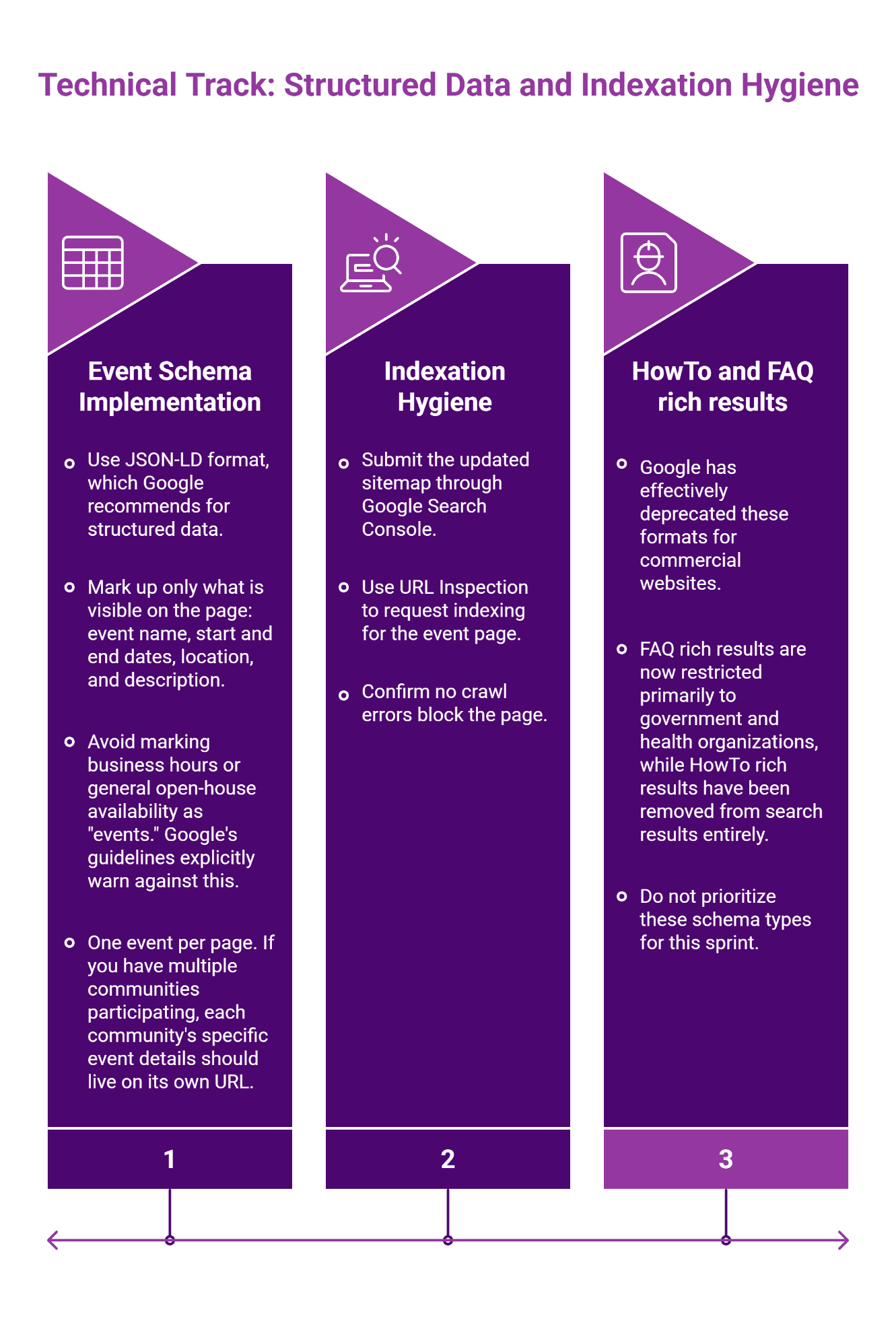
- Use JSON-LD format, which Google recommends for structured data.
- Mark up only what is visible on the page: event name, start and end dates, location, and description.
- Avoid marking business hours or general open-house availability as "events." Google's guidelines explicitly warn against this.
- One event per page. If you have multiple communities participating, each community's specific event details should live on its own URL.
For more on building pages that convert and pass technical muster, see the Perfect Page Blueprint approach.
Indexation Hygiene
- Submit the updated sitemap through Google Search Console.
- Use URL Inspection to request indexing for the event page.
- Confirm no crawl errors block the page.
A note on HowTo and FAQ rich results: Google has effectively deprecated these formats for commercial websites. FAQ rich results are now restricted primarily to government and health organizations, while HowTo rich results have been removed from search results entirely. Do not prioritize these schema types for this sprint.
Broker and Realtor Co-op Enablement
Realtors and brokers will share your event. The question is whether they share accurate information with trackable links—or outdated flyers with broken URLs.
Build a "broker pack" that includes:
Approved copy blocks: Pre-written descriptions for email, social, and MLS remarks (where external links are permitted). Keep them factual and free of claims you can't control once distributed.
Correct URLs with UTMs: Every link distributed via email or social should point to the right landing page with UTM parameters attached (e.g., utm_source=broker&utm_medium=email&utm_campaign=parade2024). This lets you attribute traffic and conversions back to partner efforts. Note: Most MLS platforms strip tracking parameters or prohibit external links in public remarks; verify local rules before including them.
Shareable images: Sized for social platforms, with event dates and community branding visible.
Contact for questions: A single point of contact for partners who need clarification.
Distribute the pack early enough that partners can schedule their communications—Day -8 in the sprint sequence.
Common Failure Modes (and Quick Fixes)
Marking non-events as events: Business hours, ongoing open-house availability, or "visit us anytime" messaging should not use Event schema. Google's documentation is clear: events have a defined start and end. Misuse can result in markup being ignored entirely.
One page listing many events: If multiple communities participate in the same Parade of Homes, each community's event details should have its own URL. A single page listing all events without unique child URLs dilutes relevance and limits rich result eligibility.
Missing or inconsistent UTMs: Without UTM parameters on partner links, broker pack links, and GBP post links, attribution breaks down. You'll see traffic but won't know where it came from—or which channels drove actual tour bookings.
Stale GBP content: A profile with two-year-old photos and unanswered Q&A signals neglect. Buyers researching luxury homes notice. Refresh content before the event window opens.
Broken booking forms: Test the full booking flow on mobile. A form that works on desktop but fails on a phone undermines the entire sprint.
Wrong destination URLs in GBP: If your profile links to a generic homepage, you leak intent. Point to the most relevant, trackable page.
Post-Event Carryover: Keep What Worked
The event ends; the pages don't have to disappear. Convert the event landing page into an evergreen recap: "Missed the [YEAR] Parade of Homes? Schedule a private tour." Keep the URL live so any backlinks or saved bookmarks continue to resolve.
Harvest what you learned:
- Which GBP posts drove the most direction requests?
- What Q&A topics surfaced repeatedly?
- Which broker partners generated trackable conversions?
Document answers and fold them into your next sprint. The goal is a repeatable launch motion—not a one-time scramble. If you run multiple communities, this becomes your repeatable schedule-aware SEO for communities motion.
What to Do Next
Ready to build a schedule-aware SEO program that aligns with your release cycles and measures what matters?
Revolutionize Your Content Strategy.
Disclaimer: This content is intended as an informational framework. Structured data implementation and platform policies may change; always verify against current documentation from Google Search Central and Google Business Profile Help.
Our Editorial Process: Our expert team uses AI tools to help organize and structure our initial drafts. Every piece is then extensively rewritten, fact-checked, and enriched with first-hand insights and experiences by expert humans on our Insights Team to ensure accuracy and clarity.
About the Brazos Valley Marketing Insights Team: The Brazos Valley Marketing Insights Team is our dedicated engine for synthesizing complex topics into clear, helpful guides. While our content is thoroughly reviewed for clarity and accuracy, it is for informational purposes and should not replace professional advice.

About the Author
Dustin Ogle
Dustin Ogle is the Founder and Head of Strategy at Brazos Valley Marketing. With over 9 years of experience as an SEO agency founder, he specializes in developing the advanced AI-driven strategies required to succeed in the new era of search.