
Neighborhood Content Clusters: Build Geo-Intent Hubs Without Cannibalizing Brand Terms
Last Updated: 03 December 2025 • 12 min read
📌 Key Takeaways
Buyers researching neighborhoods don't yet know your brand—capture them before competitors do.
- Separate Discovery from Navigation: Neighborhood cluster pages target location-based searches from buyers who know where they want to live but haven't chosen a builder, while brand community pages serve existing awareness queries.
- Route Intent Through Proximity: Link cluster content to the geographically nearest community using descriptive anchor text, ensuring relevance signals favor the appropriate destination over distant alternatives.
- Build Specificity Into Every Detail: Replace vague descriptions like "close to downtown" with precise information such as "18 minutes to downtown in typical traffic," establishing genuine local expertise that differentiates you from generic competitors.
- Track Visibility Through to Revenue: Measure local pack impressions and cluster traffic as leading indicators, then connect them through UTM parameters and CRM attribution to the metrics that matter—booked model-center tours and closed sales.
- Publish Before Communities Launch: Release neighborhood guides 60-90 days before breaking ground on new developments, building topical authority that ensures maximum search visibility when tour bookings open.
Clusters turn local search visibility into physical appointments by meeting buyers in their research phase.
Marketing directors and sales teams at luxury homebuilders will find the implementation framework here, preparing them for the detailed cluster-building strategy that follows.
Tours book when buyers find you.
Picture a marketing director at a luxury homebuilder staring at their analytics dashboard. Traffic to community pages looks decent, but something feels off. Searchers typing "[Neighborhood name] new homes" or "best neighborhoods near [ZIP] for luxury construction" land on generic location pages or worse—competitor sites. Meanwhile, the builder's brand pages rank fine, but those brand searches were coming anyway. The real growth opportunity, the non-brand geo intent that signals active home shopping, slips through the cracks.
You need a system that captures these high-intent neighborhood searches and routes buyers to the nearest relevant community page without diluting your brand terms. That system is a neighborhood content cluster.
What a Neighborhood Cluster Is (and Why Builders Need One)
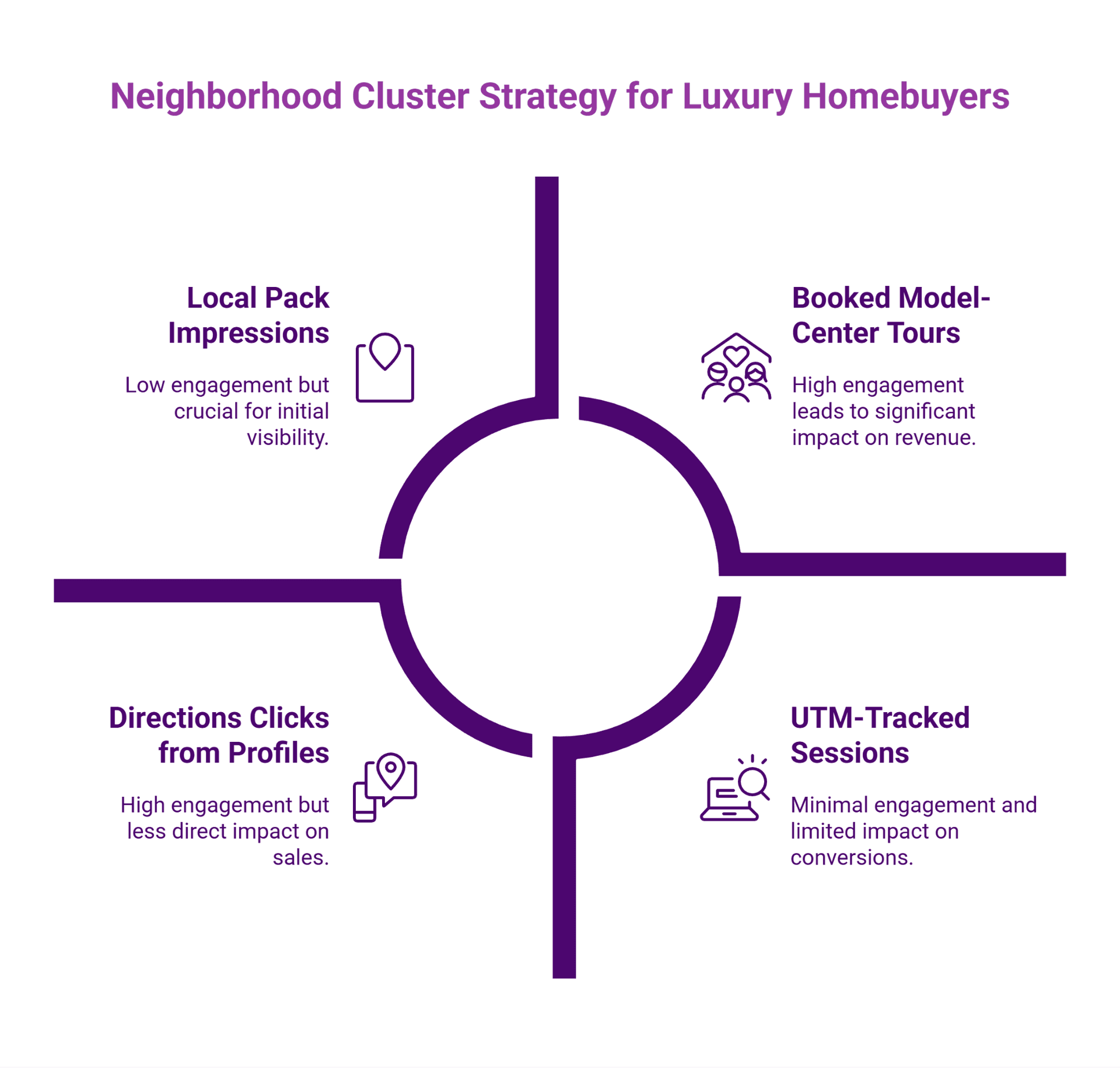
A neighborhood content cluster is a collection of in-depth, location-specific content hubs that target non-brand geographic queries. Each guide focuses on a specific neighborhood, ZIP code area, or geographic theme (such as "lakefront communities" or "top-rated school districts") within your market. Unlike your brand-driven community pages, these clusters exist to capture discovery-stage searches from buyers who know where they want to live but haven't yet identified which builder or community fits their needs.
The “Intersection Signage” Analogy
Think of neighborhood clusters as intersection signage on a highway. Your brand pages are the destination itself. Clusters are the directional signs placed miles before the exit, guiding travelers who know the general area but need routing to the specific community that matches their criteria. Without those signs, buyers miss the turn. With them, you control the journey from research to tour booking.
ROBO Behavior and Tour-First KPIs
Luxury homebuyers exhibit strong Research Online, Buy Offline (ROBO) behavior, spending weeks or months evaluating neighborhoods, school ratings, commute times, and amenity access before ever visiting a model center. Search data consistently shows that "near me" and location-specific queries dominate how people discover local options, making neighborhood-focused content essential for capturing this intent.
Your measurement framework must reflect this reality. Leading indicators include local pack impressions, "Directions" clicks from profiles, and UTM-tracked sessions from cluster pages. When properly tracked through CRM attribution modeling, these early engagement signals can correlate with lagging indicators that matter most: booked model-center tours and design-center appointments. This leading-to-lagging KPI structure provides a framework for tracking the journey from visibility to revenue, though the strength of these correlations will vary by organization and requires internal validation to confirm. Every cluster page should ultimately aim to facilitate that physical visit.
The Governance Layer: Keep Brand Navigation Separate
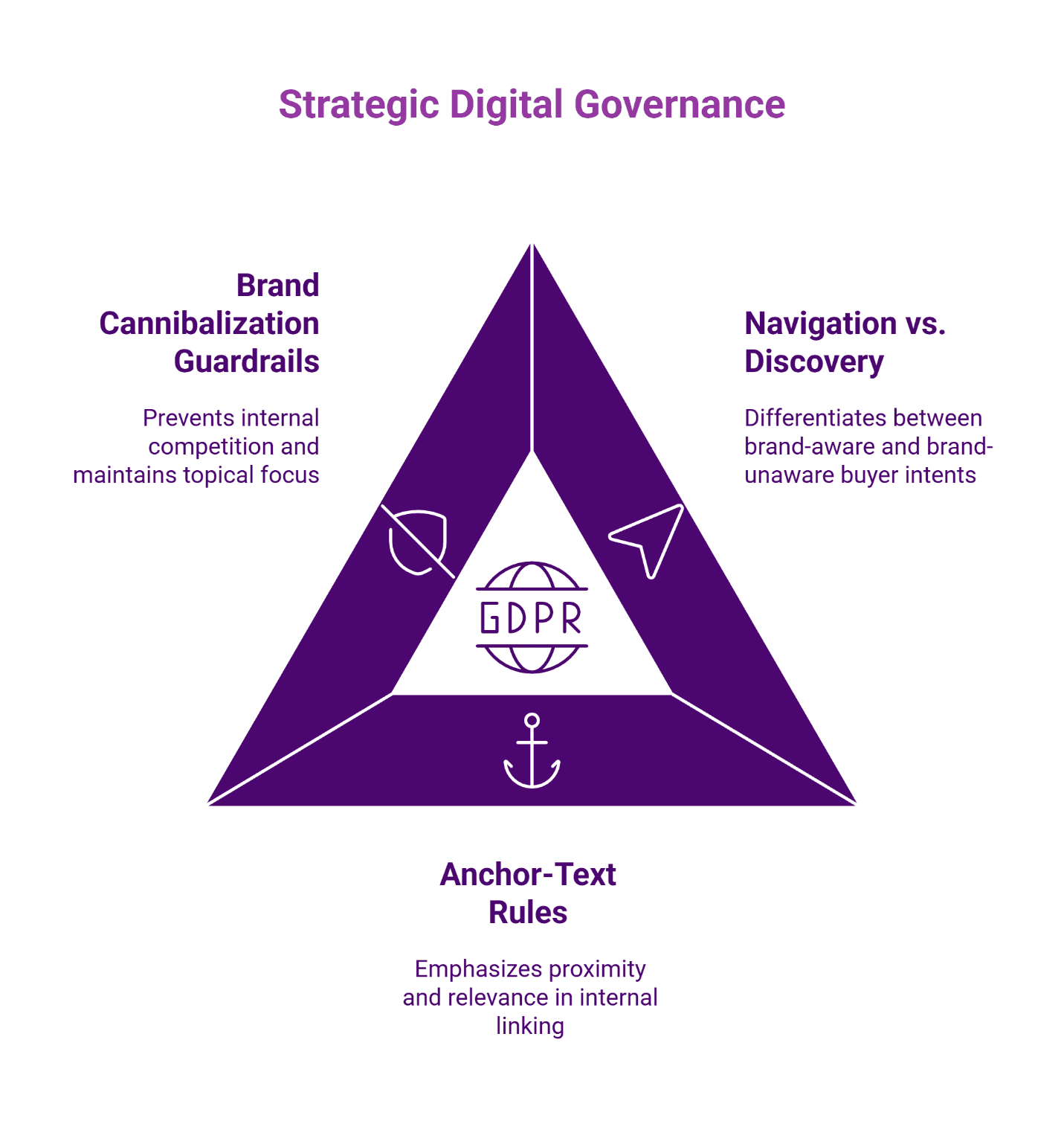
Managing the relationship between neighborhood clusters and brand pages requires strategic choices. When someone searches "[Your Builder Name] + [City]" or "[Community Name] homes," they already know who you are. That's navigational intent. Clusters exist to capture discovery intent from buyers who don't yet know your brand.
Navigation vs. Discovery: Page Types and Intents
One effective approach is establishing clear boundaries. Brand pages (your community landing pages with floor plans, pricing guides, and tour CTAs) target navigational queries. Cluster pages target informational and commercial investigation queries about neighborhoods themselves. The distinction in URL structure, internal linking strategy, and on-page optimization helps these page types serve different purposes.
It's worth noting that some SEO strategies favor "SERP domination," where ranking both a brand page and a neighborhood page for the same query can push competitors off the first page entirely. The governance approach outlined here prioritizes clean separation to avoid internal competition for brand terms, which may be particularly valuable for builders with limited resources or those operating in markets with well-established brand recognition. The optimal strategy depends on your competitive landscape and organizational priorities.
Anchor-Text Rules That Prefer the Nearest Relevant Community
When linking from a cluster page to a community page, anchor text and link placement must follow a proximity principle. If your cluster discusses "[Neighborhood A]" and you operate communities in both "[Neighborhood A]" and "[Neighborhood B]," the primary link must route to the "[Neighborhood A]" community. Use descriptive anchors like "explore our [Neighborhood A] community" rather than generic "click here" text. This ensures relevance scoring favors the geographically appropriate destination.
When to Not Link (Brand Cannibalization Guardrails)
Avoid linking cluster pages back to broad brand pages or homepage URLs when a specific community is the better destination. Similarly, resist the urge to stuff every cluster with links to all your communities. Overloading internal links dilutes topical focus and confuses both users and search engines about the page's primary purpose. Link only when the connection adds genuine navigational value for the reader.
Run a monthly cannibalization audit to catch issues early. Check whether neighborhood guides are inadvertently ranking for pure brand queries, and adjust internal linking patterns or anchor text accordingly to maintain the navigation-versus-discovery separation.
Page Anatomy: The Perfect Neighborhood Guide
A high-performing neighborhood cluster page reads like a field-ready briefing for a sales rep: practical, specific, and grounded in place. Essential modules include a neighborhood overview section establishing context and boundaries, an amenities breakdown covering parks, shopping, dining, and recreation, commute analysis with drive times to major employment centers, school district information with ratings and boundaries, an embedded map showing the neighborhood in relation to your communities, and a "nearby communities" section linking to your relevant properties.
Build specificity into every module. Rather than stating "close to downtown," write "approximately 18 minutes from [Community] to downtown [City] in typical traffic." Instead of "near parks," specify "2.3 miles from [Community] to [Park Name]." This level of detail signals genuine local knowledge and helps buyers visualize their daily routines.
For school districts and geographic boundaries, reference authoritative sources like U.S. Census Bureau TIGER data to ensure accuracy. Misrepresenting school zones or neighborhood limits erodes trust quickly with buyers who cross-reference multiple sources.
Instead of “close to downtown,” write “approximately 18 minutes from [Community] to downtown [City] in typical traffic.” Instead of “near parks,” specify “2.3 miles from [Community] to [Park Name].” This detail signals real local knowledge and helps buyers visualize daily routines.
Schema markup amplifies machine readability. Implement Place schema for the neighborhood itself, LocalBusiness schema if referencing specific amenities, and FAQ schema for common questions about the area. This structured data helps search engines understand geographic relationships and surface your content in rich results.
CTA placement should feel natural, not forced. A primary "Book a Tour at [Community Name]" button works best after the commute or schools section, when buyers have absorbed enough information to consider a visit. A secondary "See All [City] Communities" link in the conclusion provides an alternative path for browsers not ready to commit to a single location.
Building the Cluster: From One Guide to a Geo Hub
Start with topic selection aligned to actual search behavior and upcoming community releases. Themes might include "best neighborhoods for families in [City]," "luxury lakefront communities near [ZIP]," or "new construction in top-rated school districts." Each theme should have measurable search volume and clear alignment with at least one of your active or soon-to-launch communities.
Publication schedules matter. If you're breaking ground on a new community in "[Neighborhood X]" in Q2, publish the "[Neighborhood X]" cluster guide in Q1. This builds topical authority before your community page goes live, ensuring maximum visibility when tour bookings open. Coordinate with your sales and development teams to align content launches with market readiness.
Review prompts that incorporate neighborhood context help build authentic local signals. After model-center tours, encourage buyers to mention the specific neighborhood in their feedback: "What do you enjoy most about living in [Neighborhood] near [Community]?" or "How is your commute from [Community] to [Employment Center]?" These authentic references, when published as testimonials or reviews, strengthen geographic relevance signals across your digital presence.
Routing Rules: How to Pass Intent to the Right Community
The link-routing decision tree prioritizes three factors in sequence: geographic proximity between the discussed neighborhood and your communities, feature or lifestyle fit between the neighborhood's character and your community's positioning, and price point alignment when multiple communities are equidistant. Consider a buyer researching "[Lakefront Neighborhood A]." If you operate both a lakefront community two miles away and a golf course community five miles away, proximity and thematic fit both favor routing to the lakefront property.
If multiple communities qualify equally, apply a tie-break ladder: shortest drive time first, then best match to page theme, then inventory depth and phase status. Only after this systematic evaluation should multiple communities receive equal prominence on the page.
UTM governance ensures proper attribution. When a cluster page links to a community page, append parameters like ?utm_source=cluster&utm_medium=internal&utm_campaign=neighborhood-[slug]&utm_content=body-link. When Google Business Profiles link to cluster pages, use ?utm_source=gbp&utm_medium=local&utm_campaign=profile-to-cluster. Consistent tagging allows your CRM to track the full journey from initial neighborhood research through tour booking.
Before publishing any cluster page, run a QA checklist. Check for duplicate content across similar neighborhood guides using text comparison tools. Verify canonical tags point to the correct version if you've created multiple pages for the same neighborhood. Test that noindex tags are removed from all pages meant to rank. Confirm internal links follow the "prefer nearest community" rule without exception. Review mobile rendering, as many local searches happen on smartphones during weekend drive-bys.
Measurement: From Visibility to Booked Tours
Your KPI ladder connects search visibility to revenue. At the top, track local pack impressions and rankings for target neighborhood queries. These indicate discoverability. Mid-funnel metrics include organic sessions to cluster pages, "Directions" clicks from your Google Business Profiles, and time-on-page for cluster content. These signal engagement. Bottom-funnel conversions are tracked through form submissions from cluster pages, phone calls with UTM attribution, and ultimately, CRM records showing "Tour Booked" status originating from neighborhood cluster traffic.
Dashboard fields and ownership should follow a clear handoff protocol. Marketing owns cluster page performance metrics (rankings, traffic, engagement). Sales owns tour conversion metrics (appointments booked, show rate, close rate). Regular alignment meetings between marketing and sales teams ensure both sides understand how neighborhood cluster traffic contributes to pipeline and revenue. This shared accountability prevents the common trap where marketing celebrates traffic growth while sales complains about lead quality.
5 Neighborhood Cluster Outlines
To accelerate implementation, here are five ready-to-adapt cluster outlines that map to common luxury-buyer themes:
Family-Focused School District Guide — Targets parents prioritizing education quality.
Lakefront & Waterfront Lifestyle Overview — Appeals to buyers seeking water access and recreation
Golf Community Comparison —Attracts affluent buyers interested in country club living
Downtown-Adjacent Neighborhoods — Captures urban professionals wanting city proximity with suburban space
Gated & Master-Planned Communities — Addresses security and amenity-conscious buyers
Each outline includes pre-structured H2 sections, sample amenity breakdowns, school data placeholders, a suggested internal linking map, and review prompt templates. Adapt these by replacing [City], [ZIP], and [Neighborhood] placeholders with your actual market geography.
The next step after deploying clusters is ensuring your Google Business Profiles for each community are claimed, verified, and fully optimized. Complete profiles with accurate addresses, hours, photos, and UTM-tagged website links create a seamless handoff from local search to cluster content to community pages.
FAQ: Avoiding Cannibalization, City vs. ZIP, and Multi-Community Markets
What to Do Next
Start by claiming and optimizing location profiles for all active communities if you haven't already. Wire up UTM parameters across profiles, cluster pages, and community pages to enable full-funnel attribution. Then consider shipping an initial cluster version by selecting your top three neighborhood themes, drafting focused guides using our Perfect Page Blueprint™, and publishing with proper schema markup and internal linking. While some organizations may target a two-week cadence for this initial launch, the feasible timeline will vary based on your team's capacity and approval processes.
Measure progress weekly against leading indicators and monthly against tour bookings. Adjust topic selection, routing rules, and CTA placement based on what drives actual appointments, not just traffic volume. Combine this tactical work with a Deep Content Architecture™ strategy that builds topical authority across your entire service area, and you'll establish a sustainable advantage in markets where every competitor fights for the same brand-driven searches.
If implementation feels overwhelming or you need guidance on adapting this framework to your specific market dynamics, book a call with our team. We'll help you build neighborhood clusters that turn local search visibility into booked model-center tours.
Disclaimer: This article provides a strategic framework for neighborhood content clusters as an educational resource. Implementation success depends on market-specific factors, competitive dynamics, and execution quality. Consult with SEO professionals familiar with local search and homebuilder marketing for tailored guidance.
Our Editorial Process: Our expert team uses AI tools to help organize and structure our initial drafts. Every piece is then extensively rewritten, fact-checked, and enriched with first-hand insights and experiences by expert humans on our Insights Team to ensure accuracy and clarity.
About the Brazos Valley Marketing Insights Team: The Brazos Valley Marketing Insights Team is our dedicated engine for synthesizing complex topics into clear, helpful guides. While our content is thoroughly reviewed for clarity and accuracy, it is for informational purposes and should not replace professional advice.

About the Author
Dustin Ogle
Dustin Ogle is the Founder and Head of Strategy at Brazos Valley Marketing. With over 9 years of experience as an SEO agency founder, he specializes in developing the advanced AI-driven strategies required to succeed in the new era of search.