Local SEO for Luxury Home Communities: A Complete Playbook to Win Affluent ZIP & City Searches and Drive Booked Tours
Last Updated: 12 December 2025 • 12 min read
📌 Key Takeaways
When affluent prospects search "[ZIP] luxury homes" or "[City] new construction," they expect to land on a page that immediately confirms their location and provides a clear path to tour—not a generic homepage that makes them work to find what they need.
- One Community, One Asset: Each active community requires its own standalone page optimized for specific ZIP and neighborhood queries, with dedicated Google Business Profile, unique local phone number, and structured data that establishes it as a distinct entity in search algorithms.
- Map Pack Dominance Signals Tour Intent: The local three-pack occupies premium mobile real estate where most qualified searches happen, and visibility requires complete Business Profiles with booking links, consistent NAP data across all listings, and strategic review velocity that demonstrates ongoing activity.
- Neighborhood Clusters Intercept Early Research: Content targeting "[City] best neighborhoods" and "[ZIP] new construction" captures top-of-funnel demand before prospects identify specific builders, routing this traffic through editorial content to geographically relevant community pages via strategic internal linking.
- Tour Bookings Replace Traffic Vanity: Attribution tracking with UTM parameters from every traffic source into CRM status fields like "Booked Tour" and "Tour Completed" creates closed-loop measurement that calculates actual SEO contribution to sales pipeline, not meaningless impression counts.
- Launch Visibility 60-90 Days Pre-Opening: Schedule-aware rollout sequences Google Business Profile creation, community page indexing, and initial review collection to build ranking signals before model center doors open, preventing the costly visibility gap most builders face at launch.
Prepared local SEO infrastructure turns organic search from a traffic report into a predictable tour-generation channel.
Luxury homebuilders managing multi-community portfolios will find the complete implementation framework here, preparing them for the detailed technical specifications and quality control checklists that follow.
When a prospect searches "luxury homes near me" or "new construction in [ZIP]," where does that click land? For most builders, it's a homepage built for corporate messaging, not conversion. The traffic arrives, bounces, and the tour calendar stays empty.
Local SEO for luxury home communities is the digital equivalent of placing clear intersection signage at every major road leading to your model centers. It ensures affluent ZIP and city searches route directly to the right community page, your Google Business Profile appears in the map pack for each location, and neighborhood-level content captures non-brand demand before competitors do. Done correctly, it transforms organic search from a vanity metric into a tours-first revenue channel measured by booked appointments and design-center visits.
This playbook breaks down the complete system: community-level assets, map-pack optimization, neighborhood content clusters, review velocity, and schedule-aware rollout aligned to your release dates. Think of it as your digital site superintendent coordinating every trade to ensure the right intent lands on the right page at the right time.
Affluent ZIP Intent Demands Community-Level Assets
Consider what happens when a qualified prospect types "[City] luxury homes" or "new construction [ZIP]" into Google. They're not researching the category. They're hunting for a specific location.
If your organic strategy relies on a single "Communities" index page or funnels all geo-intent to the homepage, you're asking searchers to do the work. They must scroll, filter, and guess which community matches their target area. Most won't. They'll click back to the search results and find a builder who's already done the filtering for them.
Each active community requires its own standalone page, optimized for its specific geography. This isn't about technical SEO pedantry. It's about user intent alignment. When someone searches "[Neighborhood] custom homes," they expect to land on a page that immediately confirms they're in the right place, showcases available floor plans, and provides a clear path to book a tour.
The technical mechanics matter here. Search engines parse location signals from multiple sources: the page URL, title tag, H1 heading, body content, and most critically, the associated Google Business Profile. If five communities share a single generic page, none of them can rank competitively for specific ZIP or neighborhood queries. You've diluted the signal across all locations instead of concentrating relevance where it counts.
A well-structured community page includes the location name in the URL slug (/communities/[community-name]-[city]), leads with the full community name and city in the H1, and provides precise address information linked to the corresponding map profile. This creates what search algorithms recognize as a strong local relevance signal, which directly influences rankings for geo-modified queries.
This is the foundational principle of our Deep Content Architecture™ approach for builders: match the granularity of your digital assets to the granularity of search intent. One community, one asset, one clear path to conversion.
Map-Pack Presence Signals Real-World Tour Potential
The local map pack is not a secondary consideration for luxury builders. Research consistently demonstrates that a significant share of Google searches include local intent and that local searches frequently lead to visits and offline purchases.[1] For high-consideration decisions like luxury homes, this connection is even more pronounced, making map-pack visibility a critical component of any ROBO (Research Online, Buy Offline) conversion strategy.
When prospects search for communities in a specific area, the map pack occupies premium screen real estate, particularly on mobile devices where most local searches occur. If your model center doesn't appear in those top three positions, you're invisible to a significant segment of qualified traffic.
Map-pack rankings operate on different signals than traditional organic results. Proximity to the searcher's location matters, but it's not the only factor. Google's algorithm weighs the completeness and accuracy of your Google Business Profile, the consistency of your NAP (Name, Address, Phone) data across the web, review volume and recency, and the strength of local citations.
For builders managing multiple communities, this creates a specific challenge. Each model center or design center should maintain its own verified Google Business Profile. Consolidating multiple locations under a single profile or using a corporate headquarters address dilutes local relevance and prevents you from appearing in searches specific to each community's geography.
The profile itself must be meticulously maintained. Complete every available field: business description, hours (including special event hours), attributes, service areas, and multiple photo categories. Add posts regularly to signal ongoing activity. Most critically, ensure the business category selection aligns with how prospects search. "Home Builder" and "Custom Home Builder" are the primary categories; secondary categories like "Housing Development" or "Real Estate Developer" can provide additional coverage.
Here's where the tour-first mindset becomes operational. Your Business Profile should include a booking link directly in the profile's action buttons, using a tracking URL that identifies the source as Google Maps. This creates clean attribution from local pack impression to scheduled tour, the metrics that actually matter for sales pipeline forecasting.
Distinct Location Profiles Prevent Community Conflation
Builders operating multiple communities within the same market face a persistent problem: search engines struggle to differentiate between similar entities when the digital signals overlap. If three communities share the same corporate phone number, similar business names, and nearly identical descriptions, Google's algorithm may treat them as duplicate listings or, worse, conflate them into a single entity.
This isn't theoretical. Community conflation manifests as inconsistent map-pack appearances where the wrong location shows for a specific ZIP search, or one community's profile appears while another's remains suppressed. The outcome is the same: qualified local intent lands on the wrong page or bounces entirely.
The solution requires disciplined profile architecture. Each community needs a unique local phone number, even if it forwards to a central sales line. The business name should clearly distinguish locations (e.g., "[Builder Name] at [Community Name]" rather than just "[Builder Name]"). The business description must reference the specific community, nearby landmarks, and the distinct character of that location rather than using templated corporate language.
Website architecture must reinforce this separation. Each community's landing page should include schema markup identifying it as a distinct LocalBusiness entity with unique contact information and geographic coordinates. The page URL structure should be flat and descriptive (/communities/[community-name]), not buried under multiple subdirectories that dilute its authority.
Internal linking patterns matter here as well. Your neighborhood content (discussed in the next section) should link directly to the geographically closest community page, not to a generic communities index. This reinforces the topical and geographic relationship between content and creates clear navigation paths for both users and search crawlers.
When these elements align, each community can compete independently for its target ZIP and city queries without cannibalizing the others' visibility. Think of it as establishing clear jurisdiction lines on a development site map. Each trade knows exactly where they're working, and there's no confusion about responsibility or coverage.
Tour-Ready Community Pages Convert Local Intent
A community page that ranks well but doesn't convert is just expensive traffic. The distinction between a generic landing page and a tour-ready conversion asset comes down to how deliberately the page is architected to match the ROBO buyer journey.
Prospects arriving from local searches are already past awareness. They know they want a luxury home in a specific area. Your page must immediately answer three questions: Am I in the right place? What makes this community distinct? How do I visit?
The answer-first structure matters. Lead with a clear H1 that includes the community name and city, followed by a brief introductory paragraph that confirms the location and positions the community's primary differentiator. Don't bury the address. Place it prominently near the top, linked to the Google Maps profile, so mobile users can tap to navigate.
The core content should be organized around decision-making information, not marketing fluff. Available floor plans with renderings and square footage. Lot availability and premium lot features. Community amenities with specific details (e.g., "resort-style pool with lap lanes and cabanas," not just "luxury pool"). Pricing guidance, even if presented as ranges or starting prices, helps qualify traffic and sets expectations before the tour.
Visual hierarchy guides the eye toward conversion. High-quality photography should showcase model homes, community features, and the surrounding area. Video walkthroughs of model homes increase engagement and give prospects confidence about what they'll see on a tour. Interactive site maps that show lot availability create urgency and specificity.
The primary call-to-action must be unmissable and friction-free. "Schedule a Private Tour" buttons should appear above the fold and again after major content sections. The booking flow should be simple: select a preferred date/time, provide basic contact information, confirm. Every additional field or step reduces conversion rates.
For builders using our Perfect Page Blueprint™ approach, we implement a specific template structure that includes localized trust signals, such as testimonials from buyers in the same ZIP code area, partnerships with local designers or suppliers, and content highlighting nearby schools and amenities that matter to the affluent demographic.
The page should also include structured data markup for LocalBusiness and, where applicable, Event schema for upcoming open houses or VIP preview events. This enhances visibility in rich search results and helps search engines understand the relationship between the digital asset and the physical location.
Neighborhood Content Clusters Capture Non-Brand Geo Demand
Brand searches ("Google [Builder Name] [City]") indicate existing awareness. But the larger opportunity lies in non-brand geo-intent: prospects researching areas before they've identified specific builders. Queries like "best neighborhoods in [City] for families," "luxury homes near [landmark]," or "[ZIP] new construction" represent demand at the top of the funnel.
Neighborhood content clusters are designed to intercept this intent, establish topical authority around specific geographies, and route qualified traffic to the closest relevant community page. The cluster model works because it mirrors how affluent buyers actually research: they start with area selection before drilling down to specific communities and floor plans.
A typical cluster includes a pillar page covering a broader geography (e.g., "[City] Luxury Home Neighborhoods") and spoke pages for specific neighborhoods or ZIP codes within that area. Each spoke page provides genuine value: neighborhood characteristics, school ratings, proximity to employment centers, lifestyle amenities, and market context. The content is editorial, not promotional, because the goal is to rank for informational queries and build trust before introducing commercial intent.
The critical technical requirement is internal linking architecture. Each spoke page should link prominently to the geographically closest community page, creating a clear user path from research to conversion. This linking pattern also reinforces topical relevance signals for search algorithms, associating your communities with specific geographic areas in the index.
Content depth matters for ranking competitive geographic terms. A 300-word neighborhood overview won't outrank established local publications or real estate aggregators. Comprehensive guides in the 1,500-2,000 word range, updated regularly with current information, create the authority signals needed to compete. Include original photography, embedded maps showing your community's location relative to key landmarks, and genuine insights about what makes each neighborhood distinctive.
This approach feeds directly into our GEO & Knowledge Graph optimization strategy, ensuring your content appears not just in traditional search results but also in AI-powered overviews and answer engines that increasingly mediate how prospects discover information.
One implementation note: avoid creating neighborhood content for areas where you don't have an active community or a near-term development plan. The content must authentically connect to your inventory, or it creates friction when prospects realize you don't actually build in the area they researched.
Reviews & Reputation Amplify Trust and Relevance
Review velocity and recency directly impact local pack rankings and click-through rates. Recent consumer research reveals that approximately 75% of consumers regularly read online reviews for local businesses, and 71% will not consider businesses rated under 3 stars.[2] For luxury builders, where purchase decisions involve significant financial and emotional investment, this scrutiny intensifies dramatically.
The solution requires integrating review requests into your post-close process with the same discipline you apply to warranty walkthroughs. The optimal timing is 30-60 days after move-in, when buyers have had time to settle but the experience is still fresh and overwhelmingly positive. Automate the request through your CRM, personalizing the message and making the process as frictionless as possible by including a direct link to the relevant Google Business Profile.
For builders managing multiple communities, reviews must be distributed across each location's profile, not concentrated on the corporate profile. A community profile with 50 reviews carries more local relevance weight than a corporate profile with 200 reviews that don't specify location.
The content of reviews matters beyond the star rating. Reviews that naturally include location references, specific community names, and details about the buying experience provide rich local signals that search algorithms parse for relevance. You can't directly request this specificity without risking review policy violations, but you can achieve it indirectly by ensuring your review request mentions the specific community and asks buyers to share their experience with that location.
Responding to reviews is non-negotiable. Research shows that professional responses to both positive and negative reviews improve both perception and conversion rates.[2] Every review deserves a response that's specific to the reviewer's comments and reinforces your community name and location. These responses contribute to the profile's content depth and demonstrate active management, both of which influence rankings.
Photo reviews carry additional weight. Encourage buyers to share photos of their completed homes, design selections, or community amenities. User-generated visual content provides social proof and increases engagement with your profile, which feeds into Google's quality signals.
Negative reviews require careful handling. Respond professionally, acknowledge specific concerns, describe resolution steps taken, and offer to continue the conversation privately. The goal is to demonstrate accountability to future prospects reading the review thread, not to win an argument with the reviewer.
For builders launching new communities, consider running a soft-opening or VIP preview event and requesting reviews from invited guests, local real estate professionals, or design partners who can speak to the quality and vision of the project before buyer move-ins begin generating organic reviews. Consumer behavior data suggests that buyers particularly value recent reviews for high-stakes purchases, with many expecting to see feedback from within the last few weeks.[2]
Tour-First Measurement Replaces Vanity Metrics
Traditional SEO reporting for builders drowns in meaningless numbers. Impressions, clicks, and rankings matter only insofar as they drive the metric that actually counts: booked tours.
A tour-first measurement framework starts with attribution. Every traffic source must be tracked with UTM parameters that identify the campaign, source, and specific community. Your Google Business Profile action buttons should use tagged URLs (?utm_source=google&utm_medium=organic&utm_campaign=gbp&utm_content=[community-name]). Neighborhood content links to community pages should include tracking parameters that identify the referring page.
These UTM parameters must feed into your CRM alongside form submissions and phone tracking. The CRM should include specific status fields for "Booked Tour" and "Design-Center Appointment" so your sales team can mark conversions that originated from organic search. This creates the closed-loop attribution needed to calculate return on SEO investment accurately.
The KPI dashboard should be built around a conversion funnel that mirrors your actual sales process. At the top: non-brand geo-modified sessions landing on community pages or neighborhood content. Next level: engaged sessions (2+ minutes, multiple pages viewed). Then: contact events (form submissions, calls, chat initiations). Finally: tours booked and, separately, tours completed.
Track these metrics at both the portfolio level and the individual community level. A community that generates 500 geo-intent sessions but only two booked tours has a page conversion problem. A community with high tour bookings but low attendance has a follow-up problem or a qualification problem. The data tells you where to focus optimization efforts.
Beyond conversions, track competitive share metrics. Where do you rank versus key competitors for your target ZIP and city queries? What percentage of local pack appearances do you capture in your trade area? These metrics provide early warning signals when visibility shifts before it impacts pipeline.
For builders working with our team, we implement a standardized KPI field dictionary and ownership table that clarifies which metrics marketing owns (traffic, visibility, engagement) versus which metrics sales owns (tour show rate, conversion to contract). This prevents the common dysfunction where marketing celebrates traffic growth while sales complains about lead quality.
The objective is to transform SEO from a cost center measured by activity into an investment channel measured by contribution to sales pipeline. When you can demonstrate that community-level local SEO consistently generates 15-20 qualified tours per month with a 30% close rate, budget conversations change entirely.
Schedule-Aware Rollout Aligns to Release Dates & Events
A common mistake is treating local SEO as a post-launch tactic. By the time a community opens for tours, you've missed the critical window for building visibility and generating opening-day traffic.
Schedule-aware rollout means sequencing SEO implementation to match your development timeline. The Google Business Profile should be created and verified 60-90 days before model opening. The community page goes live 45-60 days out, giving search engines time to index and begin ranking the content. Initial reviews from preview events, design partners, or VIP tours should be collected during the soft opening phase so the profile shows activity and credibility at launch.
For communities with phased releases, the strategy adapts accordingly. When a new section opens, update the community page with new lot availability, create announcement content, and use Event schema to mark open houses or VIP preview dates. These time-sensitive signals can capture incremental search traffic around the specific event dates.
Grand opening events deserve their own landing pages with event-specific schema markup. A page optimized for "[Community Name] grand opening" can capture search traffic from prospects specifically researching upcoming events, and the event schema makes the page eligible for Google's event-rich results.
The neighborhood content clusters should be phased in strategically as well. Prioritize neighborhoods closest to your active communities first, establishing local authority in your immediate trade area before expanding to adjacent areas where you might develop in future phases.
Post-launch optimization follows a quarterly review cycle. Analyze which geo-intent queries are driving traffic, which pages have high bounce rates, where tour conversion is strongest. Use this data to refine content, update imagery, adjust CTAs, and expand the neighborhood content where demand signals warrant it.
For builders using a tours-first SEO program (discussed in the next section), the community-level local SEO component should be timed to launch 6-12+ weeks before broader category-level content initiatives. Establishing strong local visibility provides the foundation upon which awareness-building content can drive additional traffic to the right locations.
The Community Local SEO Blueprint
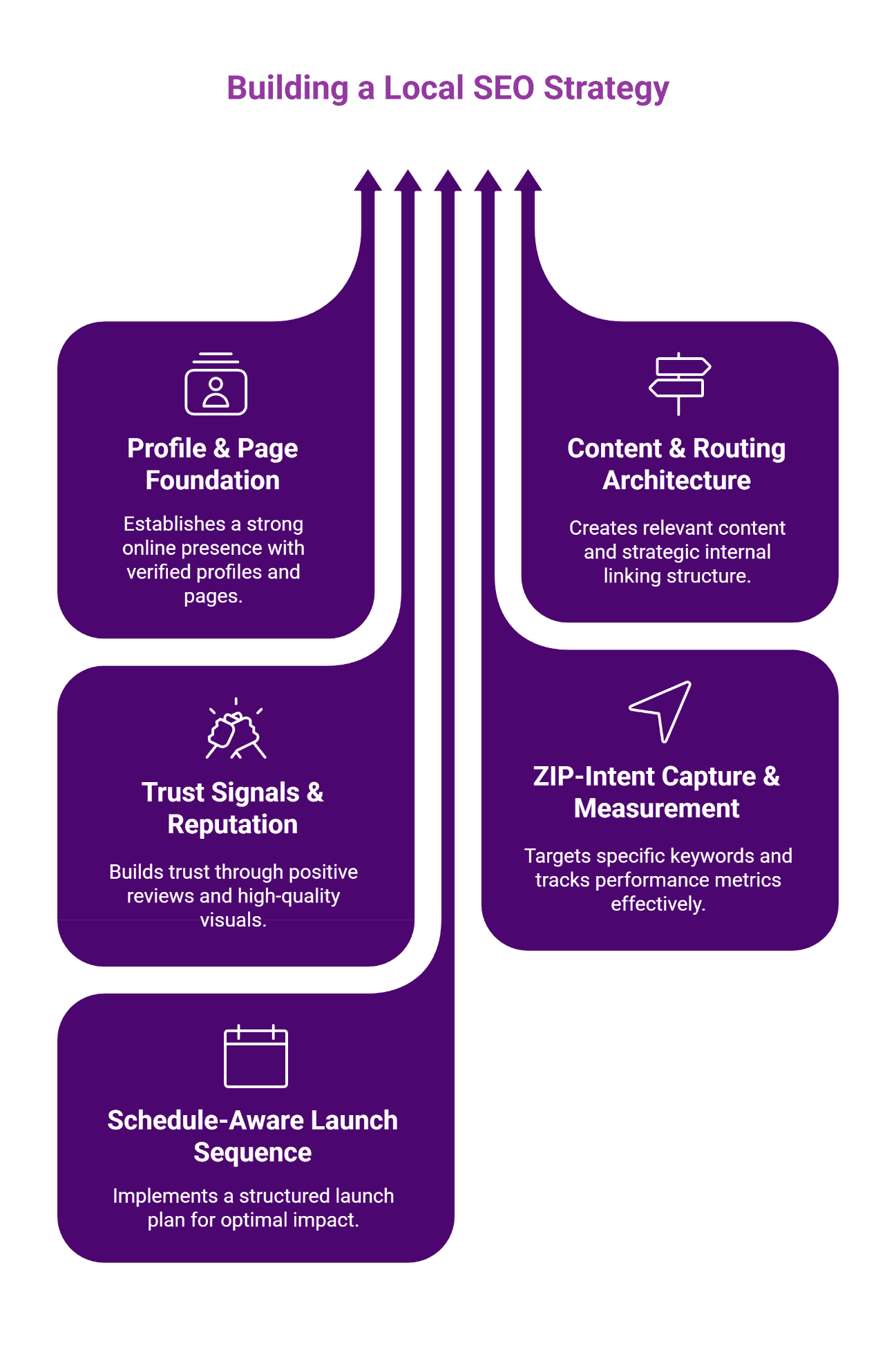
This framework consolidates the essential components into a scannable checklist for internal teams and agency partners.
Phase 1: Profile & Page Foundation
- Create verified Google Business Profile for each community/model center with unique local phone
- Launch standalone community page: /communities/[community-name] with full NAP, H1, schema markup
- Implement UTM tracking on all GBP action buttons and community CTAs
- Set up dedicated tour booking flow with CRM integration for "Booked Tour" status tracking
Phase 2: Content & Routing Architecture
- Develop neighborhood pillar page for broader market ([City] Luxury Neighborhoods)
- Create 3-5 spoke pages for high-intent ZIP codes or neighborhoods in trade area
- Establish internal linking: spoke pages → closest community page (prevent cannibalization)
- Optimize all pages for Professional readability, mobile-first design
Phase 3: Trust Signals & Reputation
- Collect 5+ reviews per community profile within first 90 days (post-close automation)
- Respond to all reviews within 48 hours with location-specific, personalized replies
- Add 20+ high-quality photos per profile (model homes, amenities, community features)
- Implement review request workflow at 30-60 days post-move-in
Phase 4: ZIP-Intent Capture & Measurement
- Target primary keywords: "[City] luxury homes," "new construction [ZIP]," "[Neighborhood] custom homes"
- Secondary clusters: "luxury home builders near me," "[Community Name] model homes"
- Set up tour-first KPI dashboard: geo-intent sessions → engaged visits → tours booked → tours completed
- Monthly rank tracking for portfolio and each community-level target query
Phase 5: Schedule-Aware Launch Sequence
- T-90 days: Create and verify GBP
- T-60 days: Launch community page, submit for indexing
- T-45 days: Begin neighborhood content cluster development
- T-30 days: Collect preview/VIP reviews, schedule grand opening event schema
- T-0 (Launch): Activate paid support for immediate visibility while organic matures
- T+30, T+60, T+90: Quarterly optimization based on conversion data
Governance & Quality Control
- UTM conventions: ?utm_source=[source]&utm_medium=organic&utm_campaign=local-seo&utm_content=[community-name]
- Campaign naming standards: Use patterns like local_gbp_[community]_[city]_[yyyy] for consistent CRM and analytics alignment
- CRM status fields: Booked Tour, Design-Center Appointment, Tour Completed, Contract Signed, No-Show
- NAP consistency audit across all profiles, directory listings, website footers
- Schema validation for LocalBusiness, Event, Breadcrumb, and FAQPage markup
Pre-Launch QA Checklist
□ All profiles verified with unique phone numbers and complete attributes
□ Community pages live with schema markup validated via Google's testing tool
□ Internal links from neighborhood content route to correct community pages
□ UTM tracking confirmed in analytics for all GBP and content-to-community links
□ CRM tour booking statuses active and tested with sample submission
□ Tour-first KPI dashboard configured with proper goal tracking
□ Review request automation scheduled and tested
□ Grand opening event pages (if applicable) with event schema live
Implementation Pitfalls and Inspection Checklist
Even well-planned local SEO rollouts encounter predictable failure points. Here's what to watch for during implementation and ongoing management.
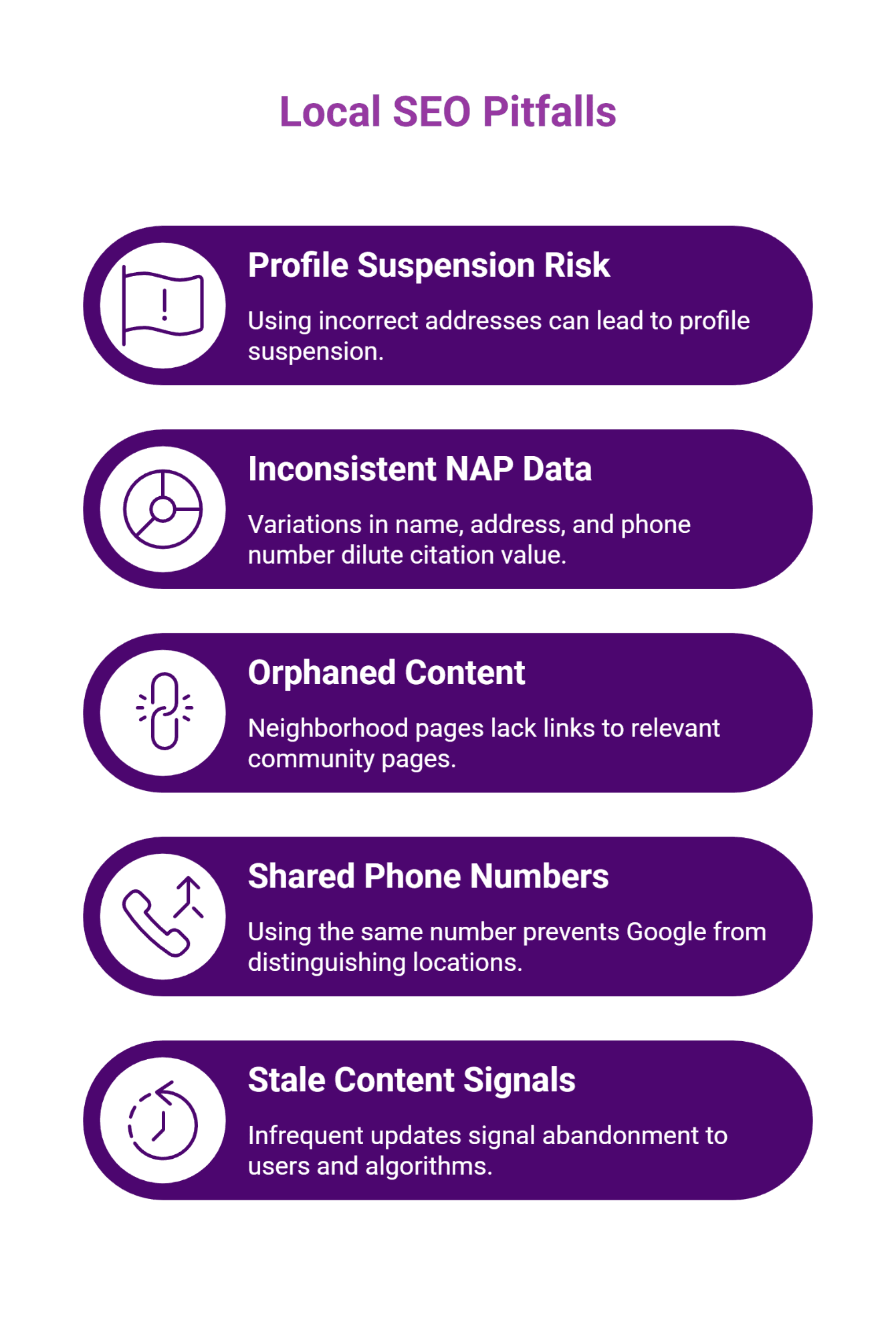
Common Pitfall 1: Profile Suspension Risk
Google aggressively polices Business Profiles for policy violations. Using a virtual office or a residential address for your corporate office while claiming it's a storefront location can trigger suspension. Solution: Only use physical model center addresses as storefront locations. If your main office isn't customer-facing, don't create a profile for it or mark it as a Service Area Business.
Common Pitfall 2: Inconsistent NAP Data
Your community's name, address, and phone number must match exactly across your website, Google profile, directory listings, and any third-party sites. Even minor variations ("Street" vs. "St." or including suite numbers inconsistently) dilute the citation value and can confuse search algorithms. Solution: Create a master NAP reference document and audit all mentions quarterly.
Common Pitfall 3: Orphaned Content
Neighborhood pages that rank well but don't link prominently to your communities generate traffic that goes nowhere. Solution: Ensure every neighborhood spoke page includes a clear call-out box or inline link to the relevant community page within the first two screen scrolls.
Common Pitfall 4: Shared Phone Numbers
Using the corporate switchboard number for all community profiles prevents Google from distinguishing between locations. Solution: Use call tracking numbers that forward to your sales team but present unique local numbers to Google and prospects.
Common Pitfall 5: Stale Content Signals
A community page that hasn't been updated since launch signals abandonment to both users and algorithms. Solution: Update pages monthly with new photos, current lot availability, upcoming events, or market context. Add regular posts to your GBP to signal ongoing activity.
Monthly Inspection Checklist
□ All GBPs active and not flagged for verification or policy issues
□ Community pages indexing properly (site:yoursite.com/communities check)
□ UTM tracking flowing into analytics with no broken parameters
□ Tour booking CRM integration functioning (weekly test submission)
□ New reviews collected and responded to within 48 hours
□ Community page content freshness (updated within 30 days)
□ Map pack rankings tracked for top 5 geo-modified queries per community
□ Tour booking conversion rates reviewed and compared to traffic volume
Where This Plugs Into a Tours-First SEO Program
Community-level local SEO is one component of a complete tours-first digital strategy. It captures existing demand from prospects who already know they want [City] or [ZIP]. But it doesn't create awareness among buyers who don't yet know your communities exist or haven't narrowed their search to a specific location.
A full-funnel program layers in category-level content that builds authority around broader search terms (e.g., "luxury home features," "custom home design process," "new construction vs. resale") and positions your brand before location research begins. This content drives traffic to a hub page that then routes visitors to the appropriate community based on their stated preferences or browsing behavior.
The integration points are specific. Your category content should include contextual links to your neighborhood pillar pages when discussing location considerations. Your neighborhood content should reference your broader category expertise to establish authority. And all paths should eventually funnel to community pages optimized for conversion.
For builders using our broader Integration Playbook, we map how community-level local SEO feeds into awareness content, how reviews collected at the community level support brand-level trust signals, and how tour booking data from local intent informs content prioritization for category-level assets.
The strategic principle is simple: meet prospects wherever they are in the journey. Local SEO captures bottom-funnel demand. Category content builds top-funnel awareness. Together, they create a complete system that consistently feeds qualified tour bookings into your sales pipeline.
Frequently Asked Questions
What to Do Next
Ready to dominate ZIP & city searches and drive predictable tour volume? Schedule your free Community Local SEO strategy session to receive a customized visibility assessment and implementation roadmap for your communities.
References
[1] Safari Digital, "Local SEO Statistics 2025," safaridigital.com.au, 2025. Available at: https://www.safaridigital.com.au/blog/local-seo-statistics/
[2] BrightLocal, "Local Consumer Review Survey 2024," BrightLocal, 2024. Available at: https://www.brightlocal.com/research/local-consumer-review-survey-2024/
Disclaimer: This article presents strategic frameworks and general principles for local SEO implementation. Actual results depend on market conditions, competitive landscape, implementation quality, and ongoing optimization. Always consult with qualified SEO professionals familiar with your specific business context before making significant digital marketing investments.
Ready to dominate ZIP & city searches and drive predictable tour volume? Schedule your free Community Local SEO strategy session to receive a customized visibility assessment and implementation roadmap for your communities.
Our Editorial Process: Our expert team uses AI tools to help organize and structure our initial drafts. Every piece is then extensively rewritten, fact-checked, and enriched with first-hand insights and experiences by expert humans on our Insights Team to ensure accuracy and clarity.
About the Brazos Valley Marketing Insights Team: The Brazos Valley Marketing Insights Team is our dedicated engine for synthesizing complex topics into clear, helpful guides. While our content is thoroughly reviewed for clarity and accuracy, it is for informational purposes and should not replace professional advice.

About the Author
Dustin Ogle
Dustin Ogle is the Founder and Head of Strategy at Brazos Valley Marketing. With over 9 years of experience as an SEO agency founder, he specializes in developing the advanced AI-driven strategies required to succeed in the new era of search.