Integration Playbook: Connecting Local SEO for Luxury Home Communities with a Tours-First SEO Program for Luxury Homebuilders
Last Updated: January 11, 2026 • 16 min read
📌 Key Takeaways
Local SEO for luxury home communities only delivers predictable tours when visibility, engagement, and booking metrics share one integrated handoff path.
- Integration Beats Isolation: Treat each community as a unified “location system” with shared UTM conventions and CRM statuses so Map Pack wins convert into attributable tour bookings.
- One Profile Per Community: Separate Google Business Profiles for each model center prevent visibility conflation and route buyers to the correct tour-ready page.
- The KPI Ladder Proves Causation: Track Map impressions → direction requests/calls → CTA clicks → booked tours to pinpoint exactly where conversions break.
- Template Governance Enables Scale: Standardized page structures with consistent CTAs, schema markup, and ownership rules prevent quality drift across multiple communities.
- Thirty Days to Integration: A four-week sprint covering data readiness, profile fixes, neighborhood routing, and dashboard setup stands up the full system before the next sales milestone.
Visibility is potential; booked tours are the proof.
Marketing directors and sales leaders at luxury homebuilder companies will gain a clear operational framework here, preparing them for the detailed alignment map and 30-day implementation plan that follows.
Three communities launching this quarter. Map Pack visibility climbing across all of them.
And yet the sales director's question hangs in the conference room like an unpaid invoice: Where are the tours?
Picture the disconnect. A buyer in your affluent ZIP code searches “new homes near [Specific Neighborhood].” Your community appears in the Local Pack. They tap for directions—maybe even call. But somewhere between that search and your model center, the thread snaps. No booking. No tour. No way to prove the SEO work mattered.
You've likely felt this tension before. High spend on community development, polished model centers, competitive inventory—and yet organic visibility stubbornly refuses to translate into showroom traffic. The anxiety compounds when sales milestones approach and marketing can't point to a clear line between search performance and booked appointments.
This playbook changes that. By the end, you'll have a single integration model that connects community-level Local SEO (profiles, map visibility, reviews, tour-ready pages) with a schedule-aware, tours-first SEO program (roadmaps, templates, attribution).
You'll leave with a one-page alignment map that tells marketing, sales, and web/ops what to build, when to build it, and how to prove it booked tours.
Local SEO wins for luxury home communities only matter if they reliably produce booked tours on schedule. The integration move is simple: treat each community as a location system (profiles, pages, reviews, neighborhood coverage) and treat your tours-first SEO program as the superintendent that coordinates content, technical, and local work against release dates.
When both layers share one KPI ladder—visibility → engagement → bookings—and one handoff path—UTMs → CRM statuses → tour SLAs—you turn geo intent into predictable showroom traffic across every community.
Why Local Visibility and Program Execution Break Apart
Two failure modes explain most of the frustration.
Failure Mode #1: You Rank, But Tours Don't Rise
The Map Pack looks healthy. Direction requests tick upward. But booked tours stay flat.
The problem isn't visibility—it's routing and conversion. Buyers land on pages that don't make the next step obvious. Tour CTAs hide below the fold or link to generic contact forms. Inventory data sits stale. The page answers “where is this community?” but never answers “how do I see it this weekend?”
When local SEO stops at the Map Pack and never connects to a tour-ready experience, visibility becomes a vanity metric.
Failure Mode #2: Tours Happen, But You Can't Prove SEO Caused Them
Sales reports a solid month. Marketing claims credit. But when leadership asks for attribution, the room goes quiet.
This happens when the handoff between digital touchpoints and CRM records doesn't exist. No UTM parameters on profile links. No CRM status that distinguishes “organic local” from “paid” or “referral.” No tour booking SLA that tells sales how quickly to follow up on a web lead versus a walk-in.
Without that handoff, tours become “dark”—they happen, but their source stays invisible.
What “Tours-First” Changes
A tours-first mindset stops optimizing for sessions, impressions, or even direction requests as endpoints. These become leading indicators—useful, but not the destination.
The destination is a booked tour or design-center appointment. Every local SEO activity gets evaluated by whether it moves buyers closer to that booking. Every reporting conversation starts with tour volume and works backward to the signals that predicted it.
“Visibility is potential; booked tours are the proof.”
The Executive Alignment Map: Inputs → Activities → Outcomes
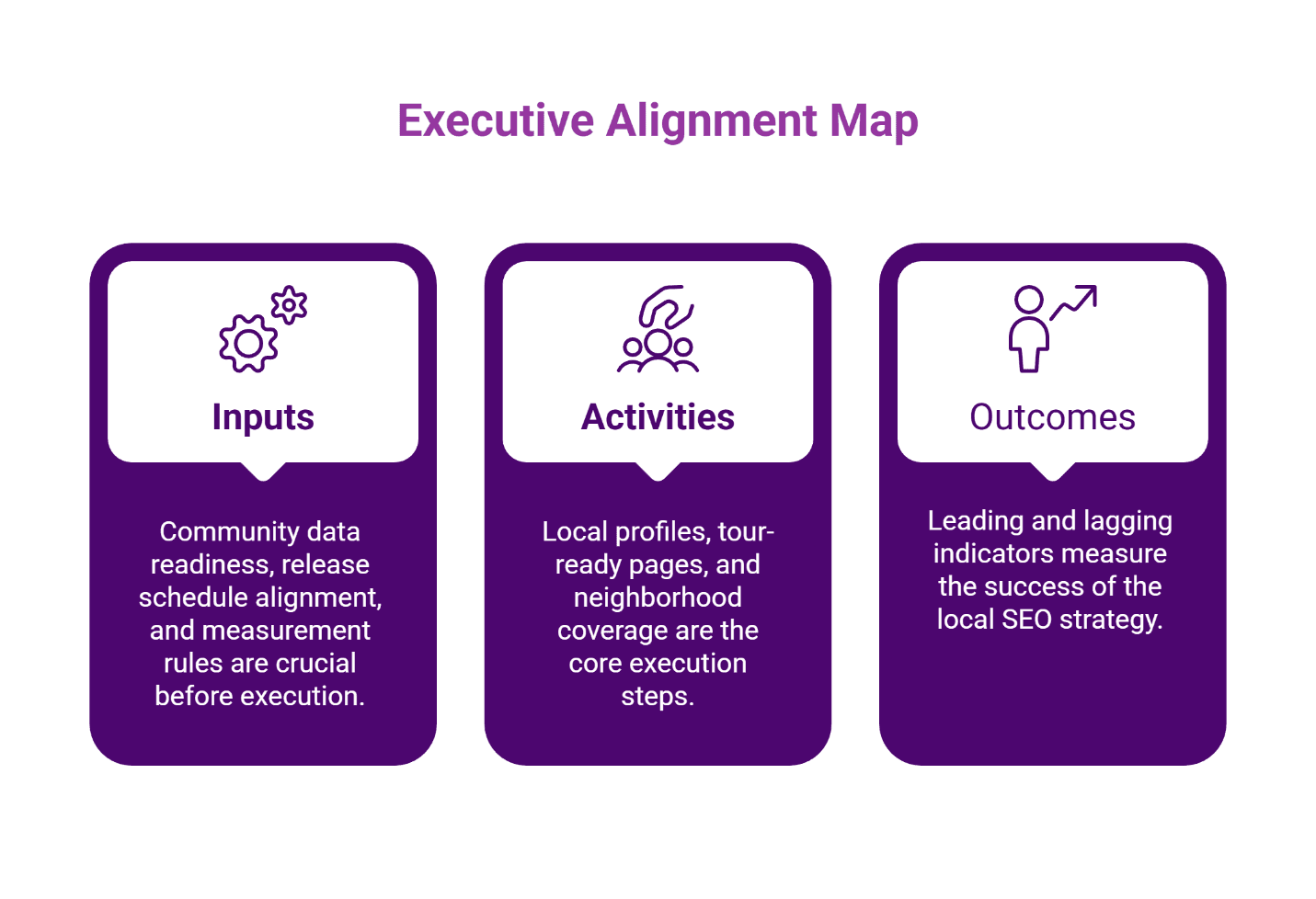
Before diving into tactics, stakeholders need a shared mental model. The Executive Alignment Map provides it—a single-page view of what must be ready, what gets executed, and what gets reported.
Inputs: What Must Be True Before Execution
Community data readiness. Each community needs accurate NAP (name, address, phone), model center hours, and a clear inventory of models and floor plans. If this data lives in disconnected spreadsheets or outdated CMS fields, local SEO work will stall.
Release schedule alignment. SEO execution must phase against sales milestones—grand openings, model releases, seasonal events. Building profiles and pages after a community launches wastes the demand surge that comes with a new release.
Measurement rules. Before publishing anything, define UTM conventions for profile links and CTAs, CRM statuses that capture lead source, and tour booking SLAs that set expectations for sales follow-up.
Activities: What Gets Executed
Local profiles and Map Pack readiness. One Google Business Profile per community or model center, with consistent categories, accurate hours, and tour-focused attributes.
Tour-ready community pages and model architecture. Each community gets a dedicated landing page optimized for geo-modified searches, with clear tour CTAs, current inventory modules, and internal links to model and floor plan pages.
Neighborhood coverage and internal routing. Content clusters targeting “[Neighborhood] homes” and “[City] new construction” queries, with clear internal links routing buyers to the nearest community that fits their search.
Outcomes: What Gets Reported
Leading indicators. Map impressions, direction requests, profile calls, and page engagement metrics. These signals forecast demand weeks before tours materialize.
Lagging indicators. Booked tours and design-center appointments attributed to organic local sources. This is the number that proves the integration is working.
Executive Alignment Map Reference Table
| Input | Activity | Output Artifact | KPI | Owner |
|---|---|---|---|---|
| Community NAP + hours | Profile setup & optimization | Live GBP | Map impressions | Marketing/Web |
| Model/Plan Inventory | Community page build | Tour-ready landing page | Page sessions | Marketing/Web |
| Release Schedule | Content phasing | Publish calendar | On-time delivery | Marketing/Ops |
| UTM Conventions | Link tagging | Tagged profile links | Trackable clicks | Analytics |
| CRM Status Defs | Lead source config | “Organic Local” status | Lead volume by source | Sales/Ops |
| Tour SLA | Sales workflow | Defined response time | Tour conversion rate | Sales |
Ready to build the content architecture that powers this flow? Explore our solutions to see how we build this architecture.
Layer 1: Community Local SEO That Routes Buyers to the Right Place
Think of community local SEO as the signage at every intersection. Done right, buyers never miss the turn.
One Profile Per Community or Model Center
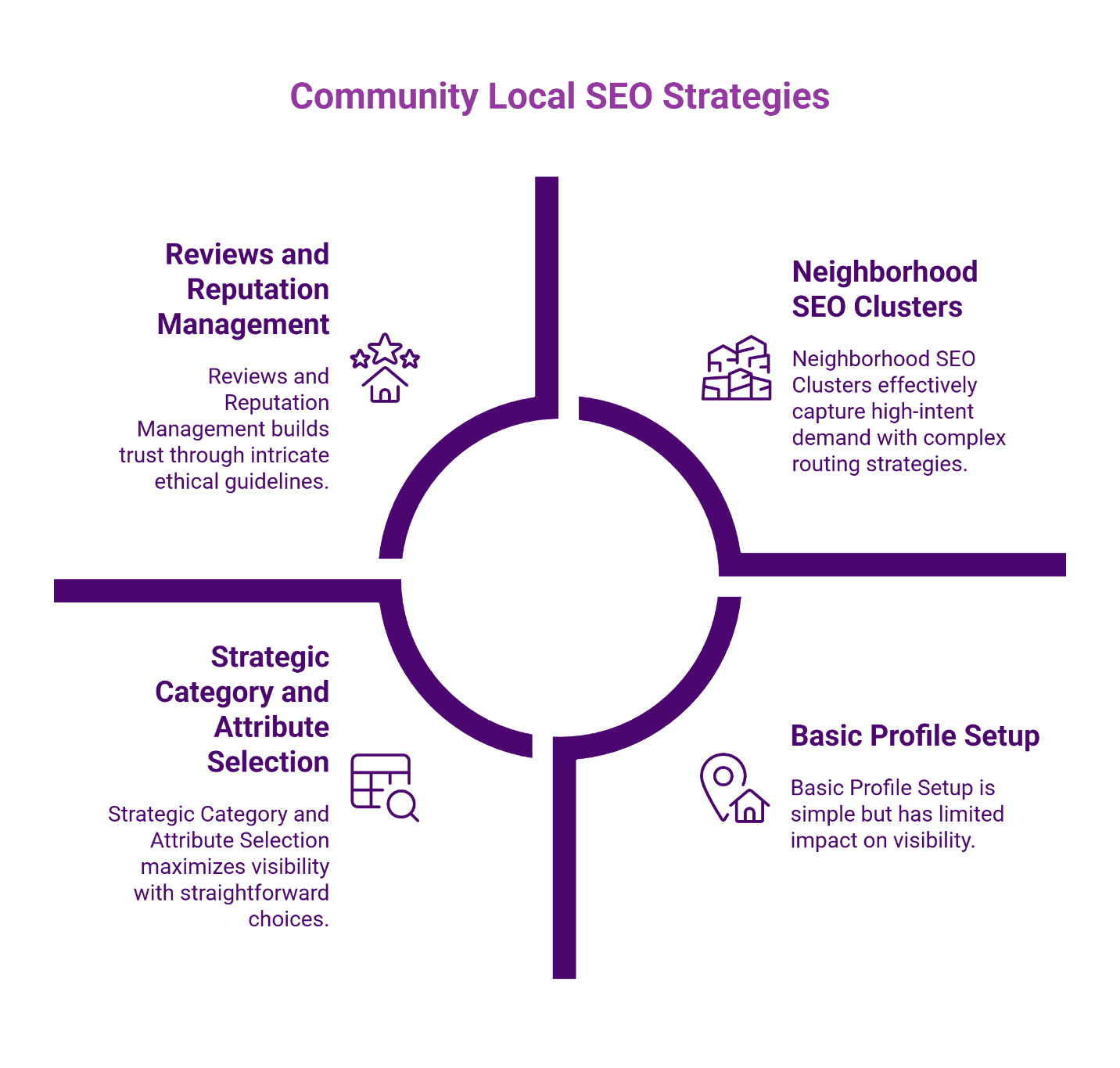
A common mistake: using a single brand-level profile to represent multiple communities spread across different ZIP codes. This conflates visibility and confuses local ranking signals.
Each community with a distinct model center address deserves its own profile. Categories should reflect what the location actually is—typically "Home Builder" or "Model Home"—and attributes should highlight tour availability. For detailed setup guidance, see map pack mastery for model centers.
Reviews and Reputation as High-Trust Signals
For luxury buyers, reviews signal more than satisfaction—they signal trustworthiness. Communities with recent, specific reviews that mention model quality or the sales experience tend to convert better than communities with generic, stale feedback.
Building review velocity ethically matters. The FTC's guidance on endorsements and reviews sets clear boundaries: no incentivized reviews, no fake testimonials, no suppression of negative feedback. Within those guardrails, systematic post-tour follow-up and simple review request workflows can build a steady stream of authentic signals. The reviews and reputation playbook for luxury communities covers this in depth.
Neighborhood SEO Clusters Without Brand Cannibalization
Buyers often search by neighborhood or lifestyle fit, not brand. Queries like “homes in [Neighborhood]” or “new construction near [City] downtown” represent high-intent demand that brand pages won't capture.
Neighborhood content clusters fill this gap—pages targeting geo-intent queries with helpful, discovery-focused content. The key is routing: these pages should link clearly to the nearest community that matches the search, not compete with community pages for the same terms. Keep brand pages navigational, clusters for discovery. Route buyers to the nearest community using proximity plus lifestyle fit to avoid cannibalization.
Layer 2: The Tours-First Program Layer That Makes Local Wins Predictable
If community local SEO is the signage, the tours-first program is the site superintendent coordinating the trades—content, technical, and local—so the job finishes on schedule.
Schedule-Aware Roadmap Tied to Community Releases
SEO work phases against the same milestones sales cares about. Profiles and scaffolding pages go live before a grand opening, not after. Content refreshes align with model releases. Seasonal campaigns sync with sales events.
This requires a shared calendar. Marketing, sales, and web/ops all see the same release dates and know what SEO deliverables are due before each milestone.
Template Governance So You Can Scale Without Quality Drift
With multiple communities launching across different markets, template governance prevents chaos. Community pages, model pages, and floor plan pages follow consistent structures—same CTA placement, same schema markup, same internal linking patterns.
Effective governance includes four components: template definitions (community, model, plan), module requirements (CTA, trust signals, location context, FAQs, media), content ownership rules (who can edit, what requires review), and canonicalization rules (to prevent thin variants and SEO cannibalization).
Google's structured data documentation provides the technical foundation for LocalBusiness schema. Consistency across templates ensures every new community launches with the same conversion mechanics already proven elsewhere.
Conversion Mechanics That Matter for Builders
Tour CTAs need prominence and clarity. “Schedule a Tour” beats “Contact Us.” Embedded schedulers beat form submissions that require sales follow-up.
Inventory modules should reflect current availability—nothing frustrates a buyer faster than falling in love with a plan that sold six weeks ago. Friction removal means mobile-first design, fast load times, and click-to-call functionality that works.
The Handoff: Turning Visibility Into Booked Tours (and Proving It)
The integration only works if the handoff is airtight.
KPI Ladder: Visibility → Engagement → Bookings
Structure reporting around a clear ladder:
- Visibility signals (leading): Map impressions, profile views, search visibility for target geo queries
- Engagement signals (leading): Direction requests, profile calls, page sessions, CTA clicks
- Booking signals (lagging): Tour form submissions, scheduler completions, confirmed tours held
Each level predicts the next. If visibility rises but engagement stays flat, the problem is page experience or CTA clarity. If engagement rises but bookings stay flat, the problem is follow-up or friction in the booking flow.
For a deeper framework on connecting these metrics, see Tracking What Matters in Local SEO.
UTM Rules for Profiles and CTAs
Every link from a Google Business Profile—website link, appointment URL, menu link—should carry UTM parameters that identify the source, medium, and campaign. A practical convention:
- utm_source=google
- utm_medium=organic
- utm_campaign=gbp_[community-name]
- utm_content=profile_website (or profile_appointment / cta_book_tour / cta_call)
This tagging ensures clicks from profiles don't disappear into “direct” traffic in analytics. The same logic applies to tour CTAs on community pages.
Governance rules to prevent attribution drift:
- Every profile link and tour CTA gets a UTM—no exceptions.
- No one swaps links without updating the UTM map.
- Monthly audit: spot untagged CTAs and fix immediately.
CRM Status Model and Tour SLA
The CRM needs a lead source field that distinguishes “Organic Local” from other channels. When a tour request comes through a tagged link, it should populate this field.
Minimum viable status pipeline:
- New Lead (Tour Intent)
- Contacted
- Tour Booked
- Tour Held
- No Show / Reschedule
- Disqualified
Beyond source tracking, define a tour SLA: how quickly must sales respond to a web-submitted tour request? A widely cited benchmark—derived from seminal research on lead response management—targets a response within 5 minutes during business hours to maximize contact rates, with same-day follow-up for off-hours inquiries. The sales–marketing alignment playbook provides a seven-step framework for establishing these handoffs, including recommended response windows and escalation paths.
A 30-Day Integration Starter Plan
Week by week, here's how to stand up the integration:
Week 1: Data Readiness and Tracking Rules
Audit community data—addresses, hours, model inventory. Define UTM conventions and document them. Configure CRM lead source fields. Agree on tour SLA with sales leadership.
Week 2: Profile and Page Fixes That Unblock Conversions
Ensure each community has a distinct, optimized profile. Audit community pages for CTA visibility, mobile performance, and inventory accuracy. Fix the highest-friction issues first.
Week 3: Neighborhood Routing and Review Velocity
Publish or optimize neighborhood content clusters with clear internal links to communities. Launch a systematic post-tour review request workflow. Monitor early engagement signals.
Week 4: Dashboard, Reporting Cadence, and Stakeholder Alignment
Build a dashboard that shows the full KPI ladder—visibility through bookings. Establish a weekly or biweekly reporting rhythm. Present the Executive Alignment Map to stakeholders so everyone shares the same model.
Failure Modes and Fixes: Quick Diagnostics
When integration stalls, these are the usual culprits:
Conflated profiles or duplicate pages. If multiple communities share a profile, or if duplicate pages target the same geo queries, visibility splinters. The fix: one profile per model center address, canonical tags on pages, and clear URL hierarchy.
Generic landings for geo queries. If a "[City] new homes" search lands on a brand page instead of routing to the nearest community, conversion suffers. The fix: neighborhood clusters with explicit internal links to community pages.
Untracked CTAs and “dark tours.” If profile links and page CTAs lack UTM parameters, or if CRM fields don't capture source, attribution breaks. The fix: audit every link, enforce tagging conventions, and train sales on lead source workflows.
Frequently Asked Questions
Bringing It Together
The calendar still says three communities this quarter. But now the path from Map Pack visibility to booked tours is clear—one integration model, one KPI ladder, one handoff workflow.
Local SEO captures the geo intent. The tours-first program converts it on schedule. And when the sales director asks where the tours came from, the answer is waiting in the dashboard.
Predictable tour volume. Clear attribution. Communities treated as signature projects that deliver on their promise.
If your team is ready to connect community-level visibility with a schedule-aware SEO program measured by booked tours, schedule a free strategy session to discuss your roadmap.
Resources
Our Editorial Process: Our expert team uses AI tools to help organize and structure our initial drafts. Every piece is then extensively rewritten, fact-checked, and enriched with first-hand insights and experiences by expert humans on our Insights Team to ensure accuracy and clarity.
About the Brazos Valley Marketing Insights Team: The Brazos Valley Marketing Insights Team is our dedicated engine for synthesizing complex topics into clear, helpful guides. While our content is thoroughly reviewed for clarity and accuracy, it is for informational purposes and should not replace professional advice.

About the Author
Dustin Ogle
Dustin Ogle is the Founder and Head of Strategy at Brazos Valley Marketing. With over 9 years of experience as an SEO agency founder, he specializes in developing the advanced AI-driven strategies required to succeed in the new era of search.