
From Stalled Pipeline to Search-Ready Demand: SEO Services for B2B Energy Sector Companies
Last Updated: January 21, 2026 • 14 min read
📌 Key Takeaways
Pipeline-focused energy SEO connects search performance to lead stages and sales feedback—not rankings alone.
- Intent Drift Kills Lead Quality: Traffic rises while qualified inquiries fall when content targets volume metrics instead of evaluation-stage queries with certifications, specifications, and procurement language.
- Governance Prevents Accuracy Collapse: SME review workflows with defined timelines and change-control protocols protect technical accuracy and speed approvals before scaling content production.
- Service Pages Reduce Perceived Risk: Proof stacks displaying certifications, equipment lists, process visibility, and compliance controls convert technical evaluators into qualified inquiries.
- Attribution Models Survive Sales Scrutiny: First-touch or multi-touch attribution connecting organic entry pages to CRM lead stages (inquiry → qualified → opportunity → closed) makes SEO defensible in pipeline reviews.
- Measurement Alignment Prevents Disputes: Shared stage definitions and disqualification reasons between marketing and sales establish vocabulary that stops “traffic is up but where are the leads” conversations.
Governed programs capture demand; ungoverned programs chase vanity visibility.
B2B energy sector marketing leaders facing skeptical sales teams will gain operational frameworks for connecting search activity to pipeline contribution, preparing them for the detailed program map and provider evaluation criteria that follow.
The pipeline review is in twelve minutes. Marketing has the slides ready—organic traffic up 34% quarter over quarter. But the VP of Sales is already shaking his head before anyone speaks. “Traffic is up. Great. So where are the RFQs? Where are the project inquiries we can actually close?”
That silence is familiar.
SEO services for B2B energy sector companies represent a managed program combining technical search foundations, high-intent content development, authority building, and pipeline-grade measurement—all governed by workflows that protect accuracy in a compliance-sensitive industry.
Think of it less as a traffic engine and more as a reliability-focused demand system: a control-room dashboard that surfaces qualified opportunities rather than vanity metrics. When the program works, your service pages rank for the queries engineers and procurement teams actually use when they’re ready to evaluate vendors—not the informational searches that fill dashboards but never fill pipelines.
The path forward starts with an SEO and lead-path audit, then moves into a staged roadmap prioritizing your highest-value service pages and the measurement infrastructure that makes results defensible in executive reviews.
What this guide gives you:
- A program map showing what pipeline-focused energy SEO includes (and what breaks without governance)
- A framework for distinguishing high-intent demand from broad visibility
- Measurement models that survive sales scrutiny
- Clear next steps for evaluating providers or starting an internal assessment
High-Intent Targeting Drives Qualified Demand
B2B energy SEO services must prioritize high-intent demand capture over broad traffic growth to improve lead quality. The distinction matters because energy services—whether pipeline integrity inspections, turbine maintenance contracts, or environmental compliance consulting—involve long sales cycles, technical evaluation committees, and significant contract values.
A thousand visitors searching “what is pipeline integrity” generate different pipeline outcomes than fifty visitors searching “API 570 certified pipeline inspection services Texas.”
High-intent demand capture means focusing optimization resources on queries that signal evaluation readiness: searches that include certifications, geographic qualifiers, specific service categories, or procurement-stage language. These are the queries from engineers building vendor shortlists, procurement managers validating capabilities, or project leads under deadline pressure.
The common failure mode is intent drift. Traffic rises steadily—the dashboards look healthy—but lead quality falls. The content calendar produced articles. Rankings improved. Yet the inquiries coming through are students researching papers, competitors monitoring your positioning, or prospects so early in their journey that sales can’t engage them productively.
Intent drift typically accelerates when content production outpaces strategic alignment, or when the SEO program prioritizes volume metrics over validated pipeline contribution.
Intent Mapping Prevents Unqualified Inquiries
Intent mapping connects query patterns to page purposes, ensuring that the content you build attracts the visitors most likely to become qualified opportunities.
| Intent Signal | Recommended Page Type | Proof Needed | CTA / Conversion Path |
|---|---|---|---|
| Certification + service + location (e.g., “API Q1 or AS9100 certified machining Houston”) | Service page | Certifications, equipment list, case context, standards compliance | Consultation request, capability statement download, project discussion |
| Process + specification (e.g., “ASME Section VIII pressure vessel design”) | Service page or technical resource | Standards compliance, project examples, methodology explanation | Technical consultation, RFQ form, related service page link |
| Problem + solution (e.g., “pipeline corrosion assessment methods”) | Educational resource with service bridge | Methodology explanation, expertise signals, neutral analysis | Related service page link, newsletter, service consultation |
| Comparison + evaluation (e.g., “NDT vs destructive testing for welds”) | Comparison guide | Neutral analysis, application guidance, decision criteria | Service consultation for specific application, project discussion |
| Vendor + category (e.g., “offshore decommissioning engineering firms”) | Service page or company overview | Capabilities, geographic coverage, team depth, delivery stages | Discovery call, project discussion, scope discussion |
What Intent Drift Looks Like in Analytics and CRM
You’ll recognize intent drift when organic sessions climb but form submissions stay flat—or when submissions increase but sales marks them “not qualified” at higher rates. The mismatch shows up as declining conversion rates from organic traffic, longer time-to-disqualification in the CRM, or sales feedback that organic leads “don’t know what they need yet.”
In analytics, intent drift often appears as rising traffic to educational blog content while service page sessions plateau. The content is attracting visitors, but not the visitors who convert.
Additional warning signs include:
- High organic entry volume to informational pages that lack a defined next step
- Inquiries that do not match priority services, regions, or qualifications
- Low movement from inquiry to next lead stage, even when form fills increase
- Sales feedback indicating “wrong fit” conversations without enough context to qualify
How to Realign Content to Service-Evaluation Intent
Realignment starts with an audit: which pages drive qualified conversions versus which pages drive volume? Then adjust the content mix.
For energy services, this typically means:
- Strengthening service pages with specific capability proof (certifications, equipment, compliance standards)
- Building internal linking pathways from educational content to relevant service pages
- Deprioritizing content production for queries that consistently attract non-buyers
- Adding conversion elements to pages that rank for evaluation-stage queries but lack clear next steps
The intent mapping framework for technical buyers provides a detailed methodology for this realignment process.
Service Pages Convert When Proof Reduces Perceived Risk
Service-page excellence is the primary conversion lever for energy-sector SEO programs. In B2B energy, service pages function as risk-reduction documents. The visitor already has a need. They’re evaluating whether you can meet it safely, competently, and within their compliance requirements. Every element on the page either reduces perceived risk—or increases it.
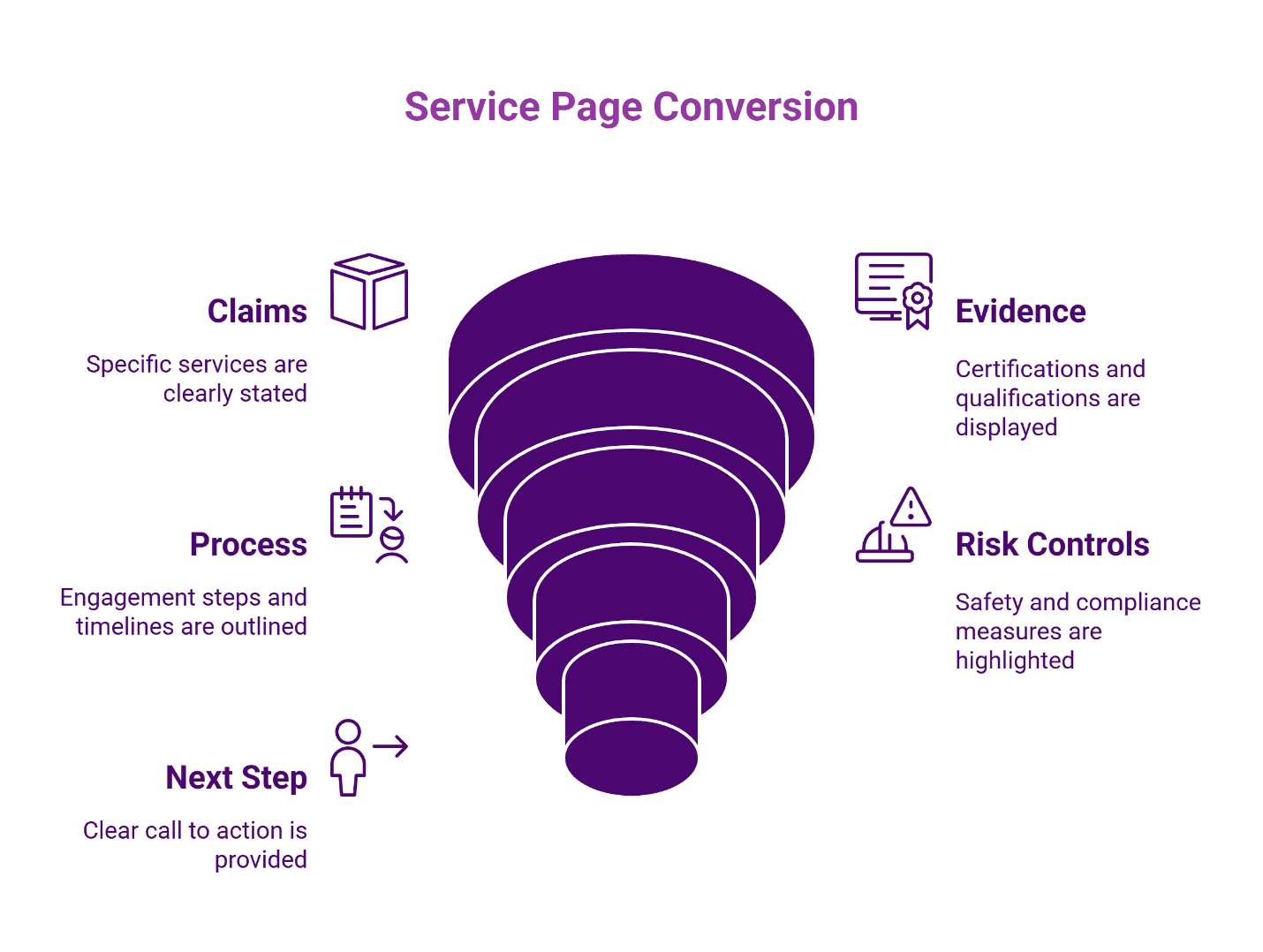
The proof stack for energy service pages typically includes:
- Claims: What you do, stated specifically (e.g., “API 653 aboveground storage tank inspections”)
- Evidence structure: Certifications displayed prominently, equipment lists, team qualifications, geographic coverage
- Process visibility: How engagements work, what the client should expect, typical timelines (as ranges or sequences)
- Risk controls: Safety posture, compliance frameworks, quality systems, SME involvement, escalation paths
- Clear next step: Consultation request, capability statement, or project discussion—not a generic “contact us”
Proof Stack Elements That Build Confidence
The most effective energy service pages answer the questions a technical evaluator asks before recommending a vendor to procurement:
- Are they certified for this specific work? (Show it.)
- Do they have the equipment and capacity? (List it.)
- Have they done similar projects? (Describe context without proprietary details.)
- What’s their safety and compliance posture? (Document it.)
- How do I engage them for my specific situation? (Make the path obvious.)
Conversion Paths That Qualify Without Forcing a Sales Call
Not every visitor is ready for a call. Effective conversion paths provide options:
- RFQ or project inquiry forms that capture enough context for sales to prioritize
- “Fit check” forms that ask for service line, timeline, and constraints
- “Request a scope discussion” CTAs that offer an agenda, not a pitch
- Capability statement or technical specification downloads (gated or ungated based on your qualification model)
- “Share requirements” paths that invite documentation or specifications
- Newsletter subscriptions for visitors not yet in active buying cycles
- Direct consultation booking for visitors ready to discuss specific projects
The goal is qualification, not friction. Each path should give the visitor a logical next step while providing your team enough information to assess fit.
Governance Protects Accuracy and Speeds Approval Cycles
The pivot variable in most B2B energy SEO programs isn’t technical capability or content quality—it’s stakeholder governance and approval latency. SME review bottlenecks and compliance sign-off delays slow content production, create rework cycles, and erode trust between marketing and technical teams.
Minimum Viable Governance (What Must Exist Before Scaling Content)
Before scaling content production, establish:
- Clear review ownership: Who approves technical accuracy? Who approves compliance language? Who has final sign-off?
- Defined review timelines: Expected turnaround and what triggers escalation
- Style and terminology standards: How services, certifications, and capabilities are described
- Change management protocol: How updates happen after publication, and who monitors for accuracy drift
What Breaks Without Governance
- Accuracy drift: Published content contains outdated certifications, retired service lines, or capability claims that don't match current operations. Sales encounters prospects who read something on the website that doesn't match reality. Trust erodes—internally and externally.
- Approval paralysis: Reviews become ad hoc, and content stalls indefinitely. The editorial calendar slips. The SEO program loses momentum.
- Trust loss: Sales and leadership stop believing reporting because inputs are questionable. Rework cycles multiply. Content gets published, flagged, pulled, revised, re-reviewed, and re-published.
- Lead quality dilution: Without technical review, content may attract the wrong queries or set incorrect expectations. Visitors arrive expecting capabilities you don't offer or certifications you don't hold.
SEO-to-Pipeline Measurement Makes SEO Defensible in Reviews
Defensible SEO reporting requires connection to lead stages and sales feedback loops—not rankings alone. The pipeline review fails when SEO can only report traffic and rankings. It succeeds when SEO can report lead stage movement, entry pages for converted opportunities, and sales feedback on inquiry quality.
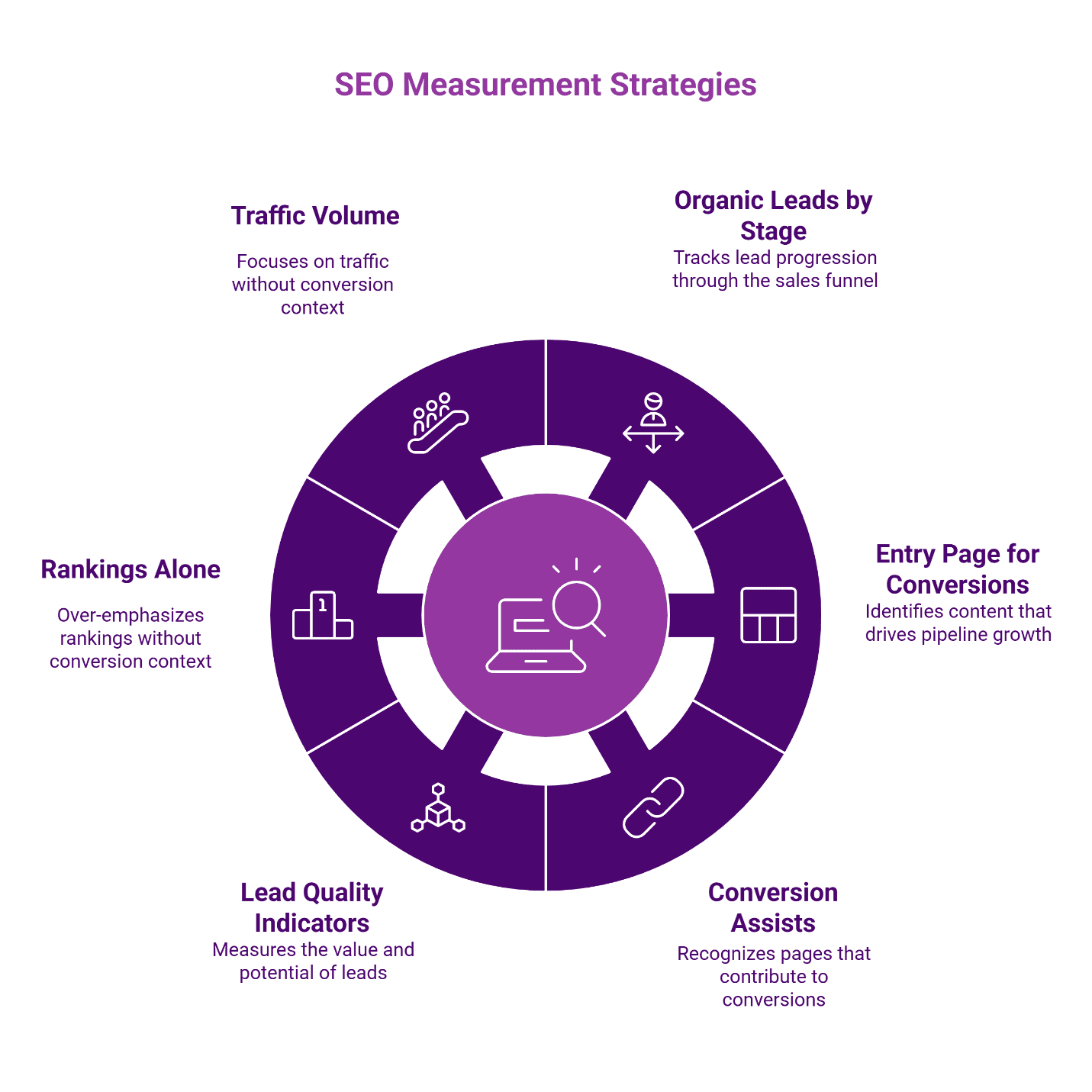
What to Measure (and What Not to Over-Weight)
Measure:
- Organic-sourced leads by stage (inquiry → qualified → opportunity → closed) using first-touch or multi-touch attribution
- Entry page for leads that convert (which content drives pipeline?)
- Conversion assists (which pages appear in the journey before conversion?)
- Lead quality indicators (sales acceptance rate, time-to-qualification, deal value)
Don’t over-weight:
- Rankings alone (rankings are leading indicators, not outcomes)
- Traffic volume without conversion context
- Keyword counts without intent alignment
Protocol: Aligning Marketing and Sales Definitions
Pipeline-grade measurement requires shared definitions. Marketing and sales must agree on:
- What qualifies as a “lead” versus an “inquiry”
- Stage definitions in the CRM (when does a lead become an opportunity?)
- A small set of disqualification reasons sales will consistently apply
- Feedback mechanisms (how does sales report lead quality back to marketing?)
- Review cadence (how often do teams align on what’s working?)
This alignment prevents the “traffic is up but where are the leads” conversation by establishing shared vocabulary and shared accountability.
What a Pipeline-Focused Energy SEO Services Engagement Includes
A governed, pipeline-focused B2B energy services SEO program includes several interconnected components. The table below maps each component to its pipeline impact and identifies what breaks without proper governance.
Pipeline-Grade Energy SEO Program Map
| Program Component | What It Is | Why It Matters to Pipeline | What “Done Right” Looks Like | What Breaks If Governance Is Missing | Primary Owner |
|---|---|---|---|---|---|
| High-intent query taxonomy + intent mapping | Documented inventory of target queries organized by intent stage and service alignment | Ensures content attracts evaluation-ready visitors, not just traffic | Queries mapped to service pages with clear conversion paths; intent definitions reviewed with sales/SMEs | Content targets wrong queries; lead quality declines; ranking improves for the wrong intent | SEO + Marketing + Sales |
| Service page proof + conversion path design | Capability-focused pages with evidence structures and clear next steps | Converts organic visitors into qualified inquiries | Certifications, process visibility, risk controls, and friction-appropriate CTAs; consistent proof structure | Visitors bounce or submit unqualified inquiries; sales loses trust; pages become generic | SEO + Marketing + SME |
| Technical SEO foundations | Crawlability, indexation, site architecture, page speed, mobile experience | Ensures search engines can access and rank priority content | Regular audits, fast remediation cycles, monitoring for regressions; clean structure | Rankings decline despite good content; new pages don’t index; fixes stall | SEO + Development |
| Content governance workflow | Review/approval process with defined owners, timelines, and escalation | Protects accuracy and speeds publication | Documented RACI, review SLA, style guide, change-control protocol; named reviewers | Accuracy drift, rework cycles, publication delays, trust erosion; bottlenecks | Marketing + SME + Compliance |
| Measurement schema + pipeline review cadence | Tracking connecting organic entry pages to lead stages and outcomes | Makes SEO defensible in executive reviews | Shared definitions, CRM integration, regular alignment meetings; sales feedback loop | SEO reports traffic while sales reports lead quality problems; reporting disputes | Marketing + Sales + SEO |
| Internal linking system to priority service pages | Strategic link architecture directing authority and visitors to high-conversion pages | Concentrates ranking signals on pages that drive pipeline | Service pages receive contextual links; orphan pages eliminated; linking tied to intent map | Authority diluted; service pages underperform; support content becomes dead-end traffic | SEO + Content |
Operating notes:
- Governance must be established before scaling content production—not retrofitted after accuracy problems emerge.
- The measurement schema requires initial setup time but pays back in every pipeline review thereafter.
- SME review bottlenecks are the most common failure point; address them explicitly in the workflow design.
- Internal linking is often neglected but directly impacts which pages rank for high-intent queries.
- Each component has a primary owner, but success requires cross-functional alignment.
How to Evaluate a Provider
When evaluating SEO services for B2B energy sector companies, move beyond “how many keywords will we rank for” to questions that reveal operational maturity:
- Governance: How do you handle SME review and compliance sign-off? What’s your process when technical content needs revision?
- Intent alignment: How do you determine which queries to target? How do you prevent intent drift?
- Conversion paths: What does service page optimization include? How do you design conversion paths that qualify?
- Measurement definitions: How do you connect SEO reporting to pipeline? How do you align with sales feedback?
- Industry experience: What’s your familiarity with compliance requirements, technical terminology, and buying cycles?
These questions surface whether a provider can deliver pipeline-grade SEO—or only traffic-focused services.
Next Steps
If your organic visibility has stalled or your lead quality doesn't match your traffic growth, the path forward starts with understanding where the disconnect lives—in intent alignment, service page proof, governance, or measurement.
Explore our Energy & Engineering SEO services for a detailed look at how we approach pipeline-focused SEO for B2B energy organizations.
When you're ready to discuss your specific situation, book a discovery call to explore whether a governed, measurement-focused SEO program fits your pipeline goals.
Our Editorial Process: Our expert team uses AI tools to help organize and structure our initial drafts. Every piece is then extensively rewritten, fact-checked, and enriched with first-hand insights and experiences by expert humans on our Insights Team to ensure accuracy and clarity.
About the Brazos Valley Marketing Insights Team: The Brazos Valley Marketing Insights Team is our dedicated engine for synthesizing complex topics into clear, helpful guides. While our content is thoroughly reviewed for clarity and accuracy, it is for informational purposes and should not replace professional advice.

About the Author
Dustin Ogle
Dustin Ogle is the Founder and Head of Strategy at Brazos Valley Marketing. With over 9 years of experience as an SEO agency founder, he specializes in developing the advanced AI-driven strategies required to succeed in the new era of search.