
Digital Infrastructure: Treating Your Website as a Capital Asset, Not an Expense
Last Updated: January 2026 • 12 min read
📌 Key Takeaways
Your manufacturing website should be managed like an appreciating capital asset, not a monthly marketing expense to defend.
- Reframe the Investment: Treating SEO as infrastructure rather than a line item shifts budget conversations from cost justification to asset appreciation.
- Match Measurement to Sales Cycles: Monthly traffic reports fail in 6–18 month B2B cycles; track pipeline influence and qualified RFQs instead.
- Own Visibility, Don't Rent It: Organic rankings compound over time while paid advertising vanishes the moment you stop paying.
- Build a 24/7 Sales Engineer: A high-performing website pre-qualifies buyers, answers technical questions at 2 AM, and shortens sales conversations.
- Start With a Focused Portfolio: Optimizing 5–10 high-margin pages in 30 days proves ROI faster than rebuilding an entire site.
Websites that produce qualified demand are infrastructure worth funding.
Manufacturing marketers defending SEO budgets to Finance will gain a boardroom-ready framework here, preparing them for the detailed implementation roadmap that follows.
The scenario is consistent: specific traffic metrics—bounce rate, time on site, session volume—are improving, yet the CFO questions the return on investment. Simultaneously, Sales disputes the lead quality. Finance says, "Then why keep funding it?"
And you don't have a number that connects to pipeline.
This is the core problem: your website is being judged like a monthly expense when it should be evaluated like infrastructure. The framing is wrong, and wrong framing leads to wrong decisions—budget cuts during planning cycles, short-term tactics that don't compound, and competitors who quietly build digital footholds while you defend last quarter's metrics.
Your manufacturing website should be managed like a compounding asset portfolio, not a recurring marketing line item. When engineers and procurement teams research suppliers online—and research confirms most B2B buyers now prefer self-service over sales rep engagement—your visibility determines whether you make the shortlist. That's not marketing. That is not discretionary marketing; it is critical market access..
Why Monthly Spend Narratives Fail in Long Sales Cycles
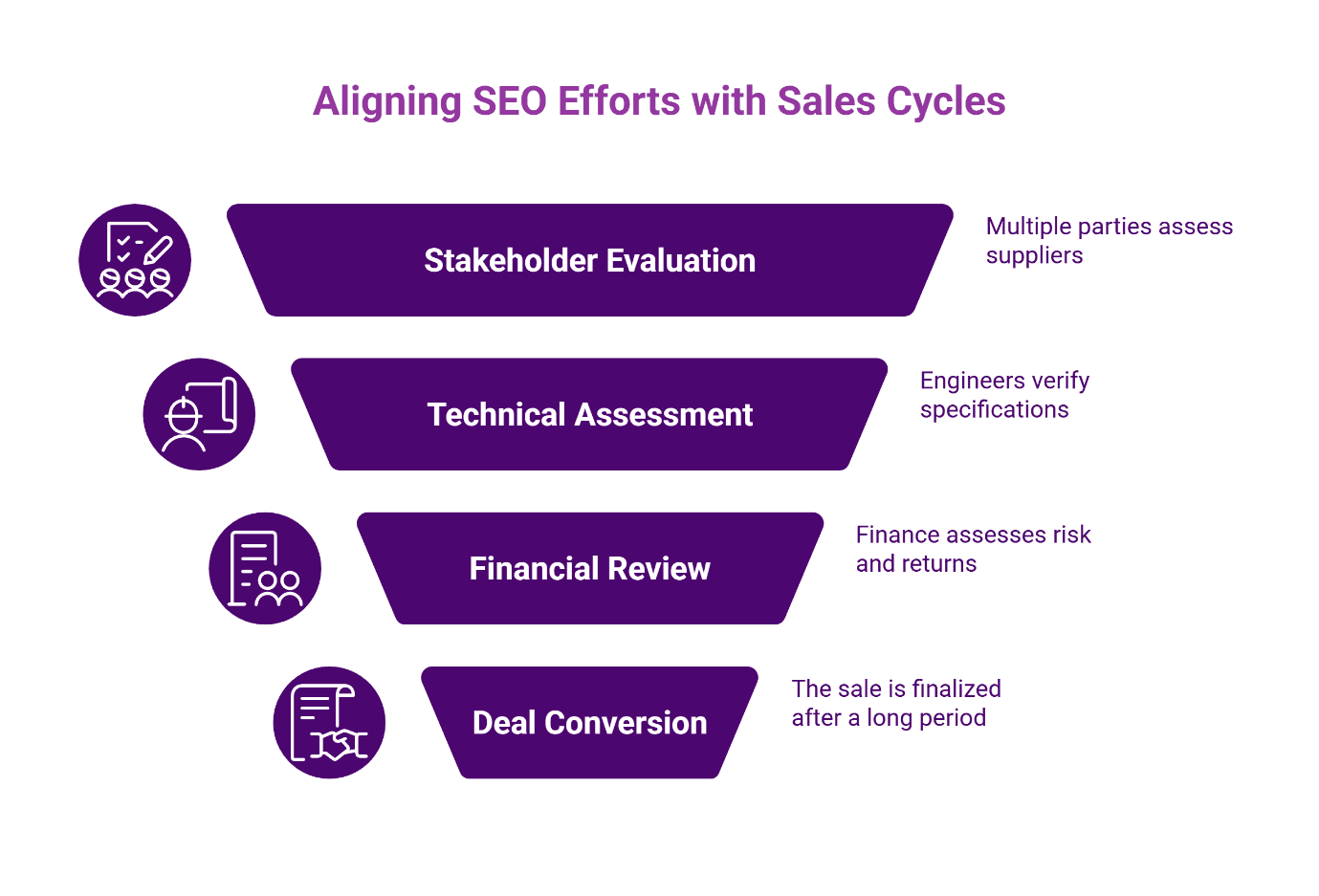
Complex manufacturing and capital equipment sales cycles typically run 6 to 18 months. Multiple stakeholders evaluate suppliers. Engineers check specs. Procurement compares certifications. Finance reviews risk.
When you report SEO results monthly—traffic up, rankings improved—you're measuring activity on a timeline that doesn't match how deals close. The website influenced an RFQ that won't convert for nine months, but you're defending last month's invoice today.
Finance understands this mismatch intuitively. They fund capital projects that take years to pay off because the asset has a useful life. They question recurring expenses that don't show immediate returns because expenses hit the P&L now.
The solution isn't better monthly reports. It's a different mental model entirely.
Borrowing the CapEx vs. OpEx Lens
Capital expenditures (CapEx) are investments in long-term assets that provide value over multiple years—equipment, facilities, infrastructure. Operating expenses (OpEx) cover day-to-day costs that get consumed immediately.
This isn't accounting advice. (Talk to your finance team about how to classify anything on the books.) But as a decision-making model, the distinction matters: CapEx thinking encourages long-term investment in assets that appreciate. OpEx thinking encourages minimizing costs that don't show immediate returns.
When you treat SEO services for manufacturing companies like OpEx—a monthly line item to justify or cut—you make short-term decisions. When you treat it like infrastructure investment, you build something that compounds.
Digital Real Estate: Rankings Behave Like Owned Property
Paid advertising is rented attention. You pay monthly, you get visibility. You stop paying, visibility disappears.
Organic search visibility behaves differently. A well-built page accumulates trust signals, backlinks, and authority over time. It ranks for more queries. It earns featured snippets. It gets cited by AI tools. The value compounds.
This is why the "digital real estate" metaphor works for Finance conversations: you're building owned visibility that appreciates, not renting clicks that vanish when the budget does.
The cost of delay is real. While you debate whether to invest, competitors are building their digital footprint. Research from major analyst firms indicates that B2B buyers complete a significant majority of the buying journey—estimates range from 57% to 80% depending on deal complexity—independently prior to the first direct contact.
Your Website as a 24/7 Sales Engineer
A high-performing manufacturing website behaves like a sales engineer who never sleeps. It answers technical questions at 2 AM when a procurement manager in another time zone is comparing suppliers. It presents certifications, tolerances, and lead times without requiring a phone call. It filters intent—serious buyers dig deeper, tire-kickers leave.
A high-performing website is a 24/7 sales engineer that appreciates in value over time.
This matters to Sales morale and cycle time. When the website pre-qualifies visitors, the leads that reach Sales are already educated. They've seen your capabilities. They've downloaded specs. The first conversation starts further down the funnel.
"Sales engineer behavior" on a page looks like this: clear technical specifications, obvious proof points (certifications, case studies, quality documentation), logical navigation to related capabilities, and a frictionless path to request a quote or download CAD files. Just as important, it filters intent—low-fit visitors self-select out, and qualified buyers self-select in. Fewer conversations start with basic qualification. More start with "here's what we need—can you quote it?"
What Makes a Website Appreciate: Two Building Blocks
Two mechanisms drive compounding value.
Perfect Page Blueprint™ turns your priority pages into high-performing assets. This means clear content hierarchy, strategic internal linking, schema markup that helps search engines understand your expertise, and conversion paths that make the next step obvious. Each optimized page becomes a durable asset in your portfolio.
Deep Content Architecture™ builds the interconnected system that grows authority over time. Instead of isolated pages, you create topic clusters that signal comprehensive expertise. Entity-based SEO helps search engines (and AI systems) recognize your company as a legitimate authority. Buyer journey mapping ensures you have content for every stage of the research process.
Together, these approaches turn a static website into infrastructure that appreciates. This is where SEO stops being a line item and becomes an infrastructure layer. Learn more about how these methods work.
The Digital Asset Valuation Model
Here's a framework simple enough to put on a board slide:
| Metric | What It Measures | Why Finance Cares |
|---|---|---|
| High-intent visibility coverage | Share of priority search queries where you appear | Market access—if you're not visible, you're not considered |
| Qualified site actions | RFQs, spec downloads, quote requests from organic traffic | Demand signal tied directly to sales pipeline |
| Pipeline influence | Opportunities where organic content touched the buyer journey | Revenue attribution beyond last-click |
| Capital Efficiency | Equivalent paid spend to achieve same visibility | Ratio of organic acquisition cost vs. equivalent paid media market rates (CPC/CPM) |
This model helps Finance see the website as an asset-like system. Visibility coverage is the footprint. Qualified actions are the yield. Pipeline influence connects to revenue. Cost avoidance shows the alternative—what you'd pay in advertising to rent what you could own.
The exact numbers will vary by your market, but the structure translates: your website either produces qualified demand or it doesn't. If it does, it's infrastructure worth investing in.
A 30-Day Start: Build Your First Asset Portfolio
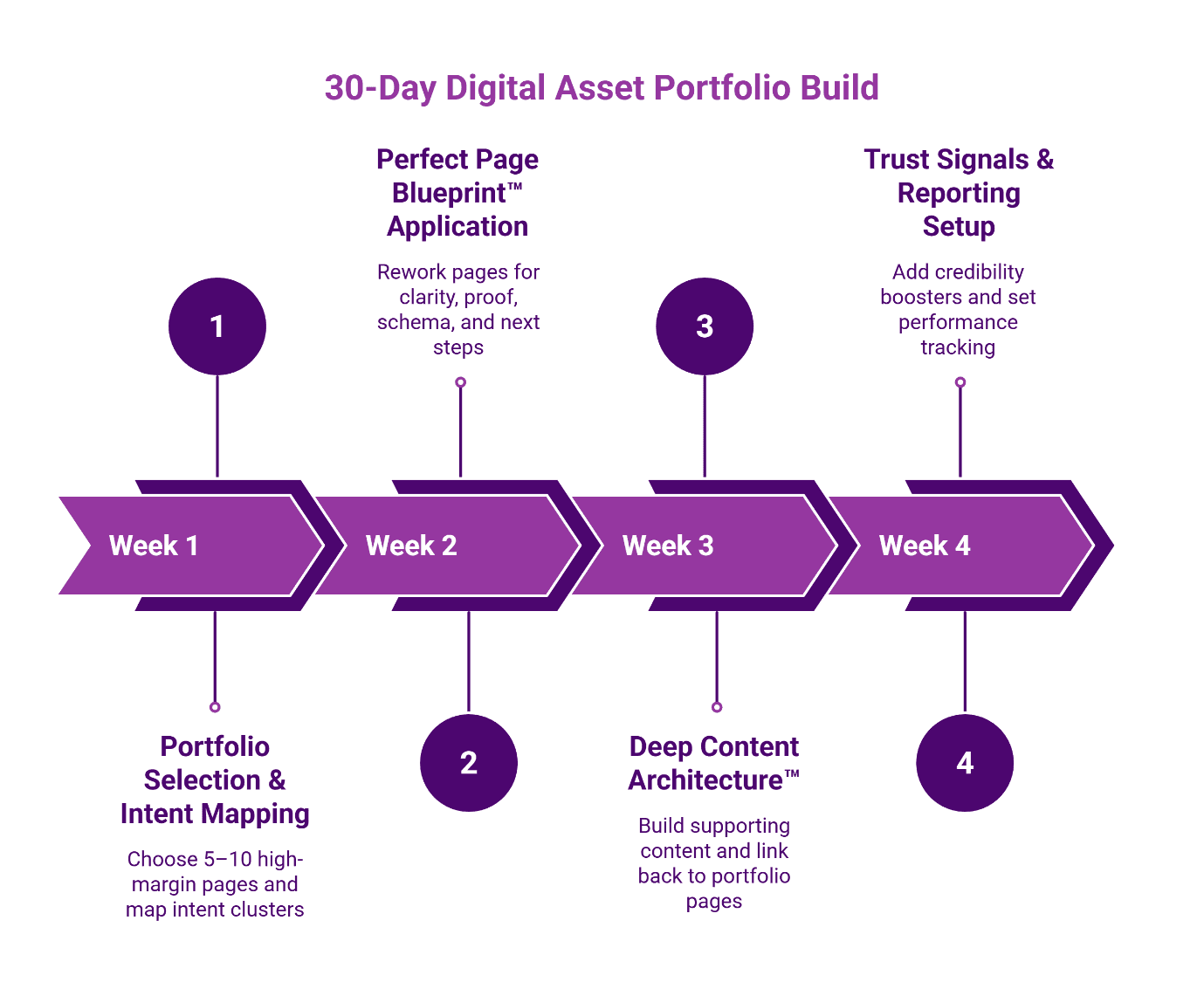
You don't need to rebuild your entire site. Start with a focused portfolio of high-margin pages tied to real demand.
Week 1: Pick the portfolio and map intent. Choose 5–10 high-margin product or service pages. These are your first "assets." Map one high-intent query cluster to each page—specs, standards, certifications, material and application combinations. Utilize SKU-level analysis and technical specification mapping to identify these targets.
Week 2: Apply Perfect Page Blueprint™ basics. Rework those pages for clarity: headings that match buyer questions, technical proof, schema markup where appropriate, internal links to related capabilities, and an obvious next step (RFQ form, spec download, contact).
Week 3: Connect pages with Deep Content Architecture™. Build supporting content that answers adjacent evaluation questions and links back to the portfolio pages—materials, tolerances, certifications, process capabilities, use cases. This creates a system, not isolated pages.
Week 4: Add trust signals and set reporting. Add one credibility booster per priority page: certifications displayed prominently, tolerances listed, QA processes explained, lead times stated, downloadable CAD files or spec sheets where relevant. Then set simple reporting that ties page performance to qualified actions—RFQs, spec downloads, and quote requests sourced from organic search.
The Board Script: Explain This in 60 Seconds
When you need to make the case quickly:
"Our website isn't a brochure—it's the infrastructure that determines whether engineering buyers can find and evaluate us during research. We're treating it like an appreciating asset, not a monthly cost. We're investing in the pages and content architecture that compound over time, so we own visibility instead of renting it."
Why now:
- Buyers increasingly prefer self-service research before contacting sales
- Competitors are building digital footholds while we evaluate
- Every month of delay is market position we don't recover
How we measure:
- Qualified RFQs and spec downloads from organic traffic, tied to pipeline influence
Your Next Step
If you're tired of defending website spend with traffic metrics that don't connect to pipeline, there's a better conversation to have.
Start a strategy session to map how this infrastructure approach applies to your specific products and markets. Or explore BVM's manufacturing SEO methodology to see how we help manufacturers build websites that produce qualified RFQs.
Frequently Asked Questions
Disclaimer: This article provides a strategic framework for evaluating website investment. It is not accounting, tax, or financial advice. Consult your finance team regarding the classification and treatment of any expenditures.
Our Editorial Process
We follow a rigorous editorial process to ensure accuracy, clarity, and relevance. Every piece is researched, written, and reviewed by our team with a focus on delivering actionable insights and trustworthy guidance.
About the BVM Insights Team
The BVM Insights Team brings together specialists in SEO, content strategy, and digital marketing for high-trust industries. We publish practical, evidence-led guidance to help organizations improve visibility, generate qualified demand, and make confident marketing decisions.

About the Author
Dustin Ogle
Dustin Ogle is the Founder and Head of Strategy at Brazos Valley Marketing. With over 9 years of experience as an SEO agency founder, he specializes in developing the advanced AI-driven strategies required to succeed in the new era of search.