
Beyond the Form Fill: Engineering a Lead Generation System That Delivers Qualified RFQs
Last Updated: January 2026 • 12 min read
📌 Key Takeaways
Qualified RFQs require engineering technical context into your lead capture system—not chasing form submission volume.
- Define "Qualified" First: A qualified RFQ contains enough information for sales to respond with a meaningful next step within 24 hours—get sales to sign off on this definition before building anything.
- Intent Mismatch Kills Pipeline: Pages ranking for generic terms attract students and researchers, not buyers—target spec-based and application-based searches that reveal active sourcing intent.
- Forms Need Minimum Viable Fields: Capture part type, material, specifications, quantity, and timeline—progressive disclosure gathers additional context after initial intent is confirmed.
- Governance Prevents Drift: Weekly marketing-sales reviews of 10–20 leads, monthly acceptance rate tracking, and quarterly scoring updates keep the system producing quality over time.
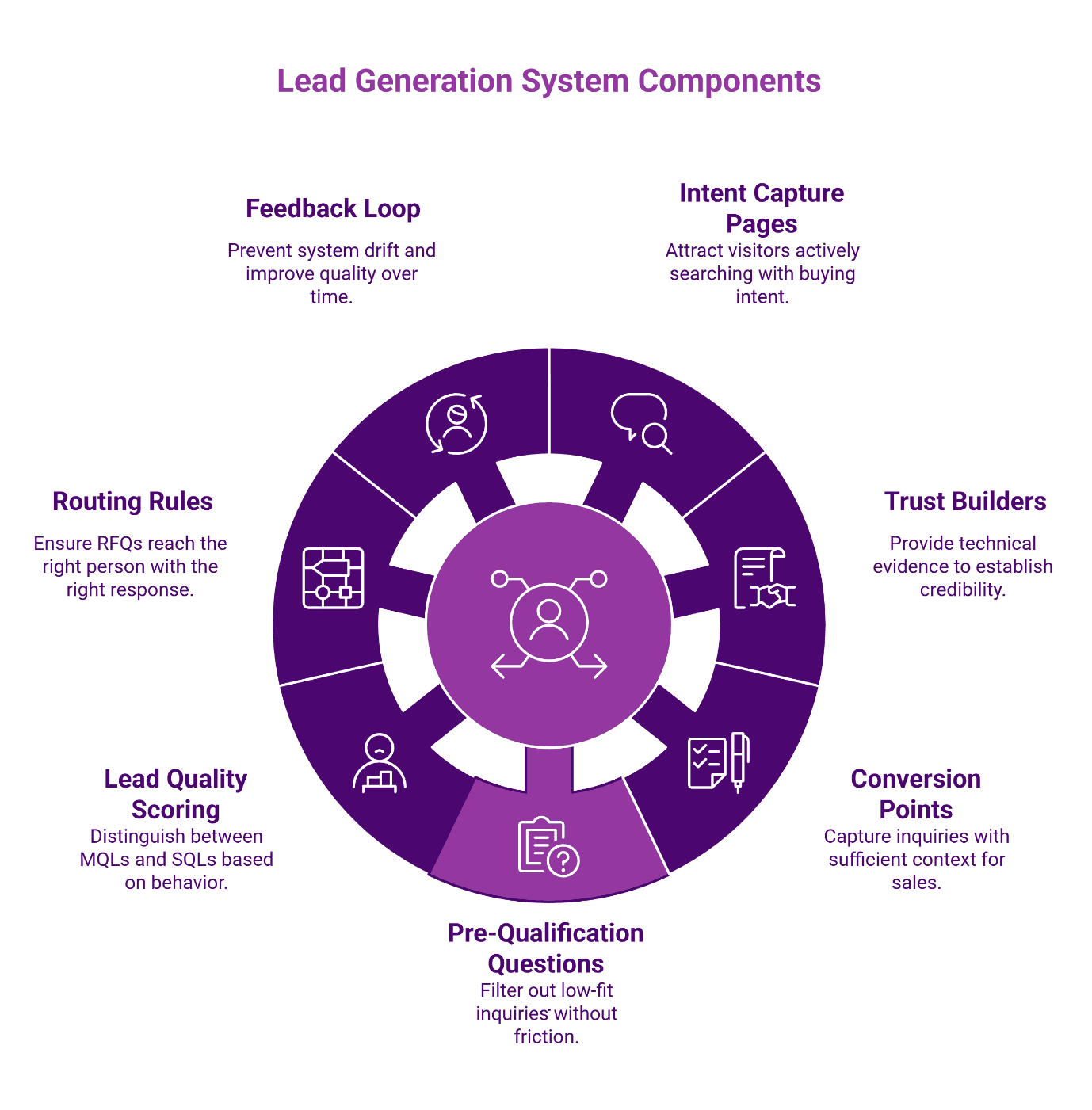
- Seven Components Work Together: Intent capture pages, trust builders, conversion points, pre-qualification questions, scoring, routing, and feedback loops form a complete system—skip one and the pipeline leaks.
Engineering beats hoping—qualified RFQs come from systems, not luck.
Manufacturing marketers and sales leaders frustrated by high form volume but low pipeline will find a complete implementation framework here, preparing them for the 14-day checklist that follows.
The weekly sales meeting starts the same way. Marketing reports 47 form submissions. Sales reports 3 worth pursuing. The silence that follows is familiar.
Manufacturing lead generation is the systematic process of attracting and converting qualified industrial buyers into actionable RFQs—prioritizing lead quality over raw submission volume. When this system works, sales receives inquiries with part specifications, application context, and clear next steps. When it doesn't, marketing defends activity metrics while sales quietly ignores the inbox.
Industry research reinforces the underlying dynamic: many B2B buyers prefer to conduct substantial research through digital channels and often avoid irrelevant outreach. This raises the bar for precision and relevance in early-stage content and experiences.
The difference between noise and pipeline isn't luck. It's engineering.
The Problem with Form-Fill Thinking
Why Submissions ≠ RFQs in Industrial Sales
A contact form submission tells you someone typed words into boxes. A qualified RFQ tells you an engineer needs 500 custom housings with ±0.002" tolerances for a medical device application, and they need them by Q3.
These are not the same thing. Treating them as equivalent creates a reporting illusion where marketing celebrates volume while sales struggles with context. The disconnect isn't a communication problem—it's a system design problem.
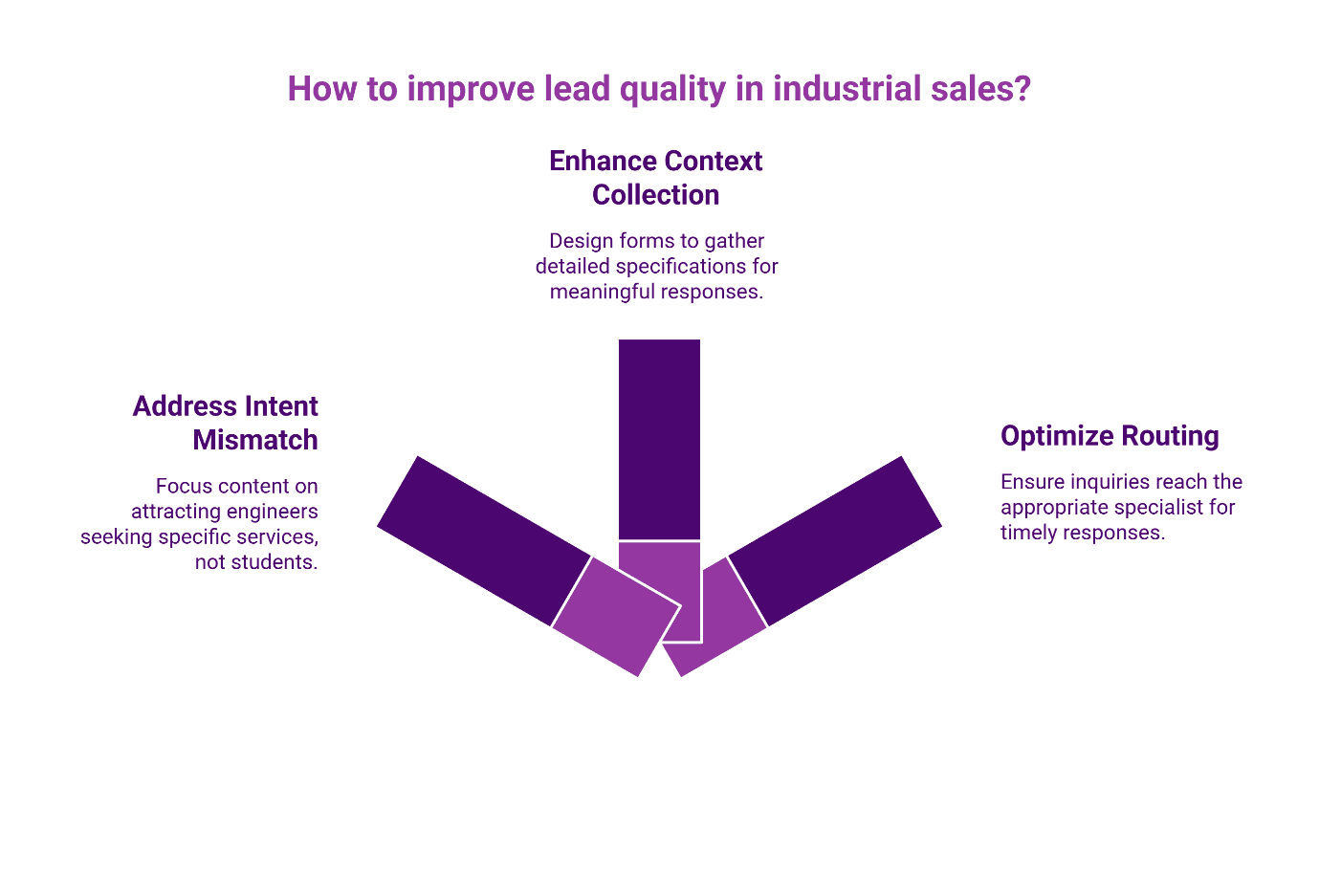
The Three Hidden Sources of Low-Fit Inquiries
Most "bad leads" aren't created by the form. They're invited by the content experience.
Intent mismatch. Your page ranks for "CNC machining" but attracts students researching manufacturing processes rather than engineers sourcing parts. The traffic looks good. The inquiries don't convert.
Missing context. A visitor submits a form asking for a "quote on parts" with no specifications, quantities, or application details. Sales can't respond meaningfully. The lead dies in triage.
Weak routing. An inquiry about aerospace components lands in a general inbox instead of reaching the engineer who handles AS9100 work. Response time stretches from hours to days. The buyer moves on.
Each source requires a different fix. Intent mismatch is a content problem. Missing context is a conversion design problem. Weak routing is an operations problem. A lead generation system addresses all three.
Define a Qualified RFQ Before You Build Anything
A Simple Definition Marketing and Sales Can Share
A qualified RFQ is an inquiry that contains enough information for sales to respond with a meaningful next step within 24 hours.
This definition forces specificity. "Meaningful next step" isn't "Hi, tell me more." It's "Based on your 316 stainless requirement and 1,000-unit volume, here's how we'd approach this."
If sales can't take that step, the RFQ isn't qualified—regardless of how promising it looks.
Form Fill vs. Qualified RFQ
| Dimension | Generic Form Fill | Qualified RFQ |
|---|---|---|
| Buyer intent signal | Unclear; could be research | Clear; evaluating suppliers |
| Technical context | Missing or vague | Part/spec/application detail present |
| Commercial context | No volume or timeline | Timeline and project stage included |
| Company identity | Often absent or unverifiable | Company and role identifiable |
| Expected sales action | "Figure out what this is" | Route, scope, respond with next steps |
| Outcome | Low sales acceptance | Higher sales acceptance |
Qualified vs. Not Qualified: Manufacturing Scenarios
| Scenario | Qualified? | Why |
|---|---|---|
| "Need quote for precision machined parts, 304SS, ±0.001" tolerance, 500 units, aerospace application, delivery Q2" | Yes | Part type, material, tolerance, volume, application, and timeline all present |
| "Looking for a machining vendor, please send info" | No | No specifications, no volume, no application context |
| "Can you make this part?" with CAD file attached, company email, phone number | Yes | File provides specifications; contact info enables follow-up |
| Student working on senior project, need help understanding CNC capabilities | No | Research intent, not buying intent |
| "Urgent: need replacement shaft, 2" diameter, 12" length, 17-4 PH, 50 units, existing customer" | Yes | All context present; urgency and relationship clear |
| Gmail address, no company name, "what are your prices?" | No | No specifications; anonymous inquiry pattern |
The pattern is clear: qualified RFQs contain technical context that enables a response. Everything else is noise that consumes sales time without producing pipeline.
The 7-Part Lead Generation System
Think of this as an engine with filters, sensors, and handoffs. Each component serves a specific purpose. Skip one, and the system leaks.
| Component | Purpose | Signals Captured | Primary Owner | Handoff Output |
|---|---|---|---|---|
| 1) Intent capture pages | Match how engineers/procurement search | Query intent, page path, depth | Marketing / Content | Qualified pathways to conversion points |
| 2) Trust builders | Reduce perceived supplier risk | Engagement with specs/CAD/compliance | Marketing + SMEs | Increased confidence + richer inquiries |
| 3) Conversion points | Provide "next step" aligned to intent | RFQ starts, downloads, returns | Marketing / Web | Structured lead/event data |
| 4) Pre-qualification questions | Capture context without blocking | Part/spec/application, timeline | Marketing + Sales | Complete RFQ payload |
| 5) Lead quality scoring | Separate MQL vs SQL behaviorally | Firmographic + behavioral signals | RevOps / Marketing Ops | Prioritized queue + routing |
| 6) Routing + response playbook | Ensure fast, correct follow-up | Product line, region, urgency | Sales Ops / Sales | Assigned owner + SLA + next-step template |
| 7) Feedback loop + governance | Prevent drift and improve quality | Sales acceptance, completeness | Marketing + Sales leadership | Iteration backlog and standards |
1. Intent Capture Pages
Purpose: Attract visitors who are actively searching with buying intent, not browsing or researching.
Signals captured: Part type, material, specification, application, industry.
Owner: Marketing (content) + SEO.
Handoff output: Visitor lands on a page that matches their specific search intent.
Intent capture pages target searches like "precision CNC machining for medical devices" rather than "what is CNC machining." The specificity filters out casual traffic before anyone fills out a form.
Build these pages around how technical buyers search and evaluate, not around internal product categories. Structure each page using an engineering-report approach: problem, requirements, constraints, options, and proof. This matches how engineers think and ensures the page answers fit questions before asking for contact information.
For a deeper look at how engineers search, see our guide on part/spec/application intent mapping.
2. Trust Builders
Purpose: Provide the technical evidence engineers need to shortlist you as a serious vendor.
Signals captured: Engagement with spec sheets, CAD downloads, compliance documentation, application notes.
Owner: Marketing + Engineering.
Handoff output: Visitor has consumed proof of capability before requesting a quote.
Engineers don't request quotes from vendors they can't verify. Spec sheets, material certifications, tolerance capabilities, and application case studies do the verification work. A visitor who downloads your AS9100 compliance documentation before submitting an RFQ is a different prospect than one who just found your contact page.
ISO 9001 certification is widely recognized as a quality management standard, and many buyers use it as a trust signal during supplier evaluation. Make these credentials visible and easy to access from your intent pages—a hidden PDF in a generic resources section rarely qualifies buyers.
3. Conversion Points
Purpose: Capture the inquiry with enough context for sales to respond meaningfully.
Signals captured: Contact information, project specifications, timeline, application details.
Owner: Marketing (design) + Sales (input on required fields).
Handoff output: Form submission with technical context attached.
Conversion points include RFQ forms, quote request pages, and spec sheet downloads that require registration. Each should capture different levels of detail based on the visitor's demonstrated intent. A CAD file download might require only an email; a formal RFQ should capture specifications.
One generic "Contact Us" form forces all intent types into the same pipe and guarantees mixed quality. Offer multiple conversion paths aligned to intent maturity: RFQ request, "talk to an applications engineer," spec download, or capability inquiry.
4. Pre-Qualification Questions
Purpose: Filter out low-fit inquiries without blocking legitimate engineers.
Signals captured: Company type, project stage, volume expectations, timeline.
Owner: Marketing + Sales.
Handoff output: Lead score based on responses.
The key is asking questions that disqualify noise without creating friction for buyers. "What is your expected annual volume?" separates a procurement manager from a hobbyist. "What stage is your project?" distinguishes active sourcing from early research.
A student writing "N/A" or "just researching" self-selects out. An engineer with a real project provides real answers.
Minimum viable context for technical follow-up:
- Part/spec/application (one structured field plus a free-text "constraints" field)
- Quantity and/or annual volume range
- Timeline (prototype vs production; needed-by date window)
- Company and role
- Drawing/spec upload (optional but high-value when present)
5. Lead Quality Scoring Model
Purpose: Distinguish between marketing qualified leads (MQLs) and sales qualified leads (SQLs) before sales sees them.
Signals captured: Form responses, content engagement, company data, behavioral patterns.
Owner: Marketing (model design) + Sales (validation).
Handoff output: Score that determines routing and priority.
| Signal Type | MQL (Marketing Qualified) | SQL (Sales Qualified) |
|---|---|---|
| Firmographic fit | Some fit indicators | Clear ICP match (industry, size, geography) |
| Intent evidence | Content engagement | High-intent pathways (RFQ start, spec pack use, repeat visits) |
| Technical context | Limited | Part/spec/application detail present |
| Commercial context | Unclear | Timeline + quantity/volume present |
| Next step clarity | Needs discovery | Ready for scoping/quote workflow |
The model assigns points based on data completeness and behavioral signals. A visitor who downloads three spec sheets, views your tolerance capabilities page, then submits an RFQ with full specifications scores higher than someone who lands on the homepage and fills out the contact form asking for "more information."
6. Routing Rules and Response Playbook
Purpose: Get the right RFQ to the right person with the right response framework.
Signals captured: Product category, application type, customer status, urgency indicators.
Owner: Sales operations.
Handoff output: Assigned owner, response template, follow-up timeline.
Routing rules prevent the "general inbox" problem. An aerospace inquiry goes to the engineer who handles AS9100 work. A medical device RFQ goes to someone with FDA compliance experience. Existing customer requests skip the queue.
The response playbook standardizes how each lead type gets handled. SQLs get a call within 4 hours. MQLs get a personalized email within 24 hours. Raw inquiries get a qualification email within 48 hours.
A good first response includes:
- Acknowledgment of receipt with a clear next step
- Request for missing critical inputs (only those needed to scope)
- A structured follow-up option (call, email checklist, drawing review path)
7. Feedback Loop and Governance
Purpose: Prevent the system from drifting back toward noise over time.
Signals captured: Sales acceptance rates, RFQ completion rates, close rates by lead source, content performance by intent.
Owner: Marketing + Sales leadership.
Handoff output: Monthly adjustments to scoring, routing, and content priorities.
Without governance, marketing optimizes for volume because volume is easy to measure. The feedback loop forces quality into the conversation.
A simple governance cadence:
- Weekly: Review a small sample of inbound inquiries together (marketing + sales). Tag as qualified/not, note missing context. Ten to twenty leads, fast categorization, concrete page fixes.
- Monthly: Review sales acceptance rate and RFQ completeness trends. Identify top pages generating low-fit inquiries. If sales acceptance drops below 40%, something upstream is broken.
- Quarterly: Update page standards and scoring rules based on what sales is actually accepting. Recalibrate thresholds using real data.
This is the mechanism that turns lead generation into engineered infrastructure rather than a one-time campaign.
Ready to dig deeper into building systems that attract the right traffic? Explore our resources library for frameworks on manufacturing SEO for lead generation and SKU-first manufacturing SEO.
Micro-Moment Mapping for Engineering Buyers
Part, Spec, and Application Intent Patterns
Engineers don't search like consumers. They search like engineers.
Part-based searches: "precision ground shafts" or "custom aluminum enclosures"—the engineer knows what they need and is looking for who makes it.
Spec-based searches: "±0.0005 tolerance machining" or "ITAR compliant manufacturer"—the engineer has a requirement and is looking for who can meet it.
Application-based searches: "hydraulic valve body machining" or "medical implant prototyping"—the engineer has a use case and is looking for who has relevant experience.
Each pattern reveals a different stage of the buying process and requires different page content. Part searches want capabilities and materials. Spec searches want certifications and tolerances. Application searches want case studies and relevant experience.
How to Pick 5-10 High-Impact Targets to Start
Don't boil the ocean. Start with the searches that represent your best customers.
Step 1: Ask sales which 5-10 products or capabilities generate the highest-margin, best-fit work.
Step 2: Research how engineers search for those specific things. What terms do they use? What questions do they ask?
Step 3: Build or optimize pages that directly answer those searches with technical depth.
Step 4: Measure which pages generate qualified RFQs, not just traffic.
This approach produces results faster than trying to rank for everything. A single page that attracts engineers searching for "5-axis aerospace machining" will generate more qualified pipeline than dozens of pages targeting generic terms.
Designing Forms and Offers That Qualify Without Scaring Off Buyers
Minimum Viable Fields for Technical Follow-Up
The goal isn't to capture everything. It's to capture enough.
Required for qualification:
- Contact information (name, email, phone, company)
- Part or service type
- Material or specification requirements
- Estimated quantity
- Project timeline
Optional but valuable:
- CAD file upload
- Application or industry
- How they found you
Progressive Disclosure: Collect More Context After Initial Intent Is Confirmed
Not all information needs to come through the form. Progressive disclosure captures initial interest, then gathers detail through follow-up.
Stage 1 (Form): Contact info + high-level need.
Stage 2 (Auto-reply): Link to upload specifications, drawings, or provide additional context.
Stage 3 (Sales follow-up): Targeted questions based on initial submission.
This approach reduces form friction while still gathering the context sales needs. An engineer who submits a basic inquiry and then uploads a CAD file within an hour has demonstrated intent. One who never responds to the follow-up has demonstrated something else.
When to Gate Content vs. When to Keep It Open
Gate: Resources that indicate active buying intent—detailed spec sheets, CAD libraries, application guides, compliance documentation.
Keep open: Educational content that builds trust—blog posts, general capability overviews, industry guides.
The logic is simple: gates should filter for intent, not block discovery. A visitor who downloads your ISO 9001 certification documentation is further along than one reading your "about us" page. Capture the former. Let the latter keep reading.
Lead Quality Measurement That Aligns Marketing and Sales
Sales Acceptance and RFQ Completeness
Sales acceptance rate measures what percentage of marketing-generated leads sales agrees are worth pursuing. While benchmarks vary by sector, high-performing industrial lead systems should target acceptance rates upwards of 30-40%. If your rate consistently trails this target, the system is likely prioritizing volume over engineering context.
RFQ completeness rate measures what percentage of form submissions contain enough information for sales to respond meaningfully. If engineers consistently skip the specification fields, the form design isn't working.
Both metrics force marketing to care about quality, not just quantity. Report these metrics weekly.
Follow-Up Consistency: Handoff and Response Standards
Measurement exposes process problems. If sales acceptance is high but close rates are low, the problem might be follow-up, not lead quality.
Track:
- Time to first response by lead score
- Number of touches before qualification
- Handoff completion rate (did the right person receive the right lead?)
Inconsistent follow-up wastes qualified leads. A system that generates perfect RFQs but responds in 72 hours will lose to a competitor who responds in 4.
Common Reporting Traps to Avoid
The traffic trap: Celebrating traffic increases when RFQ quality stays flat. Traffic is an input, not an outcome.
The activity trap: Reporting form submissions without lead scores. "47 leads this month" means nothing without quality context.
The campaign trap: Attributing wins to the last touch instead of the content that qualified the buyer. The RFQ form gets credit, but the spec sheet they downloaded six months ago did the work.
Build reports that connect content to qualified pipeline, not just content to clicks.
Research from McKinsey confirms that many B2B buyers want to progress significantly through evaluation via digital or self-service interactions. This makes early-stage experiences and relevance filters more consequential than ever—and makes accurate measurement of those experiences essential.
14-Day Implementation Checklist
Days 1-2: Define Qualified RFQ and Scoring Rubric
- [ ] Meet with sales to define what makes an RFQ "qualified" in your context
- [ ] Document the definition in writing that both teams sign off on
- [ ] Create a simple scoring rubric (5-7 criteria, weighted by importance)
- [ ] Identify the signals that indicate SQL vs. MQL vs. unqualified
- [ ] Set target sales acceptance rate (40% is a reasonable starting point)
Days 3-7: Upgrade Top Pages and Conversion Points
- [ ] Identify your 5 highest-traffic pages that generate inquiries
- [ ] Audit each page: Does it attract buying intent or research intent?
- [ ] Add or improve technical content (specs, tolerances, certifications) on buying-intent pages
- [ ] Update forms to capture minimum viable fields for qualification
- [ ] Add file upload option to RFQ forms
- [ ] Create auto-reply email that invites additional specifications
Days 8-14: Routing Rules, Alerts, and Governance Checklist
- [ ] Document routing rules: which lead types go to which team members
- [ ] Set up CRM alerts for high-score leads (immediate notification)
- [ ] Define response time standards by lead score (SQL: 4 hours, MQL: 24 hours)
- [ ] Create response templates for each lead type
- [ ] Schedule weekly marketing-sales sync to review lead quality
- [ ] Build simple dashboard: submissions, scores, sales acceptance, time-to-response
- [ ] Set calendar reminder for monthly system review
What Comes Next
The weekly sales meeting starts differently now. Marketing reports 23 form submissions. Sales reports 14 are worth pursuing. The conversation shifts from "where are the leads?" to "which opportunities should we prioritize?"
That shift doesn't happen by accident. It happens because someone stopped optimizing for volume and started engineering for quality.
The system described here isn't complicated. Intent capture pages, trust builders, conversion points, pre-qualification questions, scoring, routing, and governance. Seven components that work together to filter noise before it reaches sales.
Start with the definition. What makes an RFQ qualified for your business? Get sales to sign off. Build backward from there.
The forms will still fill. But now, the ones that matter will be obvious.
Explore More Resources
For frameworks on building pages that attract qualified buyers, visit our resources library.
Disclaimer: This content is provided for informational and educational purposes. Results vary based on industry, competition, and implementation. We recommend consulting with a qualified marketing professional to assess your specific situation.
Our Editorial Process: Our editorial process includes research and expert review to ensure accuracy and usefulness. We prioritize clear, actionable guidance that helps readers make confident decisions. Content is reviewed for clarity, relevance, and alignment with current best practices.
Written by the BVM Insights Team
The Insights Team is our dedicated engine for research and insights, exploring emerging trends, analyzing industry best practices, and translating complex topics into clear, actionable strategies. Our work is guided by editorial standards that prioritize accuracy, usefulness, and real-world impact.

About the Author
Dustin Ogle
Dustin Ogle is the Founder and Head of Strategy at Brazos Valley Marketing. With over 9 years of experience as an SEO agency founder, he specializes in developing the advanced AI-driven strategies required to succeed in the new era of search.